March 18, 2011

Jump to articles by year, month, or day.

Year
Month
Day

Year alone opens that year’s archive. Add a month or day to narrow it.

Tomorrow Night May Be the Best Time to Shoot the Moon in 18 Years

If you've been thinking of trying your hand at lunar photography, tomorrow night might present the perfect opportunity to do so. It's when the Moon will be the closest it has been to the Earth in 18 years, making it 14% larger and 30% brighter than when the full Moon is furthest away. Miss this opportunity, and you won't see a Moon like this until about 2029 -- who knows what we'll be shooting with by then! …
Fujifilm Finepix X100 Selling for Crazy Prices on eBay

If you somehow got your hands on a Fujifilm Finepix X100 already but don't mind waiting a little longer to use one, you can double or triple the money you paid by selling it to desperate buyers on eBay. Fujifilm was already experiencing extremely high demand and possible shortages, but then the tragic earthquake in Japan completely halted production of the camera after Fujifilm's factory 20 miles from Sendai was damaged.

Handmade Model of a NASA Hasselblad

"Space Program" is a project by artist Tom Sachs featuring 1:1 models of various space related objects, including an Apollo lunar module, a mission control unit, space suits, and handmade space suits. He also included the above NASA Hasselblad camera as part of the exhibition. Note the stylish wooden crank.

Early Kodak DSLR Camera Offered Pong

Did you know that some of Kodak's early DSLR cameras had built-in games? Before Canon and Nikon started making homegrown DSLRs, they actually started by partnering with Kodak in combing their camera bodies with Kodak sensors and electronics. For some strange awesome reason, the firmware developers decided to add games to a number of the models. The Pong game shown in the video above is found on the Kodak DCS 560. Too bad neither Canon nor Nikon continued this awesome feature once they started …

Homemade “Fiberstrobe” Uses Fiber Optics to Split Light

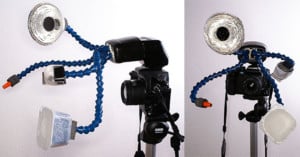
If Doctor Octopus were to design a DIY flash accessory, it might look a little something like this. German microbiologist Marcell Nikolausz has been experimenting with using fiber optics to split a single flash unit's light into multiple light sources. Optical fibers are threaded through Gorillapod-style Loc-Line channels, allowing flexible and stable positioning of the light sources. Each individual light source can be controlled using various modifiers (e.g. diffusers, gels, etc..), changing …

Light Painting in Two Dimensions Using an iPod Touch

After seeing 3D light painting done with an iPad, classmates Jinhwan Kim and Cameron Zotter decided to take the experiment a step further. Instead of simply "painting" in a single direction, they spelled out letters by waving an iPod Touch across six different rows for each long exposure photograph.