Space

Photography and astronomy offer humanity a fascinating view into the universe.
A galaxy seen edge-on with a bright core divided by a diagonal line; the left side is hazy and smooth, while the right side is detailed with blue spiral arms and stars.

Webb Wears Two Hats to Photograph the Sombrero Galaxy

NASA's James Webb Space Telescope (JWST) first photographed the Sombrero galaxy late last year. Months later, the $10 billion space telescope has set its sights back on the galaxy, this time at different wavelengths of light, completing a mind-bending photo of Sombrero's galactic disk.

A dense galaxy cluster with bright stars, distant galaxies, and orange arcs of light caused by gravitational lensing against a dark space background.

Webb Captures a Cosmic Forest of Ancient Galaxies

The NASA/ESA/CSA James Webb Space Telescope (JWST)'s new "Picture of the Month" shows the mega-monster galaxy cluster Abell S1063. This impressive collection of galaxies is about 4.5 billion light-years from Earth in the constellation Grus (the Crane). However, surrounding Abell S1063 is the true star of the show -- super-distant, ancient galaxies whose light is being warped by the gravitational force of the relatively closer Abell S1063.

Northern lights could be arriving on December 1, 2023

Heads Up, Aurora Photographers: Severe Geomagnetic Storm On the Way

A coronal mass ejection (CME) is headed straight for Earth per NASA and the National Oceanic and Atmospheric Administration (NOAA)'s Space Weather Prediction Center. Astrophotographers should charge their camera batteries, check weather conditions for tomorrow, and prepare for what could be the biggest auroral event of the year.

Abstract image split into two panels, each featuring swirling, cloud-like textures in shades of pink and white, creating a sense of motion and energy.

Scientists Capture Sharpest Images Ever of Sun’s Corona

Scientists from the U.S. National Science Foundation (NSF) National Solar Observatory (NSO) and New Jersey Institute of Technology (NJIT) used groundbreaking adaptive optics to capture sharpest ever photos and videos of the Sun's corona, the outermost layer of its atmosphere.
A rocky, reddish-brown Martian landscape with layered hills and mountains fades into a hazy, distant horizon under a pale sky. The terrain is dry and rugged, covered in loose rocks and dust.

Sit Back and Enjoy NASA’s Epic Landscape Photo of Mars

160 years ago pioneering photographers were among the first to capture the landscapes of the Sierra Nevada and Yosemite. One and a half centuries later, a robot on Mars is recording the first-ever views of Martian landscapes that bear a resemblance to those found in the southwestern United States.

A smooth, gray, glassy rock with angular edges sits among rough, beige, and dusty rocks and pebbles on a sandy surface.

NASA Perserverance Rover Snaps Photo of ‘Skull’ on Mars

A dark, jagged rock formation on Mars, nicknamed Skull Hill, has caught the attention of NASA scientists. Spotted by the Perseverance rover on April 11 while descending a slope known as Witch Hazel Hill, the rock stands in stark contrast to the surrounding pale terrain of Jezero Crater.

A split image: left side shows a black telescope on a tripod in front of green foliage; right side displays a detailed close-up photo of the Moon with cratered surface, labeled with coordinates and date.

Unistellar Odyssey Pro Smart Telescope Review: Fast, Fun, Easy, and Expensive

The Odyssey Pro Smart Telescope is among Unistellar's smallest and lightest reflector-based systems. It makes viewing and capturing the night sky as simple as clicking a few buttons on your smartphone or tablet. It is small, light, easy to travel with, and it has an actual viewfinder (powered by Nikon optics) allowing users to start viewing the night sky in less than five minutes.

A bright spiral galaxy with a glowing core is shown on the left, surrounded by stars and smaller galaxies. On the right, a colorful nebula displays red, white, and dark clouds in a star-filled black sky.

A Complete Guide to Deep-Sky Astrophotography

While photographing wide-angle nightscapes is a common occurrence for astrophotographers, not many capture the faint nebulae and distant galaxies hidden beyond the Milky Way. Trevor Jones, creator of AstroBackyard, turned his obsession with space into a dedicated passion, teaching himself astrophotography to share the deep-sky he first witnessed through a telescope. Now a successful YouTuber and respected voice in the community, Jones helps demystify the process.

A grid of four space images: a blue and orange planet, a colorful nebula with bright center, a dark dusty nebula, and a spiral galaxy with a bright core.

The Best Photos From Hubble’s 35th Year in Space

NASA's space shuttle Discovery deployed the Hubble Space Telescope 380 miles (610 kilometers) above the Earth on April 24, 1990, 35 years ago today. To celebrate Hubble's birthday, NASA released four breathtaking new images.

A split image: on the left, a close-up of a colorful crystal formation viewed through a magnifying lens; on the right, a person works with scientific equipment in a laboratory filled with tools and devices.

NASA Astronaut Don Pettit Uses His Camera for Science in Space

NASA astronaut Don Pettit, known for his incredible astrophotography, sense of humor, and clever camera contraptions, is scheduled to return to Earth this month after a seven-month mission aboard the International Space Station (ISS). Before leaving space, Pettit shared some of the awesome science he has done as part of Expedition 72.

Side-by-side images of a nebula: left, a blurry green and orange view labeled "WISE"; right, a sharper, detailed red and pink view labeled "Webb.

Incredible Photo of a Dying Star Shows How Far Telescopes Have Come

The James Webb Space Telescope's (JWST) new mid-infrared image of the planetary nebula NGC 1514, which shows a dying heart at its center ejecting vast quantities of gas and dust, is spectacular in itself. It's also an incredible example of how far space telescope imaging technology has come compared to the same object imaged by NASA's Wide-field Infrared Survey Explorer (WISE) in 2010.

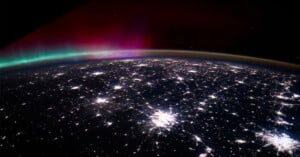
A robotic arm is visible in space with a vibrant aurora glowing green and purple over Earth. The curvature of the planet is outlined against a dark sky, showcasing a stunning space view.

Astronaut Captures Vibrant Green Aurora From Space

American astronaut and chemical engineer Don Pettit is celebrated for his orbital astrophotography created during long-duration stays aboard the International Space Station. His latest footage shows beautiful views of the Northern Lights from space.