This year, YouTube has changed how it counts views twice — and both occurred within three months of each other, which is shifting the paradigm of expectations for creators and advertisers. It also appears both creepy and desperate on YouTube’s part.
The first adjustment came back in August when YouTube changed when it would count a view, separating the metric into two parts: a standard view as well as an engaged view.
“A view is now defined as counting from the very first frame — whether that’s a Short appearing in the feed or a long-form video autoplaying on the Home page,” YouTube explains. “An engaged view is defined as clicking to watch or watching past the initial seconds. This has been, and will continue to be, how you qualify to earn (as long as the content is also public).”
That engaged view is basically what standard, public views were before the change and remains in place because YouTube wanted to make its view numbers appear larger to the public, but it also didn’t want to have to tie creator payouts to those higher numbers. Basically, YouTube wanted to have its cake and eat it, too.
YouTube says it changed the way it counts public views because it wanted to standardize metrics across formats and therefore measure audience reach more accurately. In short, because Meta and TikTok count views instantly on short-form content, YouTube felt like its view numbers on long-form content weren’t keeping up with the times.
This does, at least from YouTube’s perspective, make sense. Short-form has become a huge part of how people consume content now, for better or for worse. While YouTube Shorts are not nearly as popular as Instagram Reels or TikTok, YouTube does have them, and separating how it counted views there to be in line with the competition without adjusting them on long-form felt disjointed.
I suppose I agree.
It’s the second view change YouTube made in 2026 that feels, as I said at the top, particularly creepy and desperate. Starting earlier this month, YouTube started estimating how many people are in the room with a viewer when they play a video on a television and counting those estimations toward the public view count.
“TVs are usually shared devices where friends, families, and communities come together to watch their favorite content. Until now, one TV playback has only counted as a single public view, even if several people watched together on the same living room screen. By updating public view counts to include co-views, we’re solving this measurement gap, better aligning with long-standing TV industry standards, and telling a more accurate story of how viewers watch your content,” YouTube says.
When first hearing how YouTube is approaching this, it sounds like YouTube is finding some way to actually see into living rooms. YouTube says this isn’t the case and it doesn’t actually know how many people are sitting in front of the television. Instead, it uses a video’s genre, audience demographics, and the time of day to guess. If YouTube thinks the video attracts a group and it is being watched in the evening, it will use that data to estimate more than one viewer.
“Co-view rate works as a ratio to show how estimated co-views contribute to your overall public views. For example, a Co-view rate of 1.10 means that for every 1,100 views of a video on TV, 1,000 are primary views from the device playback and 100 come from co-viewing,” YouTube explains.
Okay, sure, but why? It just seems like YouTube is obsessed with increasing its view counts to pump up how the platform is perceived while simultaneously not giving creators anything new. None of these changes actually affect revenue for YouTubers.
“This change only updates public view counts. Your actual creator earnings, ad revenue splits, and YouTube Partner Program (YPP) requirements remain unchanged,” YouTube stipulates regarding co-views.
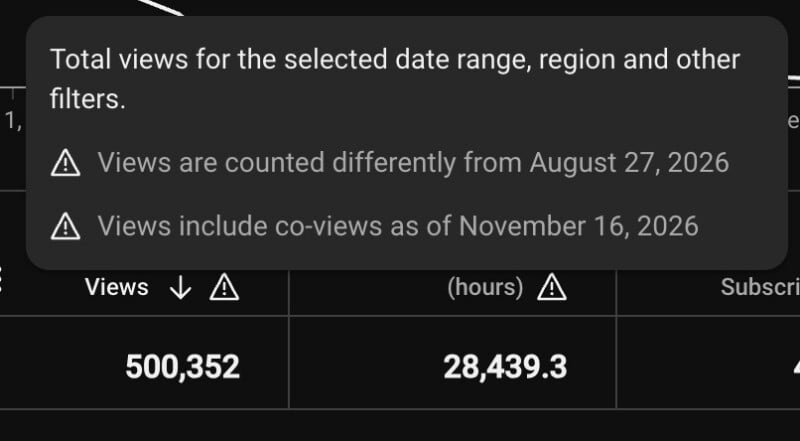
That’s the part that really stands out. Sure, not giving more revenue based on the new calculation of a standard view from August makes sense. That’s not an additional person or viewer more than before; it’s just a new way of deciding at what point the view starts. Fine.
But if co-views are calculating additional people, there is no reason why those views shouldn’t count toward earned revenue. Those are, factually, additional human eyes seeing those videos.
Instead, YouTube gets to pitch advertisers on massive living-room reach while paying creators strictly on single-device clicks. Until those estimated eyeballs translate into actual ad revenue, co-views feel less like a win for creators and more like creative accounting designed to make YouTube look bigger than it is.
I guess when investors are demanding constant growth and the number of humans whose eyes can actually watch content does eventually reach a finite point, the only option is to just make up more eyes.
Image creditsHeader photo licensed via Depositphotos.com.
Affiliate Disclosure PetaPixel articles may include affiliate links; we may earn a commission if you buy through one.