The Fujifilm X half Makes Composition Harder to Avoid
For several months, the most interesting thing about the Fujifilm X half to me was not its image quality, its Type 1 sensor or its resemblance to an old half-frame camera. It was the number of times it made me stop before taking a photograph.
I am not a professional photographer. This is an account of what happened when a deliberately constrained camera became a device through which I began to understand more clearly how photographs are constructed. The photographs accompanying this essay belong to that process. They include ordinary subjects, repeated attempts and imperfect results. Some were composed too loosely; others were soft or poorly focused. Their purpose here is to make the decisions visible: what changed when I moved closer, placed one photograph beside another or reconsidered the boundaries of the final image.
The X half did not suddenly make my photographs excellent. What it sometimes did was make a weak decision harder to overlook. A photograph stopped being simply the thing in front of the lens and became more clearly a set of choices about distance, time, space, exclusion and relation. That gradually suggested a more useful way of understanding the camera itself. Rather than functioning primarily as an alternative to the smartphone, the X half may be more interesting as a transitional device between smartphone photography and more deliberate camera photography.
A Camera for People Who Learned to See Through a Phone
The most obvious objection to the X half is also one of the strongest: there is nothing revolutionary about taking a vertical photograph. Any conventional camera can be rotated, and the smartphone has already trained millions of people to photograph, watch and share the world vertically. The X half’s native 3:4 orientation might therefore appear to imitate a habit that hardly needs another device.
That familiarity may, however, be one of its more intelligent decisions. The X half does not ask smartphone users to abandon a visual grammar they already know. Its viewfinder, rear display and default frame make the vertical image feel ordinary from the beginning. The camera is small, easy to carry and connected to an app. Its photographs can eventually return to the same smartphone library where the rest of one’s images already live.
The difference begins after that familiarity has done its work. On a smartphone, verticality can become almost invisible as a decision: raise the device, change the field of view with a tap or gesture and take the picture. The X half preserves the familiar rectangle but changes the act surrounding it. Its fixed 32mm-equivalent lens cannot be pinched or tapped into another focal length. If the subject is too small, you move closer. If the background becomes intrusive, you change position. When working with exposure controls, aperture, shutter speed and ISO become parts of an explicit system of exchanges.
The camera makes vertical framing the default. Attention can then move toward what actually happens inside that rectangle: how much room a person needs, whether the background contributes anything, where a line enters the image and what the edges exclude. This is why I increasingly think of the X half as a migration device. It begins from smartphone habits, interrupts some of their automatisms and then returns the resulting photograph to the same digital ecosystem.
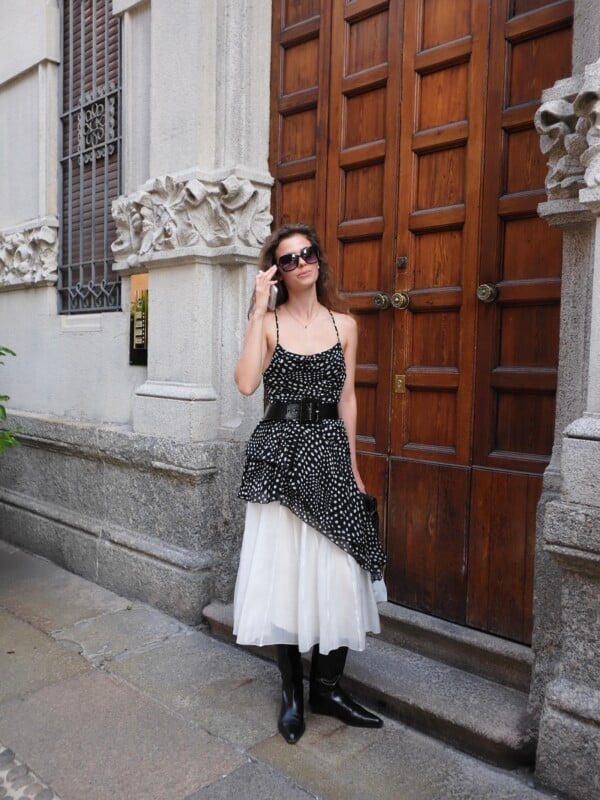
When the Frame Stops Being Neutral
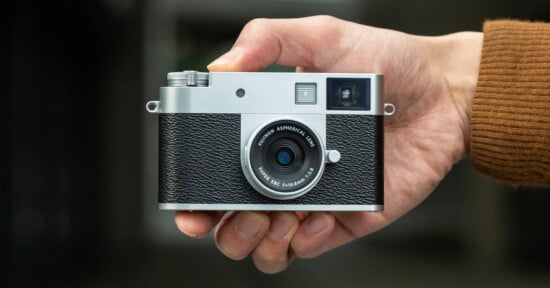
The X half is a JPEG-only digital camera built around a Type 1 sensor and a fixed 32mm-equivalent f/2.8 lens. Its specifications are modest beside those of more expensive enthusiast cameras, and the simplicity of the concept is not always matched by an equally immediate interface. What interested me was the way some of its limitations changed the location of the decisions I had to make.
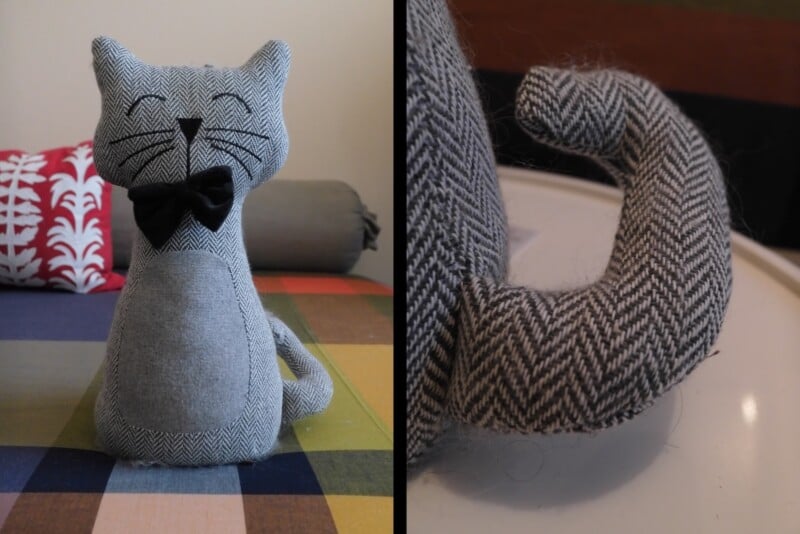
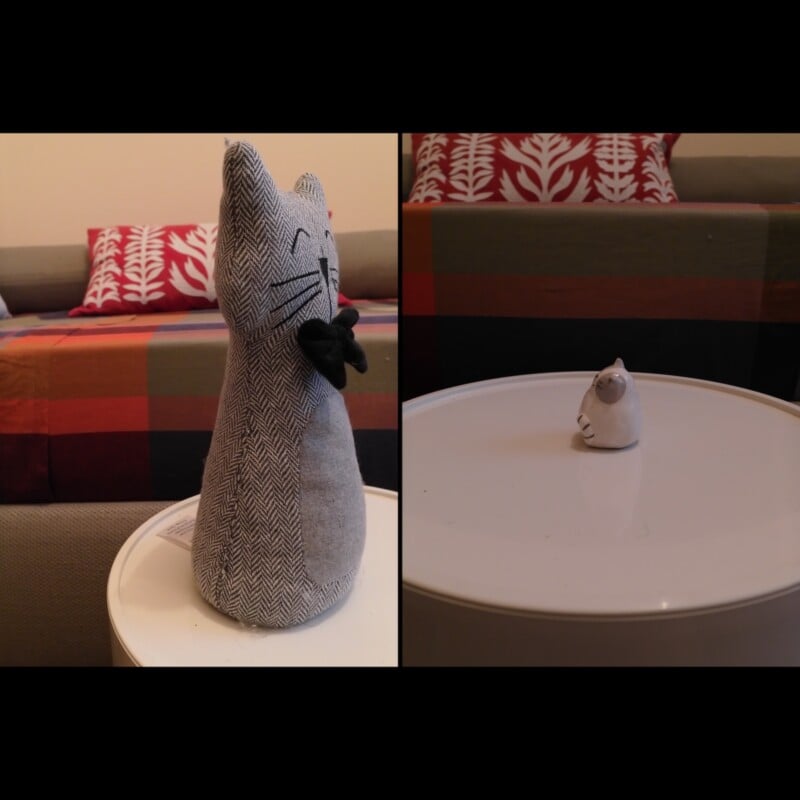
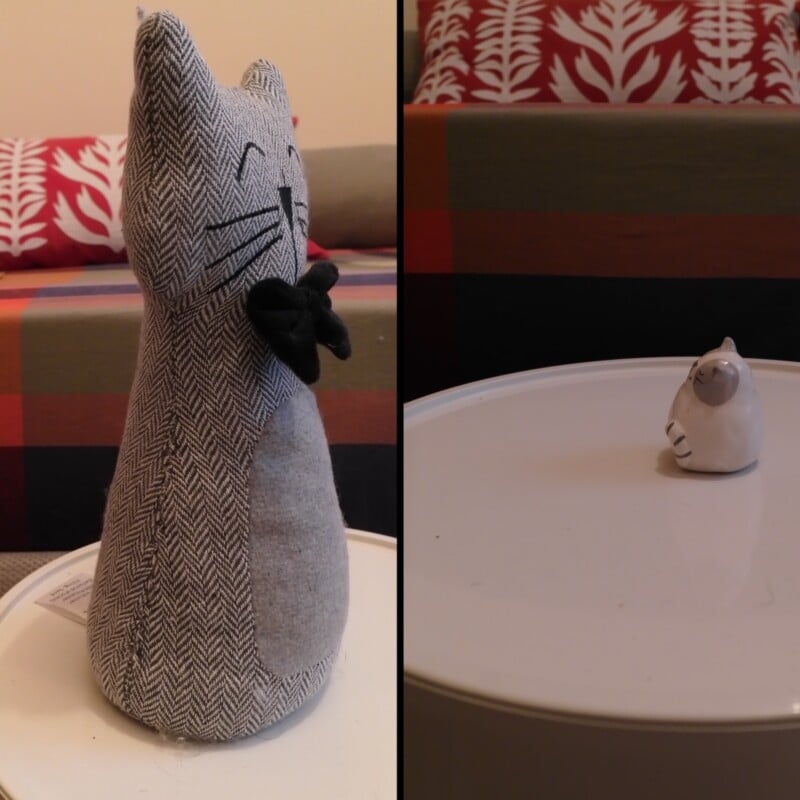
During my experiments, I photographed deliberately ordinary things: ceramic cats, a fabric cat, a cup, flowers and objects on a table. The subjects were useful precisely because they were available and could be photographed repeatedly. I could change one decision and look at its consequences. From farther away, an object inhabited a room. At an intermediate distance, it began to dominate its surroundings. Closer still, the photograph could cease to be primarily about the object and become an image of curve, texture, reflection or material.
Getting closer was therefore more than a way of making something larger. Distance reorganized the image. It changed the relationship between subject and background, as well as the amount of surrounding information the photograph retained. This is an elementary photographic principle, but knowing a principle and repeatedly encountering its consequences are different things. A smartphone makes it easy to solve the problem of a distant subject by switching cameras or cropping through a zoom gesture. With the X half, I found myself physically negotiating the frame. The body of the photographer became part of the optical system.
The same was true of exposure. Opening the aperture admitted more light and could reduce depth of field; stopping down required compensation elsewhere. If I wanted a faster shutter speed, I had to open the aperture or raise ISO. Increasing sensitivity brought its own image-quality trade-offs. These relationships do not belong uniquely to the X half. The camera became useful because it gave me repeated, concrete reasons to notice them. Technical control began to look less like a collection of isolated settings and more like a system in which changing one thing affects another.
The Second Photograph Changes the First
The X half becomes more distinctive with its 2-in-1 function. The camera can combine two vertical photographs into a horizontal composite while retaining the individual files. In its immediate shooting workflow, the sequence is simple: make the first photograph, pull the advance lever, then make the second. What interested me was what could happen between the two exposures. When the second photograph is made with the first already in mind, the individual frame stops being the final unit of composition. Photograph A becomes a proposition to which photograph B can respond.
My first experiments included straightforward relationships such as a whole object and detail. It soon became apparent that a detail adds little merely by being closer. It needs to contribute something: texture, evidence, a change of scale, a contradiction or information that the first image does not provide. Other relationships became possible. A group could be set against an individual. Repetition could be interrupted by isolation. One image could establish a presence and another suggest its trace.
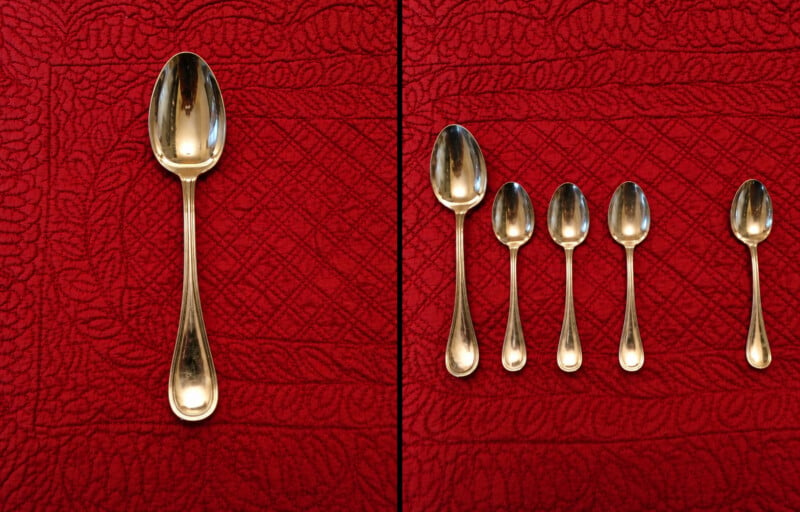
The spoons offered a simple version of this. A single spoon and a row of spoons remain ordinary subjects, but putting them together changes the reading. The eye moves between one and many, between differences within the group and the enlarged attention given to the isolated object. In some pairs, both photographs remained autonomous, capable of functioning independently and gaining additional meaning through juxtaposition.
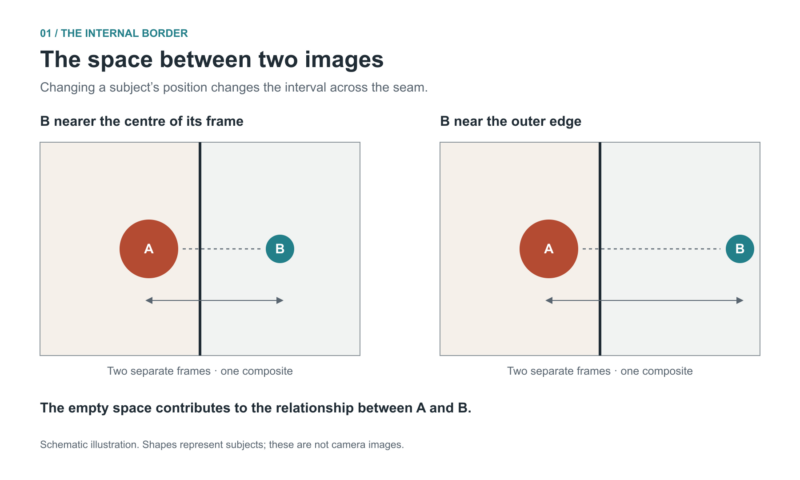
Other pairs depended more strongly on their internal border. A subject directed toward the right edge of the left photograph can appear to address something in the photograph beside it. Two separate spaces begin to behave as though they have a shared geography. The decorative bee and the rose make this particularly easy to see. One is an artificial object, the other a living flower. Their juxtaposition creates a small encounter that neither photograph contains by itself. The space between the subjects becomes part of that encounter. It can function as distance, tension, attraction, absence or suspense.
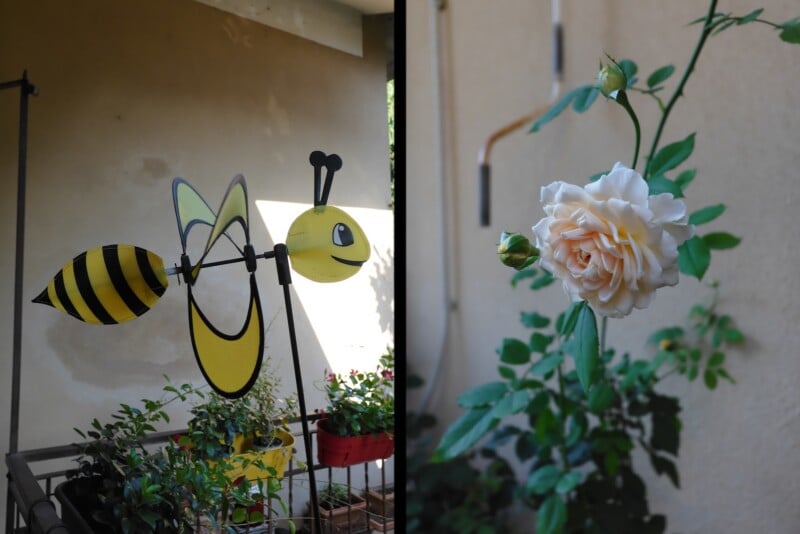
This is where the feature begins to approach montage. The line between photographs becomes an internal border through which two spaces can be reorganized into one visual sentence.
A 2025 ITmedia interview with Fujifilm’s product-planning team provides useful context. It connected the X half’s development to kumi-shashin: photographs understood through their combination and arrangement. In that account, pairing vertical images belonged to the original concept; the half-frame references came later as a way of giving it a familiar form. My reading of rhythm, negative space and the internal border is a critical extension of that idea. But the possibility that one photograph might acquire meaning through another belongs close to the camera’s conceptual origin.
Prospective and Retrospective Composition
The X half does not require every pair to be planned before shooting. Existing images can enter the pairing workflow, and the app allows relationships to be constructed afterward. There are consequently two different operations: in a prospective pair, I make photograph A and then search for B knowing that A already exists. The first image affects the construction of the second. In a retrospective pair, both photographs already exist. Their relationship emerges through selection and arrangement. The first process changes the act of photographing; the second changes the act of editing.
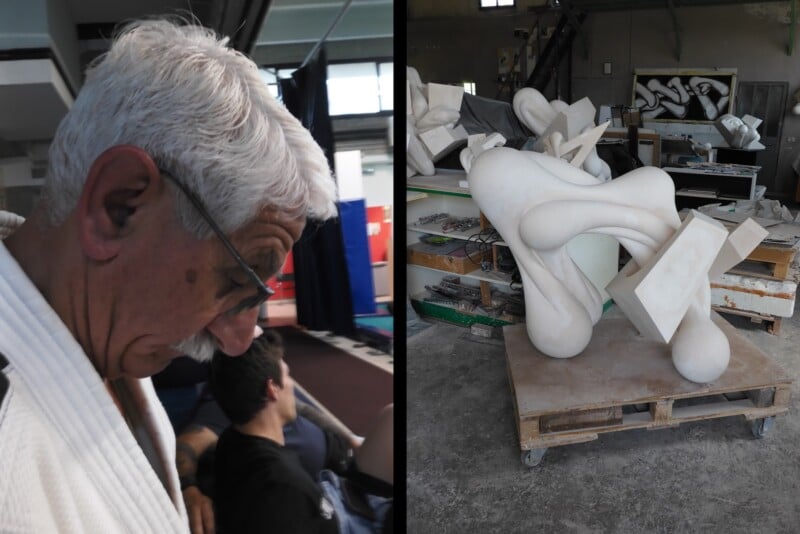
The opening pairing of a bowed head and a white sculpture can be read in terms of posture, folded forms and the distribution of light. The interest lies in what becomes visible between the images, rather than in their documenting the same subject. A pairing can also fail. Two photographs may share a color or a recognizable theme without generating much beyond that resemblance. The availability of the feature does not make every combination meaningful. What interested me was discovering that composition could move between stages: before the shutter, between two exposures and after the photographs already existed.
Composing a photograph that does not exist yet
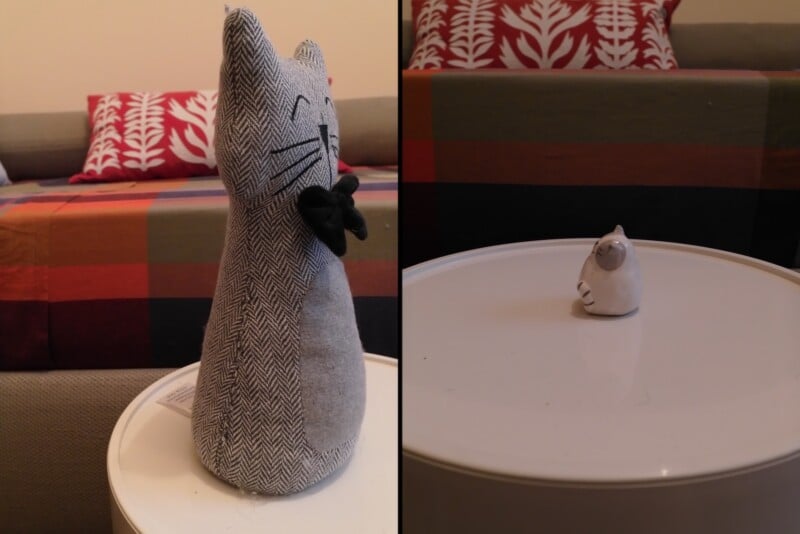
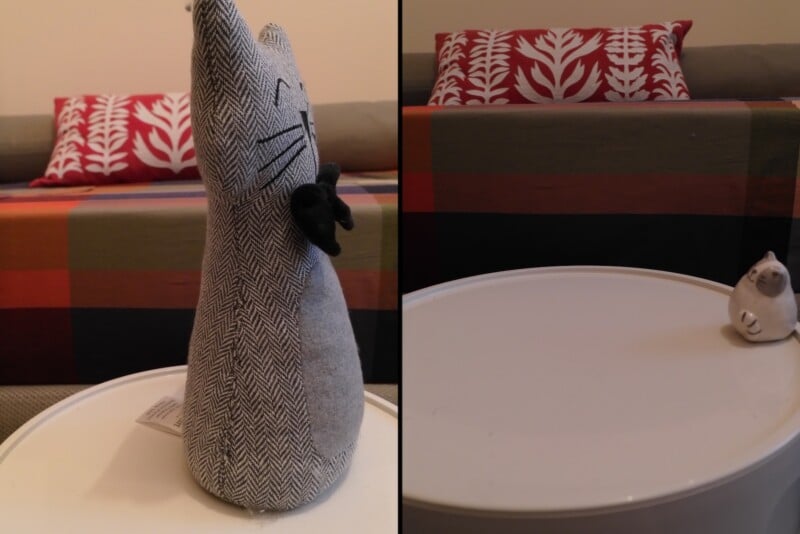
The companion app introduced another level to this process. In the iOS version I used, preparing a composite for export allowed me to move between its normal presentation and a square format, and then between Fit and Crop. With Square + Fit, the whole composite remained visible inside a square presentation. With Square + Crop, it filled the square by losing material from the outer edges. This is the export behavior I observed in the app, rather than Fujifilm’s separate in-camera 1:1 Frame Combiner.
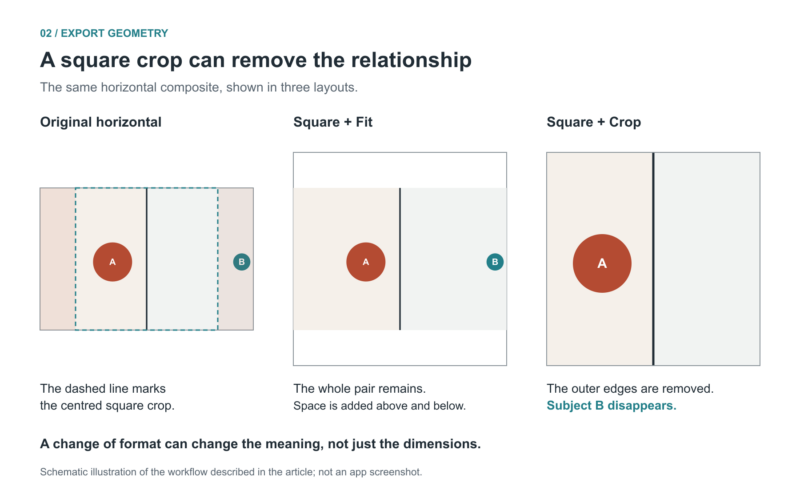
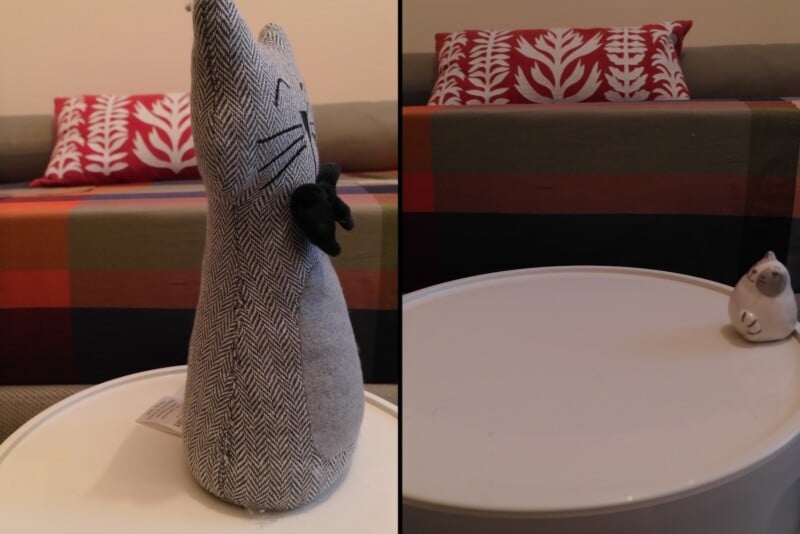
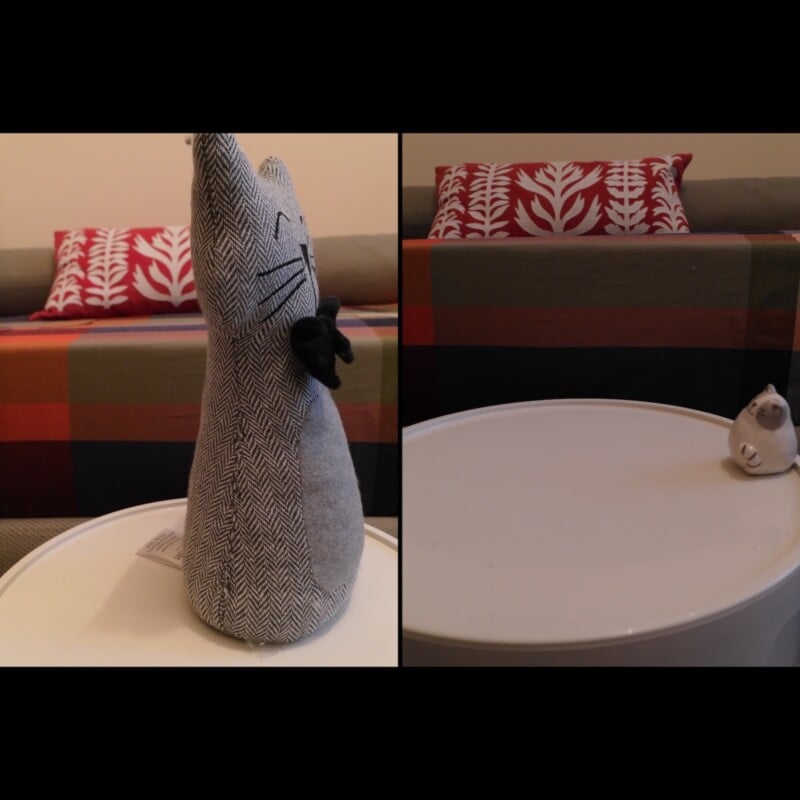
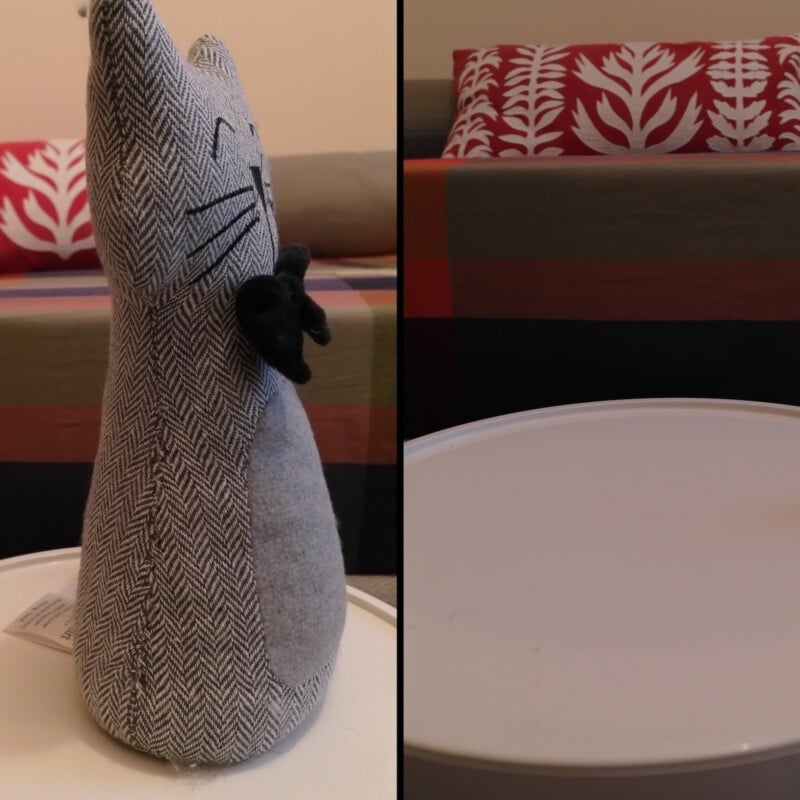
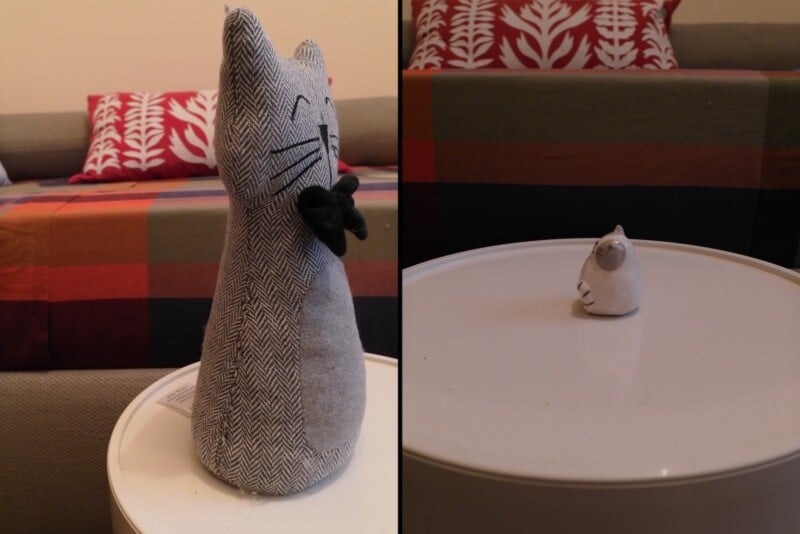
The change of geometry could substantially alter the relationship between the photographs. Empty space disappeared. Subjects near the edges became vulnerable. Two objects could seem more compressed, and a visual pause in the wider composition could vanish. The fabric cat and the small ceramic cat gave me a particularly tangible way of considering this. The amount of empty tabletop around the smaller figure affects its apparent distance from the larger one. That space is part of the relationship, even though it contains very little. A crop therefore does more than remove surplus material. It can change the terms on which the two figures occupy the combined image.
The workflow contained several compositional acts: constructing each vertical frame, arranging the relationship between photographs and transforming that relationship for a different destination. The decisive shift occurred when the last operation began influencing the earlier ones. Once I knew what a square crop might remove, I started leaving space with that future geometry in mind. I was composing for a frame that did not yet exist.
The Camera Knows the Phone Comes Afterward
The dependence of the X half on its companion app can initially seem contradictory. A camera associated with a more concentrated photographic experience still requires a smartphone for important parts of its design. Film Camera Mode uses the app for development, pairs can be assembled there and sharing naturally takes place through the phone.
In practice, I found this division more coherent than I expected. Once transferred, the photographs entered the iPhone Photos library. They could be selected, shared or moved to a computer through the environment in which my other images already lived. The app behaved less like a destination than a passage.
The X half separates the smartphone from the moment of capture without removing it from the later life of the image. For that interval, taking a photograph belongs to an object that is not simultaneously my browser, message center, map and notification system. Afterward, the phone’s advantages return: storage, selection, communication and connection with other devices. The phone is moved to the end of the process.
Seen this way, the app helps define the camera’s promise of concentration. The X half does not ask me to leave the smartphone ecosystem. It interrupts the part in which the photograph is made. Its analog references provide familiar gestures, but the problem it addresses is contemporary: how to separate image-making from the device that immediately surrounds every image with other functions.
Artificial Scarcity and the Limits of Simulation
Film Camera Mode takes that separation further. It offers virtual rolls of 36, 54 or 72 frames, removes normal live view and immediate review and makes the optical viewfinder the principal means of framing. The advance lever must be used between photographs, and the roll is later transferred to the app for digital development. This is not the material scarcity of film. No negative is consumed, no chemical processing is required and a failed exposure does not carry the same marginal cost. The scarcity is procedural: software suspends feedback and packages the photographs as a finite sequence.
Artificial inconvenience does not automatically produce discipline. Richard Butler’s DPReview assessment identified a useful problem: even a minimum 36-image roll could outlast the idea that had justified starting it. The ritual could become tedious. A useful constraint needs to remain connected to the decision it intensifies. Once the idea has disappeared but the procedure continues, friction becomes bureaucracy.
My own use of the mode was limited, and I used a 36-frame roll. What interested me was the temporary absence of confirmation. I had to continue without checking each result. That can make the act of photographing more deliberate; it can also be irritating. The mode is useful when the restriction serves the experience, rather than when completing the simulated roll becomes an obligation in itself.
Productive Constraint and Useless Friction
A camera designed around limitations creates a critical danger: every weakness can begin to look like a virtue. The X half does not deserve that protection.
Its autofocus can hesitate, particularly in difficult conditions. The display is small. The optical viewfinder gives only an approximate account of the recorded frame. The interface is not always as fast or intuitive as the simplicity of the concept suggests, and the JPEG-only workflow limits recovery options. Its launch price also attracted criticism relative to its specifications, although subsequent price reductions in markets including the United States and the United Kingdom have made that objection less compelling.
These characteristics do not all belong to the same category. A fixed focal length limits one kind of choice. A two-image sequence creates a relational constraint. Delayed review changes when feedback becomes available. Slow autofocus, by contrast, is simply slow autofocus. A touchscreen that ignores an operation is not teaching patience, and a bug is not photographic philosophy.
A meaningful constraint removes or delays one possibility so that another decision becomes more visible. Useless friction makes the instrument less reliable. The optical viewfinder sits on the boundary. Its roughly 90% coverage is a disadvantage when composition depends on a precise relationship between subject and edge. I had to learn that the recorded photograph would include more than the finder showed. Becoming aware of that discrepancy helped me understand my results. It did not turn the discrepancy into an advantage.
The same distinction matters when looking at my imperfect photographs. Some reveal decisions worth examining. Others are simply unsuccessful attempts. Learning involves recognizing which is which.
What the Camera Actually Taught Me
There is an obvious causal complication in this story: I was deliberately trying to learn photography. Some of the improvement in my attention must belong to practice itself. Another fixed-lens camera could have prompted many of the same discoveries. What I can describe is how the X half gave those discoveries a practical form.
Moving closer changed the balance between subject and surroundings. Exposure settings became connected decisions. Pairing photographs made the space around an object relational. Preparing a square export revealed how a later boundary could alter an earlier composition.
The camera gave these questions a material interface: Where should I stand? What belongs inside this vertical frame? What does the second photograph contribute? What happens at the border? Which parts of the relationship survive the crop? The accompanying images are records of working through those questions. Their value here includes the attempts, the differences between versions and the moments when a familiar object began to look different.
The Photograph, Then the Phone
Nostalgia is therefore no longer the most interesting way for me to understand the Fujifilm X half. Its lever, optical finder, virtual rolls and vertical frame look backward. Its more contemporary idea is the connection it makes between photographic habits.
It starts with a user for whom vertical framing, portability and app-based transfer are already familiar. Into that system it inserts a fixed lens, physical distance, a second photograph and a set of boundaries that become harder to ignore. Once those decisions have been made, the image returns to the phone.
The smartphone is not defeated. It simply comes afterward. That is the most coherent idea I found in the X half: it keeps the ecosystem while giving the act of capture its own object, gestures and interval of attention. It does not make composition easier. It makes more of the decisions behind a photograph available to notice.
Full disclosureFujifilm Italia provided the camera used for this article on loan. My thanks to its press office for kindly arranging it.
Affiliate Disclosure PetaPixel articles may include affiliate links; we may earn a commission if you buy through one.