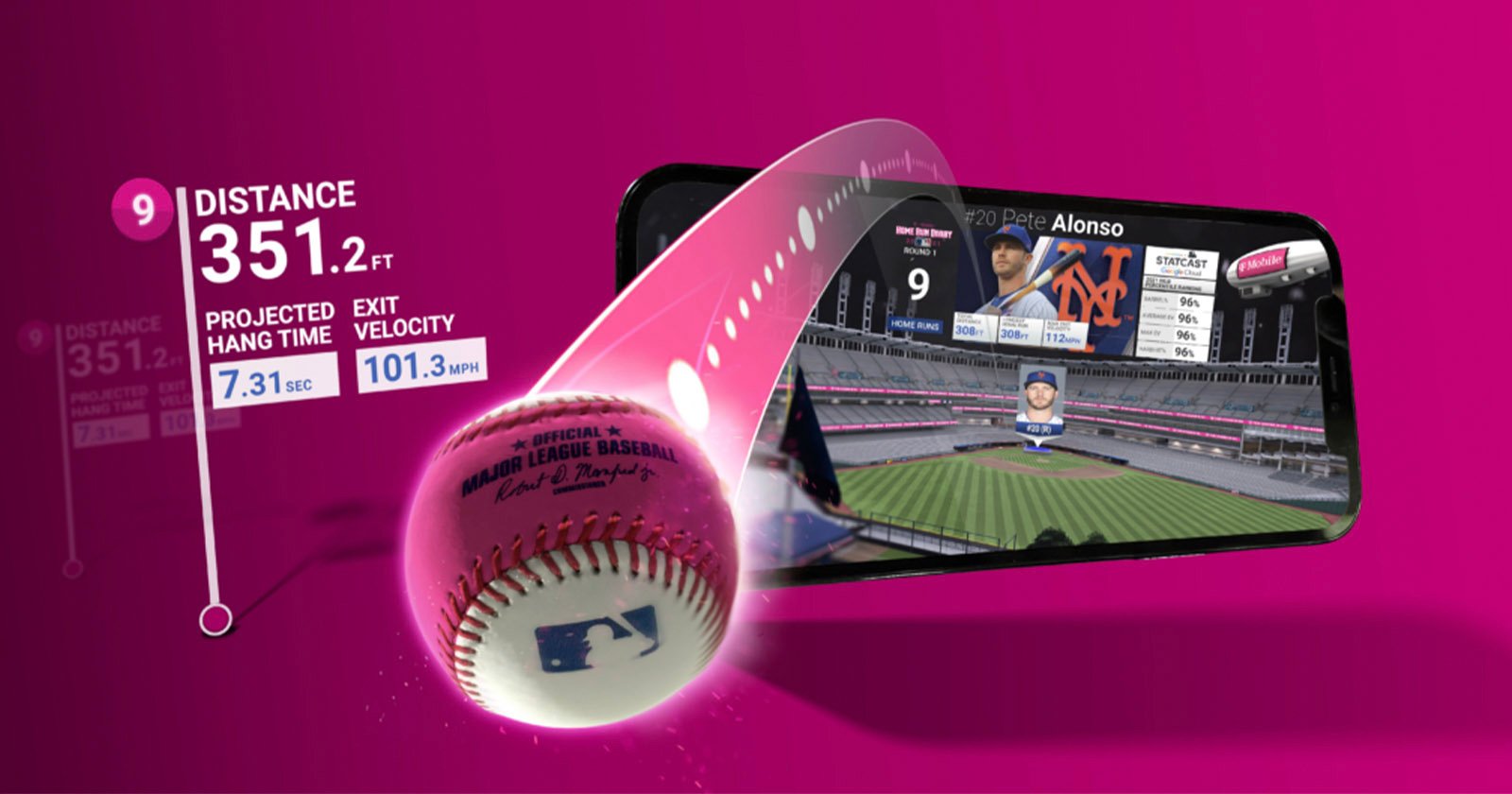
Have You Ever Wondered How MLB Home Runs Are Measured? It’s Cameras!

Major League Baseball (MLB) playoffs are well underway. The on-field action has been great so far. Sophisticated camera technology, often going unnoticed, enriches the spectator experience, including telling viewers at home just how far that monstrous walk-off home run went.
MLB stadiums are big, often with seats encircling the entire playing field. They also differ from one another, with varying dimensions, altitudes, typical weather conditions, and more. These variables make it extremely difficult to predict how far a home run will go. That’s where Sony’s Hawk-Eye camera technology comes in.
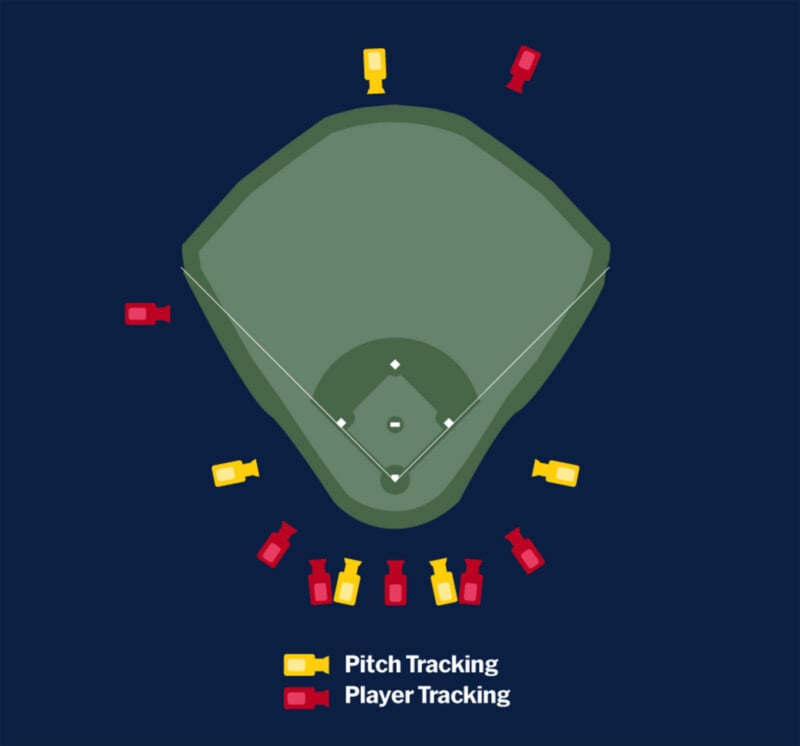
Every Big League stadium has a dozen Hawk-Eye cameras installed, each pointed down at the field. These cameras see everything that happens on the field, including where each player is located at all times, where the baseball is, and even how much the ball is spinning.
In theory, determining how far a baseball is hit is as simple as measuring it, right? The issue is that if a baseball hits part of the stadium, like an upper-deck seat or a wall, it stops in its tracks. A ball that traveled 380 feet before hitting an obstruction could have gone 400 feet, or even 450 feet, if it hadn’t been stopped.
As the excellent and endlessly entertaining SportsBall_Visual explains in the YouTube video below, determining home run distance then becomes a physics problem. If a ball is hit at exit velocity X at angle Y, where would it have hit the ground?
However, reality is not so simple. In any given season, like this one, many baseballs have been hit at the same velocity and launch angle, but they didn’t all go the same distance. Not even close. Wind, humidity, altitude, and temperature all play a role, which is why MLB cannot rely on straightforward math to determine a home run distance. If it did, it could be off by over 60 feet in some cases.
Instead of pure math, cameras save the day. Obviously, math is involved in how cameras operate, but the 12 Hawk-Eye cameras in every MLB stadium create a robust mesh network of visual data that tracks a ball’s location in three-dimensional space and its speed at all times.
Five cameras face the infield diamond, capturing data at 300 frames per second and enabling things like those glorious ABS ball-and-strike reviews, while the remaining seven cover the entire field.
When a ball is crushed high into the air, destined for the outfield bleachers, multiple cameras track it at once, each collecting slightly different data that is then fed into the cloud for analysis. Hawk-Eye cameras can track a ball’s position with extreme precision, even as it soars through the sky at a hundred miles per hour. During last year’s Home Run Derby, a tiebreaker was decided by home run distance, coming down to less than a tenth of an inch.
Determining how far a ball would have gone if nothing were in the way requires that pesky math again, which completes the arc the ball was on when it stopped. Because launch angle, velocity, and external variables vary, two home runs that land in the same spot in the stands may have traveled vastly different distances. But don’t worry, Hawk-Eye knows. Your favorite player won’t be robbed of any home run distance.
Affiliate Disclosure PetaPixel articles may include affiliate links; we may earn a commission if you buy through one.