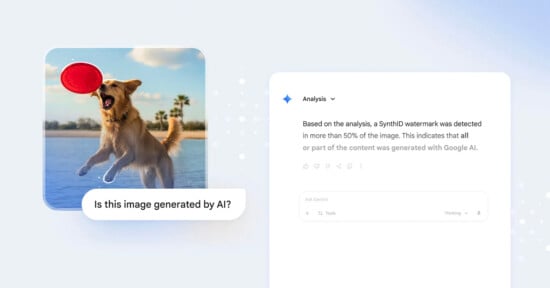
Google’s SynthID AI Detector is Now Freely Available to Everyone
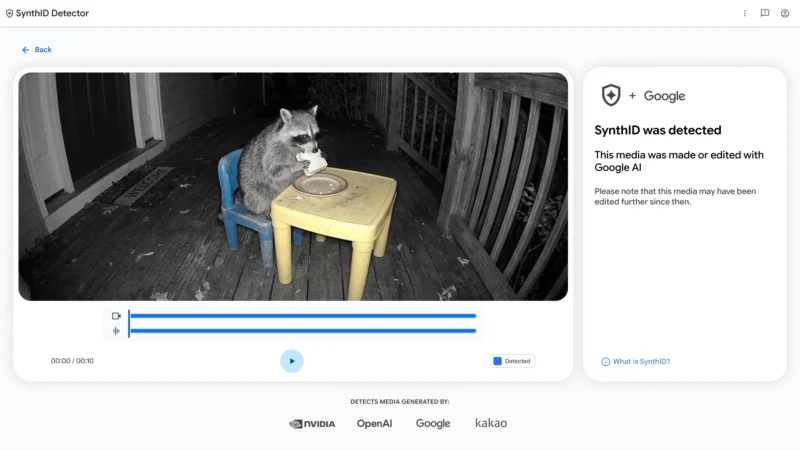
Google has made its SynthID Detector publicly available, allowing users to check whether images, videos, and audio clips contain watermarks associated with generative AI.
The tool was previously limited to selected journalists, media professionals, and researchers for testing; the tool is now open to a wider audience through a dedicated website.
Introduced in 2023, SynthID embeds imperceptible watermarks into AI-generated media so that the content can be identified later. Google uses the technology across its AI models and products, including Nano Banana, Veo, Lyria and Gemini, as well as Flow, ProducerAI and Vids. The detector supports a range of common image, video, and audio formats, enabling users to upload files for analysis.
The tool has expanded beyond Google’s own products to support content associated with OpenAI, Nvidia, and Kakao. Apple has also announced plans to adopt SynthID, although Google has not provided a specific date for when support will become available across its products.
SynthID detection is already available through the Gemini app and Google Chrome, and Google says the system receives approximately one million verification requests each day. Its wider release comes as increasingly realistic AI-generated media makes it harder to distinguish authentic photographs and recordings from synthetic or altered content.
CNET found that the detector can identify some AI-assisted edits as well as entirely generated media.
For example, the tech news website found that an image captured on an iPhone and subsequently adjusted using Apple’s Reframe tool was identified as containing a SynthID watermark, while an unedited iPhone photograph was not flagged.
The detector also has limitations. Its results depend on whether the tool used to create or modify the media embeds a compatible watermark in the first place. Content without SynthID may therefore go undetected, even if it was generated by AI. Other verification services have similar constraints: OpenAI operates its own detector, but it checks for OpenAI watermarks rather than identifying all forms of AI-generated content.
Google says uploaded files are processed in real time and deleted after the results are displayed, according to the site’s terms of service. A digital signature associated with the uploaded media is linked to the user’s identifier and deleted after 24 hours.
Image creditsGoogle
Affiliate Disclosure PetaPixel articles may include affiliate links; we may earn a commission if you buy through one.