Photographer Captures the Milky Way Over Manhattan, Despite the Light Pollution
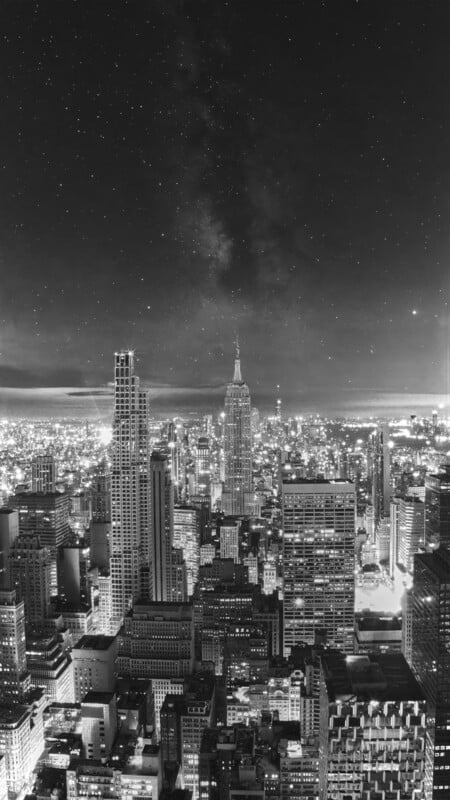
A photographer has captured a magnificent timelapse of the Milky Way above New York City using infrared camera equipment.
The type of star that New Yorkers are most likely to get a glimpse of is one appearing in a Broadway production, not in the night sky.
That’s because Manhattan is heavily light-polluted, with the night sky virtually always washed out because of the countless lights that festoon the city.
But that doesn’t mean the stars aren’t still there.
As proven by astrophotographer Jason Kurth (@frozen.spectrum), who went to the Top of the Rock at the Rockefeller Center to capture the Milky Way galaxy glimmering above the Empire State Building.
“I used a monochrome astronomy camera with high infrared sensitivity, which was modified to add an 850-nanometer filter directly over the sensor,” Kurth tells PetaPixel.
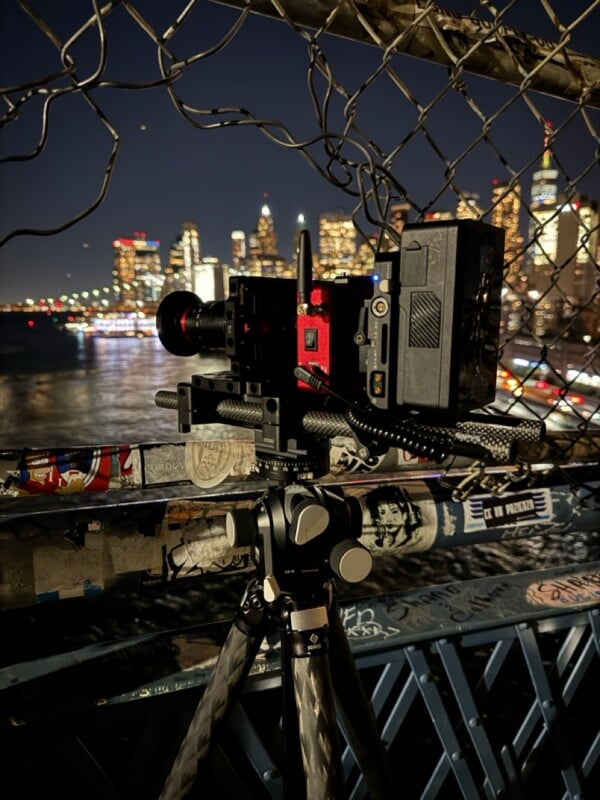
The visible light spectrum is roughly 400 to 700 nanometers, so Kurth’s camera, which is recording light from 850nm into the near-infrared spectrum, is able to reject much of the visible light pollution while still picking up stellar light.
“I have several infrared-converted full-frame and medium format cameras, but their infrared sensitivity is much lower than this particular model, which uses a [1/1.2-inch] Sony IMX 585 sensor,” Kurth explains. He adds that he wishes “they made a larger version of the same tech.”
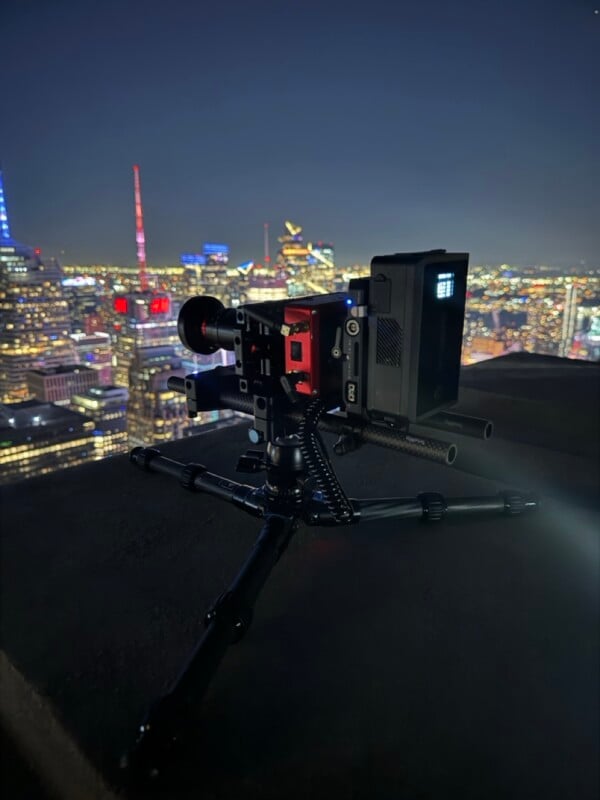
Adding to the strong infrared sensitivity of this sensor is Kurth’s special lens: a Kowa 8mm VIS-SWIR industrial lens. Whereas most lenses have low infrared transmittance and performance, this $5,000 lens is designed to deliver wavelengths up to 2,000nm.
“To put this together, I mounted the camera on some cheese plates to a cinema rod-type setup,” says Kurth. “I added a wireless astronomy mini PC and V-mount battery holder to power everything, and the camera was controlled by my phone. All on a small tabletop tripod.”
The small setup was essential as normal tripods and large camera setups are prohibited at the top of 30 Rockefeller Plaza.
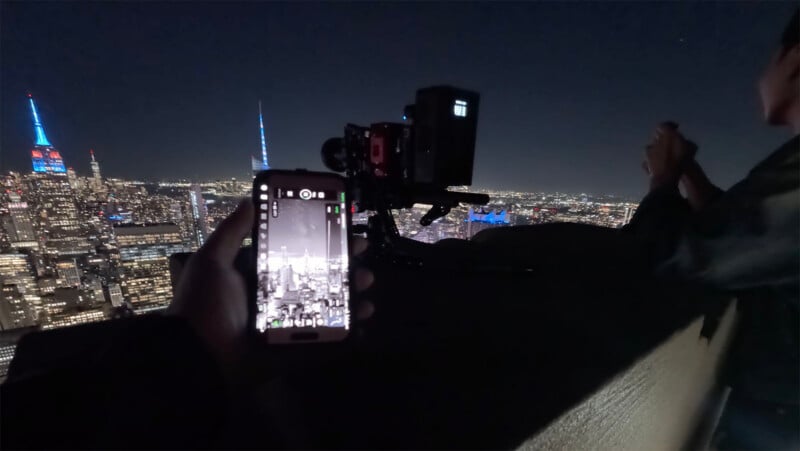
Kurth, who shot the video on Sunday (October 4), says that he knew the timelapse was possible after doing some test runs and receiving technical assistance from his friend Ty Buckley.
“It was pretty exciting seeing the first images come on the screen,” Kurth adds. “At this time late in the year, I only had a short window when it got dark for the direct Milky Way lineup, and was waiting for a chance when weather/Moon conditions lined up before it was too late.”
More of Kurth’s work can be found on Instagram and his website.
Image creditsPhotographs by Jason Kurth
Affiliate Disclosure PetaPixel articles may include affiliate links; we may earn a commission if you buy through one.