
Archivist Restores Rare Footage of The Velvet Underground at Vietnam War Protest
The year is 1969, legendary rock and roll band The Velvet Underground is playing at a Vietnam War protest in Texas. It sounds like an iconic moment. The only problem? Back then, people didn’t care all that much about The Velvet Underground.
Although they are now heralded as one of the most important and influential rock groups of the 20th century, the band from New York, fronted by Lou Reed, were famously ignored by critics and performed poorly in record charts. In fairness, there were a lot of great bands around at that time.
So when footage of The Velvet Underground performing live in their heyday is unearthed, it’s a big deal. This particular film was discovered in 2019 by accident at the G. William Jones Film and Video Collection at SMU in Dallas. Videographer and film archivist Jack Amadon recently breathed new life into it and uploaded it to YouTube, where it’s now nudging 700,000 views.
“People are shocked to see the legendary band performing in their prime in a way that had never been seen before,” Amadon tells PetaPixel.
The Velvet Underground were famous for serving as the house band at Andy Warhol’s studio; the visionary artist was also their manager.
Pulling Together a Historic Moment
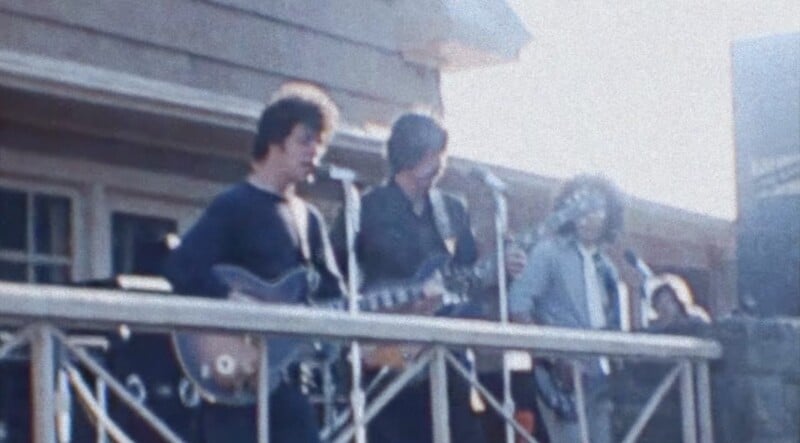
The film that Amadon uploaded to YouTube shows The Velvet Underground performing at the Dallas Peace Moratorium on October 15, 1969. But the audio is taken from just a few days later, when the band was playing at the End of Cole Ave. Club, also in Dallas, on October 19, 1969.
The visuals are actually pulled from two sources: a 30-second silent 8mm home movie shot by amateur local John Tincher, who briefly appears in the footage around 1:12. “It’s a three-lens turret, standard 8mm model,” says Amadon, who says he’s not sure of the exact model.
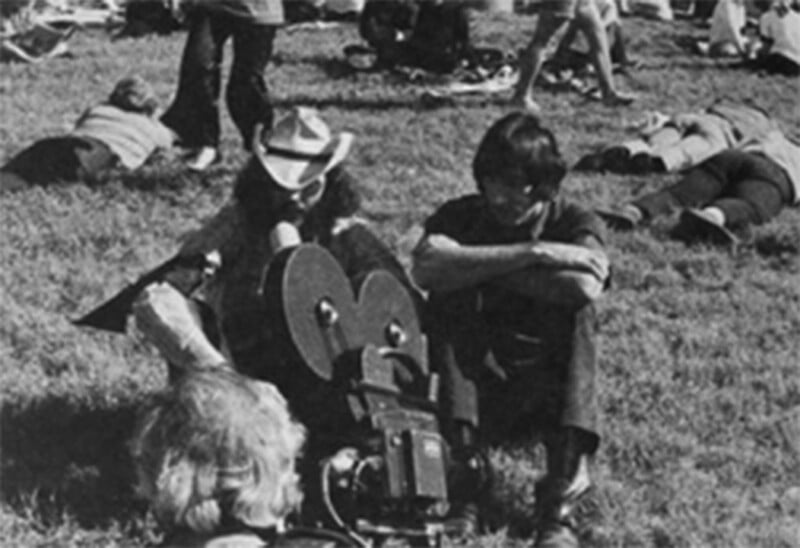
The other footage is a 16mm documentary produced by Stoney Burns, the editor of the underground newspaper, Dallas Notes. Amadon believes the camera was a chop-top Auricon CM-72A with a dog-leg viewfinder and an Angenieux 12-120 f/2.2 lens attached.
“This was an extremely common news kit of the time, with Auricons shooting single system sound,” he says. “The chop-top mods provided compatibility with Mitchell 400-foot magazines, and the Angenieux was a fast, reflex, 10x zoom — the first zoom to ever achieve a 10:1 ratio.”
Ever since the footage was discovered and uploaded, Amadon says he “always had it in the back of my mind that it would be fun to try to combine all of this footage into one usable piece.”
He took the audio of the band performing Waiting for the Man at the End of Cole Ave. show and laid it over the footage. “Much to my excitement, the audio almost matched the footage, with the band performing both versions nearly identically,” says Amadon. “I then used the rate stretch tool, as well as slowing down the audio by around one percent to see if I could get the timing closer. The results ended up being pretty damn good.”
In Amadon’s video, drummer Maureen Ann “Moe” Tucker is seen playing along perfectly to the beat, adding to the immersion. “In this case, the rate stretch tool was my best friend, used in tandem with frame blending to mask frame rate changes,” adds Amadon.
“I’d patch any sections that had no band footage with pieces of the crowd from the documentary. On the editing front, I found this to be a necessity. But looking at this as a historical document, it’s fun to see the crowd of people who both go to a Vietnam War protest and a Velvet Underground show.”

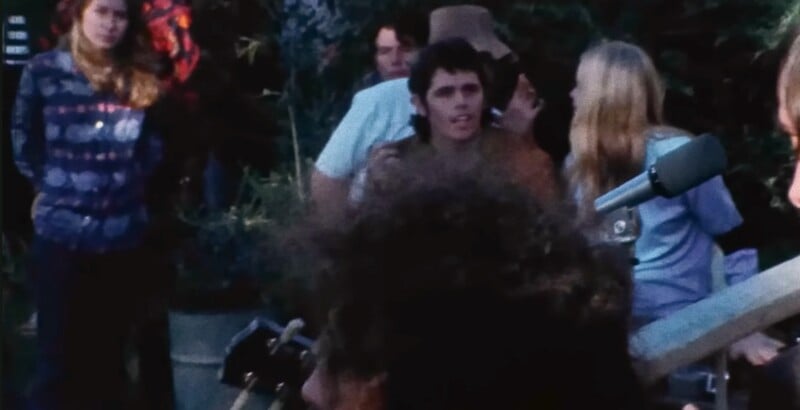
Once Amadon had put the edit together in Adobe Premiere, he brought the film over to DaVinci Resolve for restoration. “I denoised all of the footage to get rid of grain and digital compression, applied a small amount of sharpening, and then did my color grade,” he explains.
The restoration ran into a dilemma as he didn’t want to betray the original look of the footage. But the footage he had spanned the entire day, meaning there were color temperature and exposure changes, so tweaks had to be made.
“The 8mm footage was a bigger challenge, as it was lower resolution, and the color had an orange wash throughout,” Amadon explains. “I decided that the 8mm footage should look like 8mm footage, and that I shouldn’t try to pass it off as 16mm.”
As he mastered the file, the filmmaker added back accurate film grain. “The 16mm footage got an appropriate amount, as did the 8mm,” he says. “As I said, I’m not trying to pass this footage off as anything else. This isn’t digital 4K that was shot yesterday, it’s archival film, and I think there’s a beauty in reproducing it as such.”
More of Amadon’s work can be found on is YouTube channel and website.
Affiliate Disclosure PetaPixel articles may include affiliate links; we may earn a commission if you buy through one.