Everything You Need To Know About I’m Back’s $850,000 APS-C Kickstarter
The I’m Back Roll APS-C launched on Kickstarter earlier this month to significant attention and support. With over two weeks left in the campaign, the I’m Back Roll APS-C has shattered its $44,603 goal, garnering nearly $850,000 in pledged support at the time of writing. But what exactly are people actually backing: an ambitious project or a wild dream?
When crowdfunding platforms like Kickstarter are used as they were initially designed, there’s always some level of risk. Sometimes projects are in the very earliest stages of ideation, and creators need money to keep iterating and, hopefully, eventually make something. At the other extreme, sometimes a product is already done, and companies just use Kickstarter to drum up interest and sell products to their biggest fans at slight discounts, like what Peak Design does. The I’m Back Roll APS-C seems to be somewhere in between.
What Is the I’m Back Roll APS-C?
Like most stories, it is worth starting at the beginning with the I’m Back Roll APS-C. I’m Back started a decade ago with the dream of letting photographers easily capture digital photos with analog cameras. It was not a wholly new idea at the time, picking up the spiritual mantle from the failed Silicon Film company from the early 21st century.
But unlike Silicon Film, I’m Back brought products to market, including the I’m Back Pro in 2018, the I’m Back 35 in 2020, and the I’m Back Film in partnership with Yashica early last year. These products all have a couple of important things in common. First, they all require large, bulky external attachments. And secondly, they all have relatively small image sensors, with the largest being the Micro Four Thirds sensor in the I’m Back Film release.
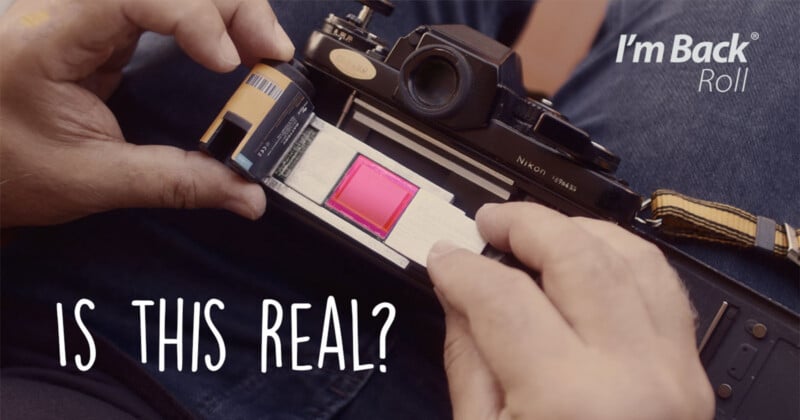
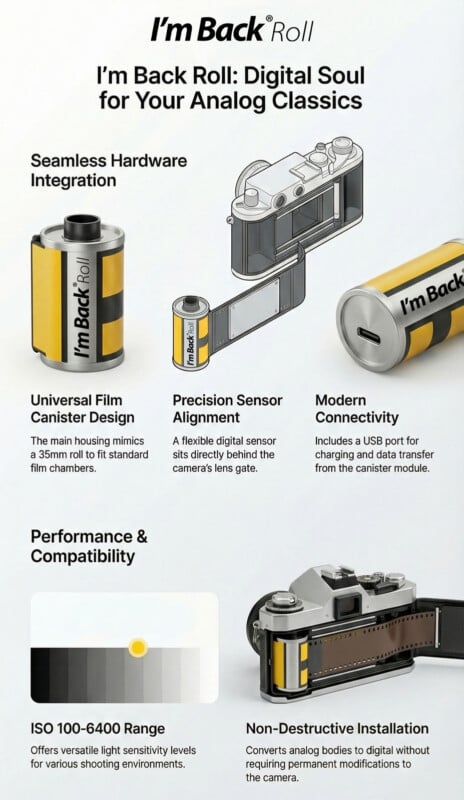
The idea is that a digital “film roll” goes inside a compatible vintage film camera, placing a digital image sensor behind the lens mount and allowing photographers to capture digital photos using their film equipment. It promises a different sort of photographic experience, breathes new life into older film gear, and doesn’t require photographers to buy and develop film roll after film roll.
Of course, a photographer can certainly make the case that the actual film is an integral part of using a film camera. Still, given how much money I’m Back has raised through its various projects over the years, there is obviously real demand for the idea the company is selling.
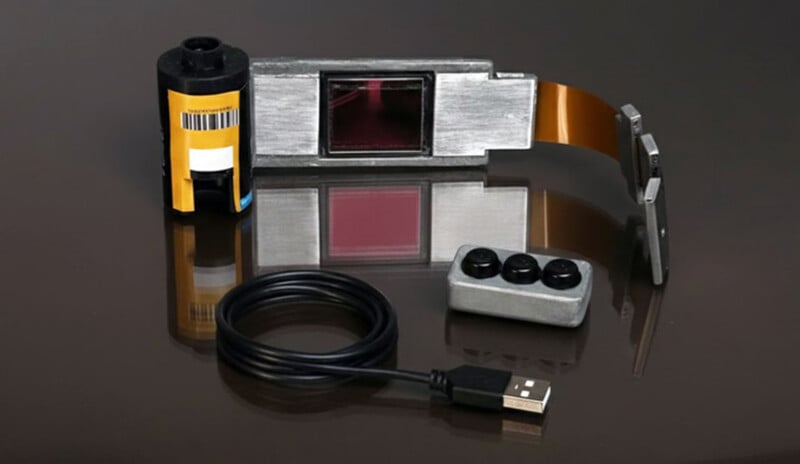
The I’m Back Roll APS-C aims to significantly refine this digital-slash-analog experience and improve image quality. It gets rid of a huge, bulky add-on, putting all the vital electronics, including power and storage, inside the “film roll” itself. And it sports a larger APS-C image sensor, which means, all else equal, better image quality and a smaller crop factor than before.
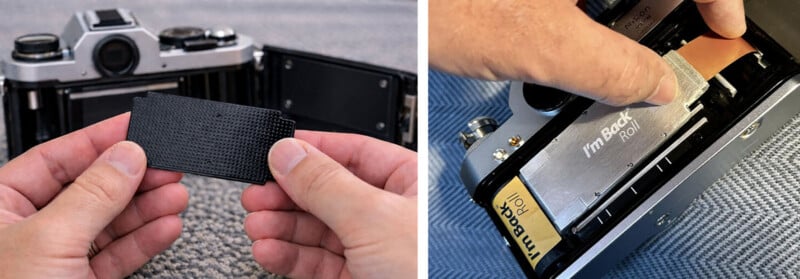
It is worth noting that there is also a version of the I’m Back Roll designed for rangefinders, including semi-transparent add-on framelines to compensate for the crop factor. Overall, I’m Back Roll works with “most 35mm film cameras,” per the developer. The I’m Back Roll works with 35mm cameras from Canon, Nikon, Minolta, Pentax, Olympus, Contax, Yashica, Leica, Fujifilm, Konica, Ricoh, Chinon, Praktica, Voigtländer, Rollei, Exakta, Alpa, and more. The company says that in most cases, simply removing the pressure plate is sufficient, although some cameras may require custom backs for a proper fit. “Very compact” cameras may also have compatibility issues.
Where the Project Is Now
Given the dramatic technological departure the I’m Back Roll represents — moving the electronics from a big, bulky add-on to a thin board that fits inside a film camera — it is reasonable to wonder whether this photo product is realistic or a pipe dream. I’m Back tells PetaPixel it is definitely the former, although it has not yet built a working prototype with an APS-C image sensor.
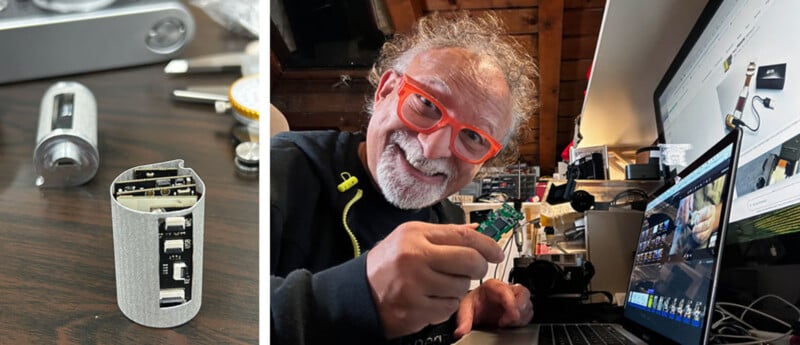
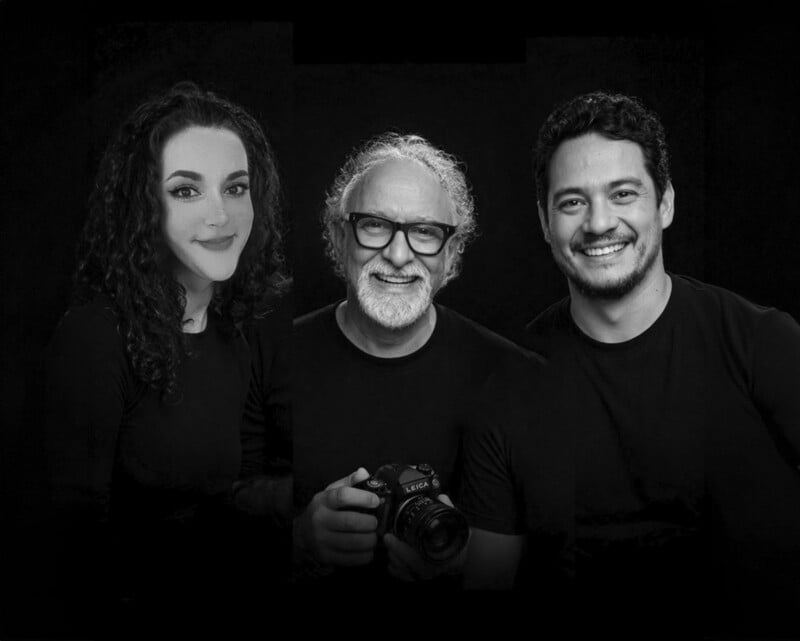
“This project is not at a conceptual stage. Throughout 2024 and 2025, we developed and tested a working prototype based on a flexible architecture, where all components were integrated into a film-roll format. I personally used this system inside a real camera for approximately one year in practical conditions,” says Samuel Mello Medeiros, CEO of I’m Back.




The company shared sample images shot with this prototype. However, it is worth emphasizing that the prototype used featured a Micro Four Thirds sensor, not the proposed 26-megapixel Sony IMX571 APS-C sensor that the company says the final version will use.
As of now, the team is working on the final phase of mechanical and electronic design, which includes redesigning the system to integrate the battery internally and optimize the mechanical structure. I’m Back has no particular concerns about the move to an APS-C sensor, as it is familiar with Sony sensor architecture from prior releases.
“A fully functional prototype (PCB, internal battery, and metal structure) is expected within approximately six months after the campaign closes,” I’m Back says.
The company then expects to begin shipping final production units in August 2027. When pressed on whether this timeline is realistic, I’m Back emphasizes that it is not starting from zero and is evolving a system it has already successfully developed.
“The timeline is ambitious, but it is not arbitrary,” I’m Back promises. “It is an aggressive timeline, but it is grounded in real development experience.”
When pressed on why a fully integrated solution is possible now, when it wasn’t before, I’m Back cites technological improvements.
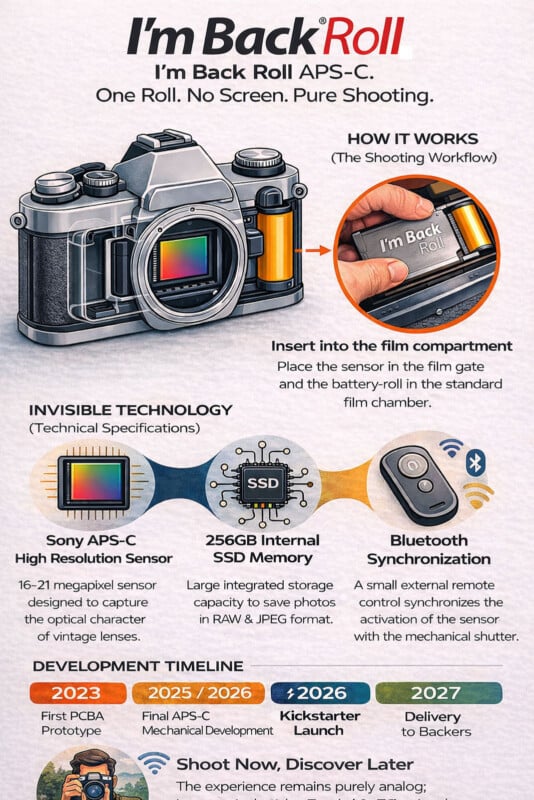
“The concept is not new — the execution is. Previous attempts failed due to technological limitations. Today, sensor technology and miniaturization make this approach viable,” the company says.
I’m Back claims it has already “physically demonstrated” that the components it requires fit inside the new design, that the system works, and that image capture is possible. ”The challenge is not whether it works — it is optimization,” I’m Back tells PetaPixel.
Limitations
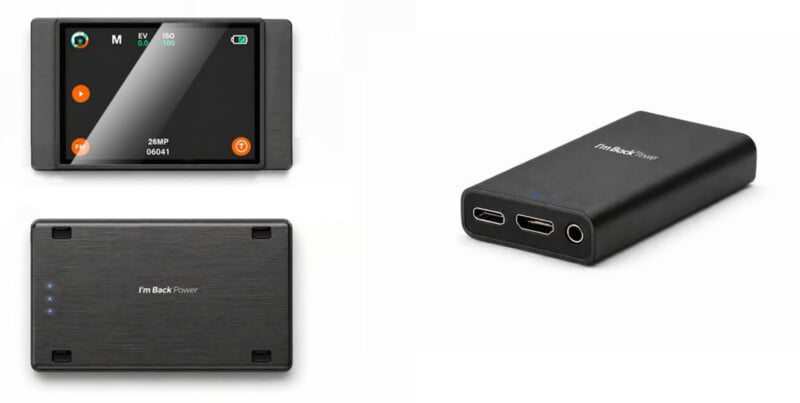
Even though I’m Back says it has, or at least will, realize the goal of putting all essential digital image capture components inside a facsimile film roll, it acknowledges that there are some limitations. Power is a big one, which is why the company is also developing an optional external module that increases battery life. It also has a microphone input, HDMI output, and USB-C port.
“The system is fully functional internally, with expansion when needed,” I’m Back says.
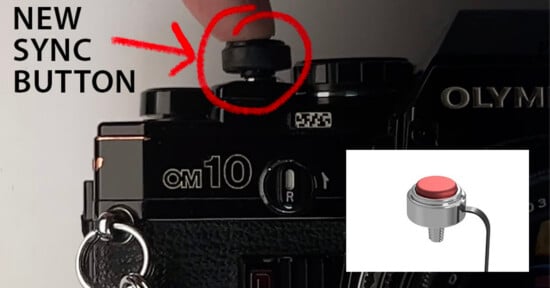
That said, there is an external component that is non-negotiable: a remote. There is a small wireless remote that communicates with the image sensor and creates a controlled exposure window.
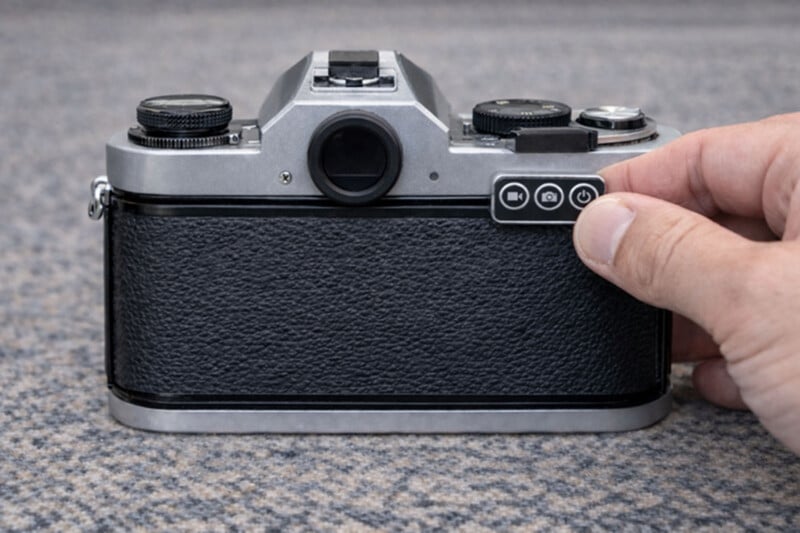
Once the I’m Back Roll has been installed and the remote control fixed to the camera, this is how a photographer will actually capture images, per I’m Back. The photographer uses their analog camera as they normally would, including setting focus, aperture, and shutter speed. Once they have dialed in their settings and are ready to capture a photo, they follow this sequence:
- Press the remote control button to activate the digital image sensor
- Press the camera shutter release within about one to two seconds
The company says this will become natural over time.
“We tested automatic detection methods (light, motion), but they were not reliable,” I’m Back says.
Another limitation is not a limitation for everyone. When I’m Back launched its new Kickstarter campaign, it touted the system’s lack of a screen as a benefit. “No distractions,” I’m Back said.
Apparently some early backers disagreed, and argued that they actually do want a screen. In response, I’m Back introduced a new add-on to its campaign, an external display.
“Because so many backers asked for it, we are making an external display available as an optional add-on,” I’m Back says on Kickstarter. “You asked, we delivered!”
This add-on will be a 2.5-inch touchscreen that will be entirely optional. It will work alongside the Power Bank Hub mentioned above, which is also optional, and let photographers frame, more easily focus, and review their digital images from their analog camera. The screen will attach to the hub, which will be positioned on the back of the camera.
I’m Back Says This Is Not Vaporware
It is entirely reasonable to be skeptical. I’m Back is doing something that hasn’t been done successfully before. While the company is adamant that it can pull this off, pointing to its extensive engineering experience and its functioning prototype, there is still a decent amount of distance between a prototype and a fully working, viable production release, especially when the prototype doesn’t have all the components of the promised final release, like an APS-C sensor.
“This is not an experimental project,” I’m Back tells PetaPixel. “We have already developed working digital systems, integrated sensors into analog cameras, and built firmware and processing pipelines.”
It doesn’t necessarily help that many of the product images shown on the Kickstarter are CGI, or, in some cases, generative AI, which the company labels as just “a communication tool.” I’m Back says any computer-generated assets are at least closely based on real prototypes it has made and tested.
“Kickstarter involves risk — that is understood,” I’m Back says. “However, there is a clear difference between a concept with no validation and a system already tested in real use. [I’m Back Roll] belongs to the second category.”
“Skepticism is understandable and healthy. But it is important to distinguish between concept and execution. This is not a theoretical idea, it is something we have already built, tested, and are now refining,” I’m Back concludes.
The company is adamant: The I’m Back Roll APS-C is real, it’s coming, and it will deliver on its promises.
But these are big promises, arguably the biggest I’m Back has ever made. The company has historically delivered on its Kickstarter campaigns, even with occasional delays. Hiccups come with the territory, and could, despite I’m Back’s best efforts, happen again here.
Backers are clearly happy to assume a level of risk, though, as 1,416 people have pledged $846,629 so far to the I’m Back Roll campaign, with 17 days left.
Image creditsI’m Back. Some product images are computer-generated versions based on prototypes. Sample images were captured using a prototype I’m Back Roll that has a Micro Four Thirds sensor, not the APS-C sensor I’m Back says its new product will use when it releases.
Affiliate Disclosure PetaPixel articles may include affiliate links; we may earn a commission if you buy through one.