Why No One Will Know That Viral Photo is Yours (And What Can Help)

You might not know what the word “provenance” means but you probably are familiar with the problem it can cause. You take an amazing photo, it goes viral on social media, but no one knows who took it. There is no provenance trail to link back to the creator.
You finally had your big break, but no one knows it was yours. There have been attempts to fix this problem for photographers for years. Let’s review and explore what’s next.
C2PA to the Rescue
The concept behind C2PA (The Coalition for Content Provenance and Authenticity) is a powerful tool for giving photographers credit. The idea is to record some details at the time of image capture (author, when and where the image was taken) and package this with the image itself. Where the image goes, so do these details. Supported by the most powerful of tech heavyweights imaginable like Adobe, Microsoft, Google, Amazon and Meta, it seemed like C2PA was the answer to the problem.
However, 5 years after launching, according to the Reuters institute, currently fewer than 1% of news images or videos published globally include this C2PA information.
The Social Media Bouncer
The Achilles heel of the C2PA is the intentional stripping of the metadata by social media companies. At the point of sharing on most social media sites, the photo is compressed, metadata stripped and shared to a wide network. It’s like a bouncer at a club taking your ID before you enter.
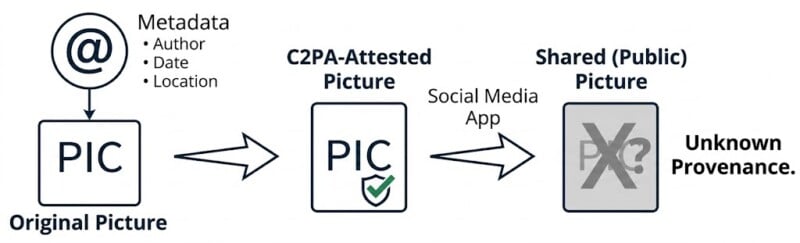
Why would they do this? According to an Infosys white paper, the metadata component is around 100kB for jpg and png files, which isn’t terribly high. Our tech heroes should have no problem keeping that information in the name of digital provenance.
The Problem of Scale
What is missing in this context is the sheer volume of images the tech companies have to store. It is estimated that 14 billion images are uploaded to social media every day. That translates to 1.4 Petabytes of extra storage space needed every day that the tech companies have to purchase to preserve C2PA metadata.
What incentives do the tech companies really have for taking on this extra burden? Is the public screaming at them demanding C2PA metadata be preserved? Will they make any extra revenue from doing so? A perfect middle ground might be to garner positive vibes from the photography community by appearing to support the C2PA initiative while doing very little to actually support it. Sound familiar?
Incentives Drive Behavior
The real incentive we need to explore is that of the photographer – the engine that actually will drive change. What incentives do photographers have to use the C2PA standard? As discussed, if the goal of a photographer is to make sure people know they took the image when shared over social media, then enabling C2PA on their images won’t do them much good. A photographer selling a photo directly and proving that they took the picture? Maybe. However, until these hurdles are overcome, the C2PA importance risks being stuck perpetually in photography nerdom.
The Lesser Known (but Potentially More Effective) Alternative
pHash (perceptual hashing) is starting to gain more attention as something that can help photographer get credit. The use of pHash takes a different approach. Firstly, a unique digital fingerprint (pHash) is made of the image up to 64 characters long. Believe it or not, 64 characters in a row actually can do a good job of describing an image. Here’s where things get tricky — those characters can not be decoded back to an image. However, comparing a second image to that string of characters will tell you if they are the same image.
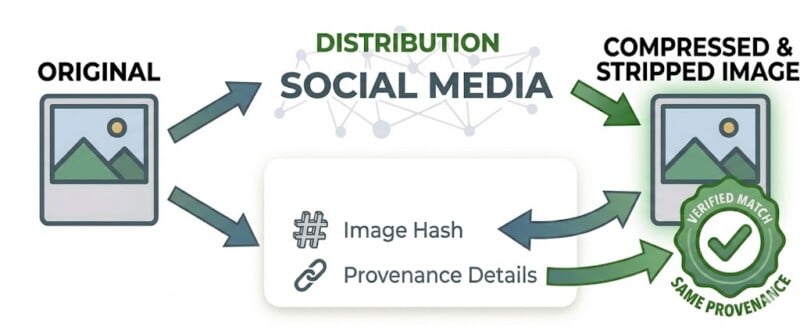
Still confused? Let’s walk through an example. Kelley takes a picture of a local protest, creates a pHash automatically on an app and shares the photo on social media. The photo goes viral and is shared on various social media platforms. Abi finds the photo online after it was screenshotted and reshared on different platforms and submits it to the app to find out who took it. The app would compare Abi’s photo to its library of hashes, which will flag Kelley’s photo and her identity.
But here’s the best part. No metadata needs to be attached to the image. The picture itself is all you need. The photo can be cropped, compressed (to a degree), shared on social media and still be squeaky clean on the other side ready to establish provenance. You could line your birdcage with the image and a week later still find out who took the image. It’s like seeing someone in a club and checking on your phone their social media account to find out who they were after the bouncer confiscated their ID.
Imagine a scenario where it is even easier to use. Rather than Abi having to download the photo and find out who made it manually, the social media site automatically puts a badge on the image which shows the original author of the image with no effort from Abi at all. That would be like a floating bubble over everyone’s head in the club with their name on it without you having to look up their social media account.
So what problems does this solve? First of all, nothing needs to be packaged with the image since the image itself is all you need. What about those tech company incentives? No more extra storage space needed. Put simply, at least in today’s environment, pHash is the only option for preserving provenance when sharing images widely.
What Photographers Should Do Now
The reality is that both C2PA and pHash can coexist and can both provide benefit to photographers. For those interested in preserving the details offered by C2PA, enable the feature on your phone or camera. It’s free, doesn’t take much effort to enable and does a great job at providing a digital trail from the point of the shutter closing. For those concerned about getting credit for their work being shared across all corners of the internet, there is technology out there worth exploring that uses pHash. The technology works and is providing real benefit to real photographers.
Everyone wants the same goal — to assign proper credit to those who create the work. The way in which that is achieved is still up for debate and you will shape how that will happen.
Image creditsLogo via C2PA. Elements of header photo licensed via Depositphotos.com.
Affiliate Disclosure PetaPixel articles may include affiliate links; we may earn a commission if you buy through one.