
FAA Lifts Blanket Aerial Ban It Placed to Protect ICE Activity From Aerial Scrutiny

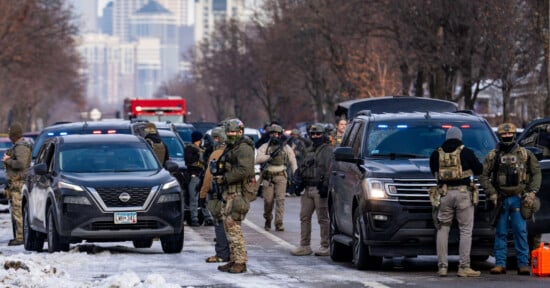
The US Federal Aviation Administration (FAA) has lifted its blanket and unconstitutional “invisible, moving” ban on drone flights near Department of Homeland Security (DHS) and other government agencies — a ban put in place to make it more difficult to cover the activity of Immigration and Customs Enforcement (ICE).
In January, the National Press Photographers’ Association (NPPA) urged the FAA to withdraw sweeping drone restrictions that were meant to make it more difficult for journalists to cover ICE activity.
The Notice to Airmen, or NOTAM, imposed Temporary Flight Restrictions (TFRs) on drone use within 3,000 feet laterally and 1,000 feet above ground level of facilities and “mobile assets,” including “ground vehicle convoys,” connected with DHS, Department of Defense (DOD), and Department of Energy (DOE) activity. This “moving ban” as it was called came into effect in January and was scheduled to stay in place through October 2027.
“Our members are finding it impossible to comply with the order—even when photographing stories with drones that are unrelated to these agencies,” NPPA President Alex Garcia said in January. “A moving, effectively invisible TFR, applying to unmarked or rented vehicles creates a constantly shifting restricted airspace that journalists have no practical way to identify or avoid.”
The organization joined with local and national news organizations to formally request the FAA withdraw the notice. Today, it did so.
“NPPA is pleased to report that the FAA has withdrawn an onerous flight restriction issued earlier this year, which had prohibited drone flights near ‘mobile assets’ of ICE/DHS and several other federal agencies. The prior TFR has been replaced with a cautionary notice. Instead of an outright prohibition, UAS operators are advised to ‘avoid flying in proximity to’ the vehicles,” the NPPA says.
The change doesn’t mean there isn’t still risk associated with using drones, but it is at least not outright banned.
“Affected agencies reserve the right to take action against drones that they deem a threat. Therefore, flying a drone near DHS activities still carries some risk, and the notice advises drone pilots to use caution.”
Regardless, the NPPA says that the FAA’s ban was unconstitutional and is pleased to see it removed far ahead of the initial plan.
“The rescission of the broad and unconstitutional flight restriction means that drone journalists will no longer have to risk their drone license and criminal charges because of an overbroad, invisible, moving flight restriction. NPPA is grateful for all of those who advocated against the ill-conceived TFR.”
Image creditsHeader photo licensed via Depositphotos.com.
Affiliate Disclosure PetaPixel articles may include affiliate links; we may earn a commission if you buy through one.