Leica 35mm Noctilux-M f/1.2 ASPH Review: A Long Time Coming

Ultra-fast 35mm lenses are not a new thing. Leica users have had access to the excellent Voigtlander 35mm f/1.2 Nokton across multiple versions for many years. The Noctilux title isn’t new either. Leica has multiple insanely fast 50mm lenses, going down to as bright as f/0.95, on the market.

The “Noctilux” title represents some of the most prestigious and expensive lenses, and the 35mm f/1.2 Noctilux is no exception, with its $9,650 price. Why it has taken Leica so long to create a fast 35mm is unknown, but I can tell you that the wait is finally over.
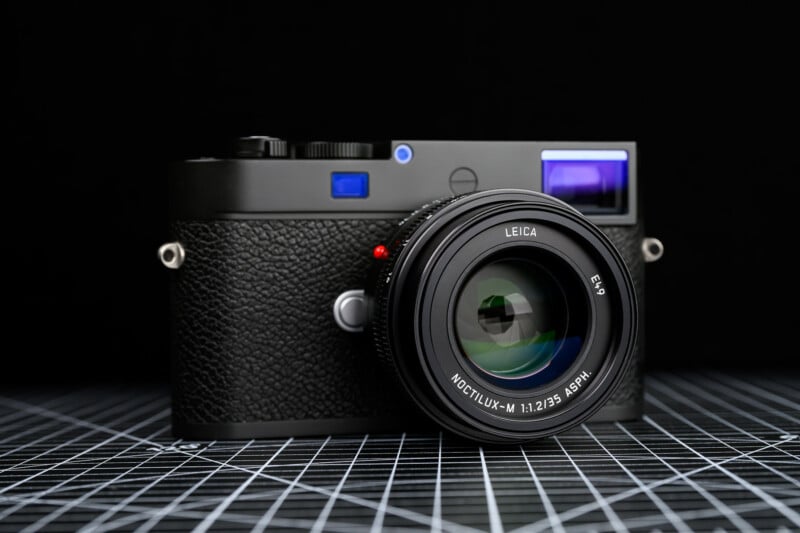
A black Leica camera with a large lens sits on a grid-patterned surface against a black background. The camera has a textured grip and blue highlights near the viewfinder.
The new Noctilux is still very discreet and compact.

Leica M 35mm f/1.2 Noctilux: How It Feels

The 35mm Noctilux could have been physically humongous, but the intention was to keep this lens fairly compact and manageable. At only 14.7 ounces (416 grams), the lens is quite easy to travel with and does not feel heavy or bulky on the M11 camera I tested it on.

The 49mm filter size is reasonable, and the lens itself does not significantly obstruct the view through the rangefinder. There is an extendable hood built into the front of the lens, and the focusing and aperture ring controls are impeccably constructed as always.
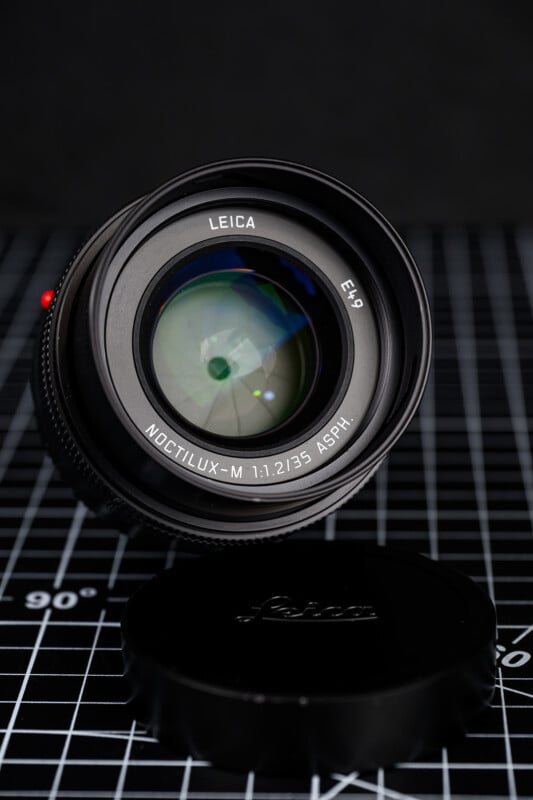
A Leica Noctilux-M 35mm f/1.2 ASPH camera lens is placed upright on a black grid-pattern surface, with its lens cap lying in front of it. The lens branding and details are clearly visible.
The front of the lens has a 49mm filter mount, and you can also see the built-in hood extended.
Close-up of a black Leica camera lens showing focus markings, engraved text "LEICA CAMERA WETZLAR MADE IN GERMANY 11635," and a portion of the lens barrel with a smooth, metallic finish.
Leica lenses always come with Leica prices.
A black camera lens with yellow and white markings is placed on its side on a grid-patterned surface, next to a detached lens cap. The background is dark and out of focus.
The aperture ring, focusing ring, and stencilling are all impeccably cut.

Focusing the lens is done through a knurled metal focusing ring, and it does not incorporate the classic half-moon focusing assist knob that you will often find on smaller Leica lenses. Frankly, it doesn’t need one because the diameter of the focusing ring seems to fit nicely in the hand. I had no issues with focusing the lens or adjusting the aperture while shooting under pressure. All the controls are simple to use and easy to find without having to take my eye away from the viewfinder.

Close-up of a black 35mm camera lens with yellow and white distance and aperture markings, mounted on a textured black camera body, set against a dark background.
I’m surprised that Leica waited so long to make this instant classic.
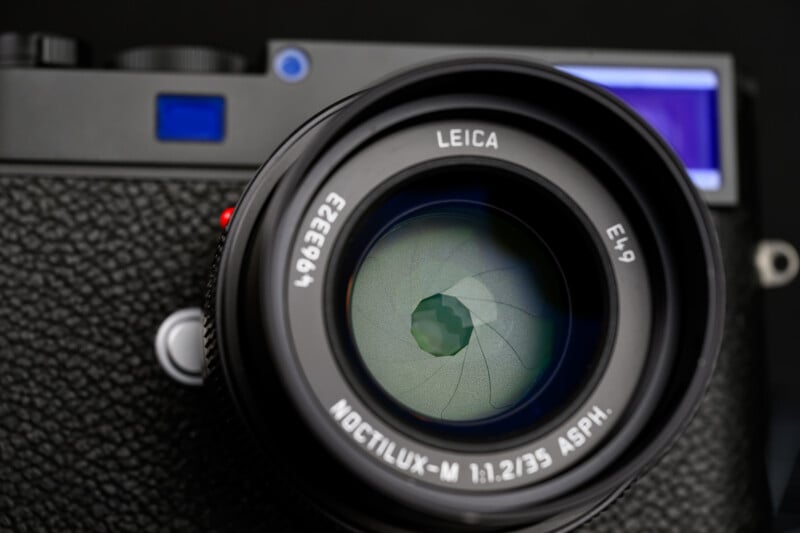
Close-up of a Leica camera lens showing the aperture blades. The lens markings read "NOCTILUX-M 1:1.2/35 ASPH." The camera body is partially visible with a textured finish and blue highlights.
The aperture is never fully round with Leica lenses, which gives both character to the images while still creating gentle-looking bokeh.

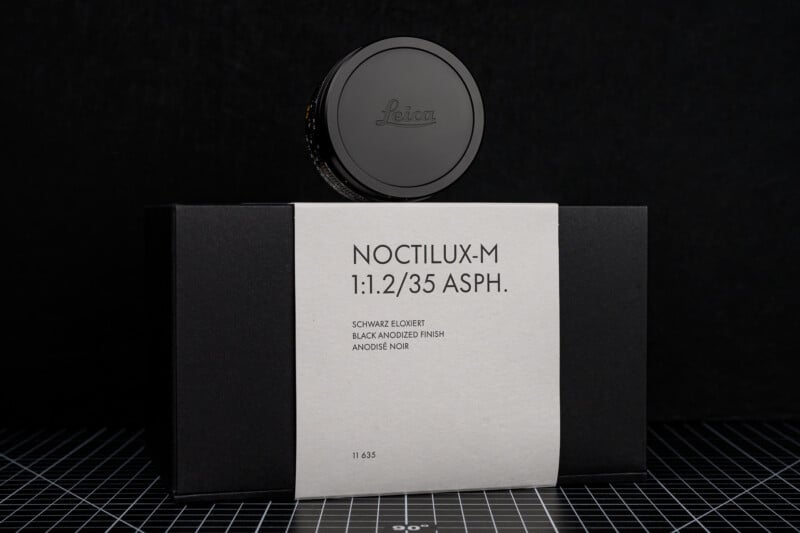
A black Leica camera lens with a cap stands on top of a black box labeled "NOCTILUX-M 1:1.2/35 ASPH." on a white band, against a dark, grid-patterned background.

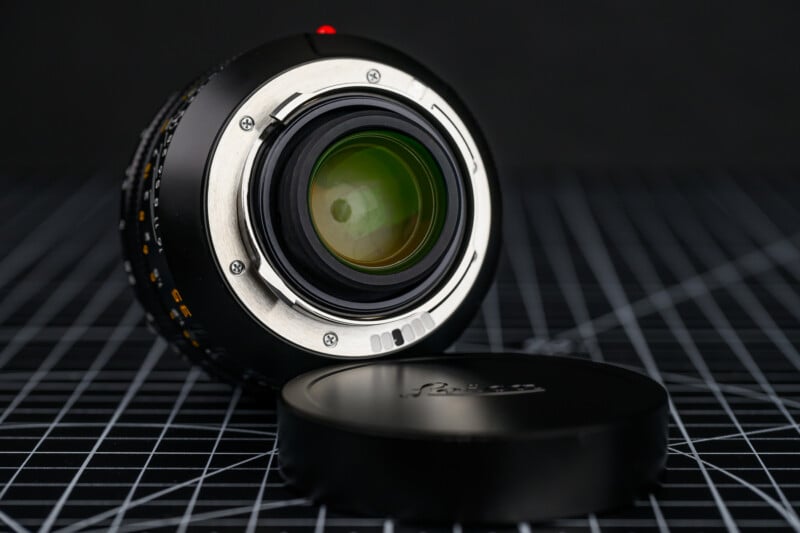
A camera lens facing upward rests on a grid-patterned surface, with its rear element and metal mount visible. The detached lens cap, labeled "Leica," lies nearby. The background is dark and out of focus.

Leica M 35mm f/1.2 Noctilux: How It Shoots

The controls on a Leica lens may be very simple, but the optical engineering involved can be quite sophisticated. Such an expensive lens has to have some serious optical chops, and the Noctilux incorporates three aspherical elements to maximize performance. Leica lenses also feature advanced multi-coatings to prevent flare, and I tested this thoroughly on a bright and sunny day.
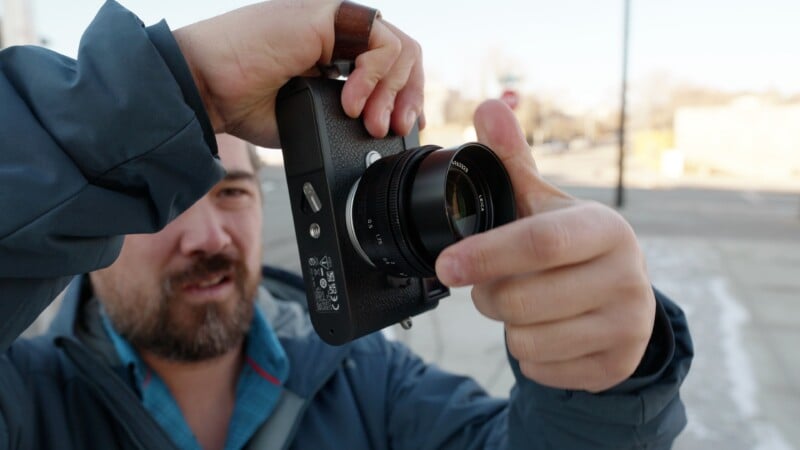
A person holding a camera close to their face, adjusting the lens and preparing to take a photo outdoors on a bright day. The background is slightly blurred, showing a sidewalk and some buildings.
The extendable hood is fancy and functional.
A man walks alone on a city sidewalk in the sunlight, casting a shadow on a stone pillar. Another person sits on a bench in the background. A trash can is in the foreground. The scene is in black and white.
I took the 35mm Noctilux out for a walk and found it to function flawlessly.

A metal drain cover on a paved surface with dramatic shadows of railings or bars stretching across the ground in black and white.

A mural of colorful flowers, including one labeled "Saffron," is painted on a white brick wall in a narrow alleyway. Sunlight casts warm highlights on the wall and flowers, with trees and buildings visible in the background.

I was very impressed by the overall lack of any flare issues, especially because ultra-fast lenses tend to suffer from plenty of optical compromises. Contrast is fully retained, even when shooting at f/1.4, and having the sun shining directly into the lens didn’t cause any unwanted reflections. Stopping the lens down usually causes ghosting to appear, but any colorful or bright areas were very minimal. Having the incorporated hood at my fingertips was very convenient and did a great job of blocking any errant light from the sides.

Fluffy, dried plant vines climb a metal trellis, backlit by sunlight. In the background, there are houses and a blue sky with a few clouds.
Flare was very well controlled and contrast is excellent.
Silhouettes of utility poles and a construction crane against a dark sky, with the sun shining through the structure and creating a starburst effect near the horizon.
You can have some fun with sunstars when you need to.

A tree with many small orange berries and sparse leaves stands against a clear, vibrant blue sky on a sunny day.

LoCA, or longitudinal chromatic aberration, is often an issue with ultra-fast lenses. I very much expected to see green and magenta color fringing in the out-of-focus areas of the image. However, the amount of LoCA was minimal. You will get some at f/1.2, although it is quite minor, and once the aperture gets even a little tighter, it goes away. In fact, the Leica 35mm Noctilux was largely free of any chromatic aberrations, which is a testament to its exceptional optical design.


A person’s shadow is cast on a fence in front of a beige brick building with graffiti, with a tall cell tower extending above the building against a clear blue sky.
The images out of this lens are clean, and free of chromatic issues.

A man with a beard and mustache, wearing a jacket, sits indoors holding a glass of dark beer. He gazes thoughtfully upward. The image is in black and white, with soft, blurred lights in the background.

Two glasses of amber beer with frothy heads sit on a wooden table, both labeled "Marda Loop Brewing Co." The background is softly blurred with warm lighting and a partially visible outdoor setting.

Bokeh was equally beautiful with a pleasant-looking cat’s eye effect at f/1.2 in the specular highlights, and a nice round shape to the highlights when stopped down. The 11-bladed aperture does not create a completely round aperture opening, so you can even get a fairly dramatic sunstar out of it. Backgrounds are nice and soft without any harshness or distractions. I especially like any 35mm lens when it has such a fast aperture because I can get up close to subjects, shoot at f/1.2, and really separate them from the background.

Close-up of a tree trunk with a sawed-off branch, wrapped in green string lights. In the background, blurred warm yellow lights create a soft bokeh effect.
Bokeh is smooth and round, with a pleasant cat’s eye effect towards the corners.

Numerous hourglasses hang from the ceiling by wires in an art installation. The photo is in black and white, emphasizing the shapes and patterns formed by the suspended hourglasses.

Close-up of dry, tangled branches with fluffy white seed pods against a clear blue sky, capturing a natural and autumnal scene.

So far, the Leica Noctilux had been turning out impressive results, so I, of course, wondered if it would be sharp as well.

At f/1.2, there was plenty of detail in the center of the image, and the contrast was excellent. This lens has no hint of dreaminess or diffusion at its widest aperture. Stopping down adds a little more detail, but this lens was clearly made to shoot effectively at f/1.2.

However, corners do exhibit a fairly strong amount of vignetting, and the detail drops off noticeably towards the extremes. Closing down a couple of stops will help clear up any darkening of the corners and provide far more consistent detail across the frame. I’m still very pleased with the results this lens gives at f/1.2, and I endeavored to do a large amount of my sample photos wide open.

Side-by-side comparison chart showing test patterns labeled "f/1.2" on the left and "f/2.8" on the right, with grayscale, color bars, and images of a woman's face and currency for sharpness testing.
Detail at f/1.2 is excellent in the center of the image.
Side-by-side comparison of two photos showing a Canadian one dollar bill and focus test chart. Left image labeled "f/1.2," right image labeled "f/2.8." Differences in sharpness and focus are visible.
Corners will show vignetting and softness at f/1.2 but that quickly goes away.

A mostly empty room with sunlight streaming through a door and large windows, casting strong shadows on the floor and walls. A small blue dustpan and broom are on the floor near the light. Reflections show cars and buildings outside.

A person with long red hair walks past a white garage door labeled "LOADING BAY" on a city sidewalk, with sunlight casting sharp shadows on the building.

A café counter with blue and white patterned tiles, two red poinsettia plants in red pots, bakery display cases, and reflections on the glass window.

Leica has also designed the 35mm f/1.2 to focus closer than usual, with the ability to go to roughly half a meter in distance from the subject. There is a haptic click within the manual focus ring to indicate when this close-range focusing is engaged because the rangefinder will no longer couple properly. You can simply use the back LCD panel, the electronic viewfinder if you’re equipping it on the M EV1, or a Visoflex attachment. Keep in mind, even at this closer range, the frame is not macro by any stretch, but it can be nice for close-up portrait shots, for example.

A single tan slipper with patterned trim hangs on a bare tree branch, with blurred houses and a bright blue sky in the background.
You can focus quite close if needed, and the results are sharp.

Black-and-white photo of a checkered tile floor with sunlight forming a bright geometric shape on the wall. There is a white bench or table on the left and faint reflections on the shiny tiles.

Two mannequins dressed in formal wear stand behind a shop window, reflecting sunlight and buildings outside. The left mannequin wears a skirt and heels; the right wears trousers and dress shoes.

Leica M 35mm f/1.2 Noctilux: Exquisite and Expensive

The Leica 35mm f/1.2 Noctilux is going to be the best ultra-fast 35mm lens you can get for the M series right now. It is certainly an incredible optical achievement, and it has very few downsides when it comes to optical performance. I also appreciate that the lens is fairly compact and easy to take pretty much anywhere you may want to go. However, all of these benefits come with an incredibly high cost. At nearly $10,000, this lens is going to be a luxury purchase, even by Leica standards.

Close-up of rusty, metal stairs with textured surfaces and signs of corrosion. Light casts strong shadows from a railing across the steps, highlighting the rough and weathered condition.

A person walks alone through a shadowy alleyway with sunlight streaming in from the far end, creating a stark contrast between light and dark. Various storefronts and a car are visible in the background.

A person in a black jacket stands on a sidewalk near the street, while another person sits on a bench. Cars and buildings line the background on a sunny day.

As a reviewer, I find myself always having to talk about exorbitant Leica pricing with the caveat that it is Leica after all. A premium brand is going to have a premium price, and I don’t think Leica has to apologize for that. Anyone who purchases this lens will be pleased with the optical performance and images that they get out of it, and will likely feel that the expense is justified. However, there is no denying that the Voigtlander Nokton 35mm f/1.2 is so similar to this Leica 35mm both optically and in size and weight, and yet costs only a tenth of the price. By all accounts, the Voigtlander is sharp, resistant to flare, and creates beautiful bokeh, while also being well-made.
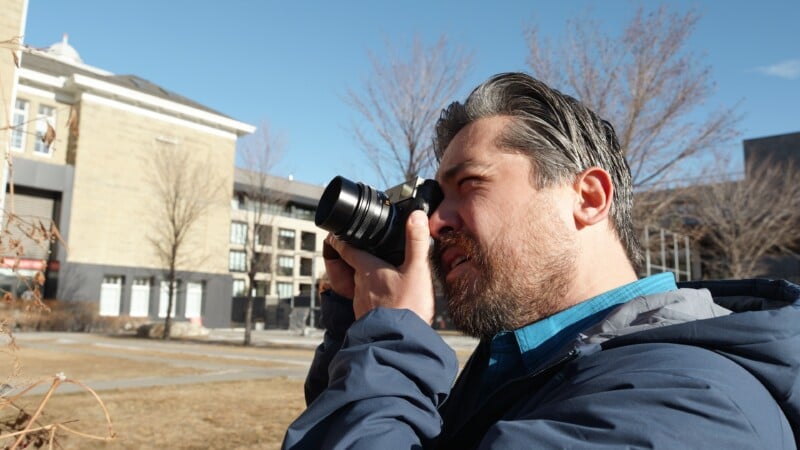
A man with gray hair and a beard wears a blue jacket and holds a camera up to his eye, photographing outdoors on a sunny day with trees and buildings in the background.

Are There Alternatives?

The clear choice is the latest Voigtlander 35mm f/1.2 Nokton IV, which has been through multiple updates and is widely loved. It will cost only a fraction of the price and deliver nearly as good a result.

Should You Buy It?

Yes. Diehard Leica fans will be paying for an amazing example of what the Leica design house can produce, and the lens is about as good as you could ever hope it to be.
Discussion