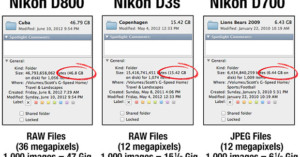
The megapixel war is heating up again in the high-end DSLR market, with the 36MP Nikon D800 leading the charge and rumored high-MP Canon and Sony competitors on the way. If you’ve been drooling over massive megapixels, be warned: with great megapixels comes great responsibility storage costs. Photoshop guru Scott Kelby writes:
I was reminded this week how large the file sizes are for images I shoot with my Nikon D800. I grabbed a hard drive to copy around 1,000 images I took in Cuba, and I was shocked to see that it wouldn’t fit on the drive because it was a whopping 43 Gigbytes!!! I looked at what the Raw files were from my Nikon D3s, and for around 1,000 Raw files it was 1/3 the size (around 15GB) and for the same number of JPEGs from a similar camera it around 6GB. I’ll shoot more than 1,000 photos at any given football game in just three hours (glad I’m shooting JPEG).
If you’re planning to buy a high-MP DSLR this holiday season, you should also be thinking about stocking up on external hard drives as well.
It’s “Lots of Quick News” [Scott Kelby's Photoshop Insider]

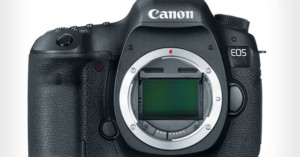
PhotoPlus is going down over in New York City in the second half of this week, and that’s when we might be hearing a peep out of Canon regarding its rumored high-resolution DSLR. If there’s any mention of the camera at all, it will probably at most be an “in development” announcement that confirms rumors but doesn’t reveal too much else.
Read more…

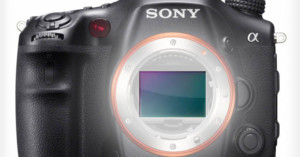
It has only been a month since Sony announced its latest flagship full-frame camera, the A99, but rumors are already beginning to emerge regarding the company’s next top-of-the-line offering. sonyalpharumors writes that Sony has reportedly marked sometime between May and June 2013 as a tentative release date for its next high-end full-frame:
The camera will be more “photographer” oriented. There are currently a couple of different prototypes. One we heard of has a 36 Megapixel sensor (same as Nikon D800) and built-in vertical grip. Priced well above the current Sony A99. A second prototype has a new 50 Megapixel sensor which goal is to go as close as possible to a “medium format” quality.
The new camera wouldn’t be intended to replace the A99, but would instead become the flag-bearer by creating an entirely new tier in the Sony lineup. If the latest rumors pan out, then 50 megapixels may soon become the new standard resolution for flagship DSLRs; Canon is reportedly working on its own high-res (46MP) camera.
Update: Reader Scott Hutchison reminds us that back in May, there was a rumor that working on a “A1S” camera with a full-frame 36x36mm square sensor. Hmm…

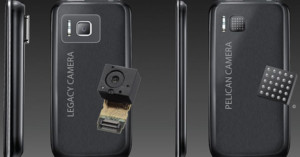
With the limited lens and sensor sizes of cell phone cameras, the megapixel race isn’t really doing much to improve the quality of the resulting photos. A new startup called Pelican Imaging thinks it can revolutionize the game by increasing quality without focusing on megapixels. Instead, they use an array of 25 micro-cameras to capture each image, processing the data into a single photograph with fancy software. If all goes well, future cell phones will be taking much nicer photos while still staying thin and compact.
Pelican Imaging (via GigaOM)

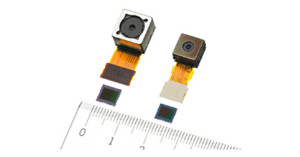
It was only at the beginning of the year that the megapixel race for cell phone cameras hit 14.6 megapixels, but now Sony has unveiled a 16.41 back-illuminated CMOS sensor that can shoot 15 frames per second at full resolution, and is capable of HD video recording (30fps at 1080p and 60fps at 720p).
Read more…

Remember the days when a 5 megapixel digital camera was considered top-of-the-line? I do. Remember the days when 570 megapixel digital cameras were the size of cars? That’s a question people might ask years from now, when the most basic pocket cameras boast hundreds of megapixels, and when we have petabyte external hard drives.
The “camera” shown above is one of the largest digital cameras in existence, created by Fermilab, a US national laboratory specializing in physics. It uses 74 CCD sensors to create 570 megapixel images of galaxies and supernovas. Scientists plan on using the $35 million dollar camera to map some 300 million galaxies.
Any guesses as to how long it will be before we’re paying $350 for a 570 megapixel compact digital camera? Will that day ever arrive?
(via PopPhoto Flash)