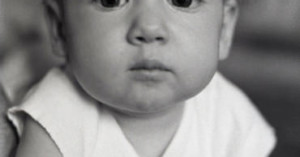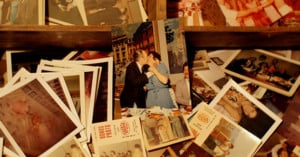
Ever since she entered the world 30 some-odd years ago, Alison has had her father Jack Radcliffe‘s camera pointed at her. Radcliffe, a Baltimore, MD-based photographer, started out by documenting her life casually as new parents commonly do, but slowly became more interested in the relationships involved in growing up. He writes,
My photographs of Alison, because of the nature of our relationship, are very much a father-daughter collaboration-Alison permitting me access to private moments of our life, which might, under different circumstances, be off-limits to a parent. The camera, early in her life, became part of our relationship, necessitating in me an acceptance, a quietness. We’ve never had long photographic sessions, but rather moments alone or with friends.
The significance of these pictures emerges in retrospect. I realize as I look at them, that I created a visual life story of Alison, capturing moments in her metamorphosis from infant to woman-her relationships with friends, her rebellion, and underlying it all, her relationship with me, a constant throughout her life. I wanted to photograph her in all her extremes, and to be part of these times in her life without judging or censoring. Only in this way would I have a true portrait of Alison.
The entire collection of photographs in the project allows you to look at decades of an individual’s life with one quick glance, and reminds us all of how quickly the years pass by. Read more…
Cesar Kuriyama spent a couple years saving enough money to take an entire year off from work — his 30th year of life. He spent that year living frugally, doing all the things he never had enough time to do: travelling, personal creative projects, and spending time with family. He decided to document that special year by capturing 1 second of footage every single day and creating a short compilation video at the end, similar to Madeline’s video that we shared back in January. After completing the year, Kuriyama now is planning to capture 1 second from each day for the rest of his life. This means he’ll have a 5-hour video summarizing 50 years of life if he lives to be 80, since every decade creates roughly one hour of video.
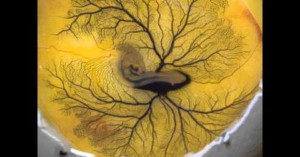
Anna Franz, a researcher at the the Sir William Dunn School of Pathology at Oxford, has won Nikon’s first annual Small World in Motion competition with an amazing video that shows the beating heart and blood vessels of a 72-hour-old chick embryo. Franz cut a window into an egg to expose the embryo, and then carefully injected ink into the yolk sac artery in order to visualize the beating heart and the vasculature of the embryo.
Art director Sean Ohlenkamp, his wife Lisa, and an army of volunteers spent many sleepless nights at Type Books in Toronto, Canada moving, stacking, and photographing books. The result was this beautiful stop-motion video showing books coming to life at night.
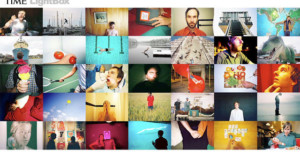
Toronto-based photographer Jeff Harris started a photo-a-day project back in 1999 in an effort to document his life through self-portraits. Since then, he has captured 4,748 beautiful photographs that show everything from reckless stunts to a fierce battle with cancer (warning: there’s a graphic image). Harris states,
I didn’t want 365 images of me sitting on the couch each day. There could have been that tendency, especially during the cold dark winter months to stay inside all the time, but this project inspired me to get out there and seek out interesting things.
[...] I see no reason to not make a self-portrait each day. I’m always around and always free. It’s kind of like going to the gym—it flexes your muscles and keeps you in shape. [#]
Harris is entering the 14th year of his project this year, and although his body is far from being the same as when he started this endeavor, his great photographic vision is still evident in each of his images.
Earlier this week, photographer Jeanine Thurston shared a letter that she received from a client that powerfully illustrates the value of photography. Thurston writes,
This letter wasn’t mailed – it was at my doorstep when I got home a couple months ago. I read it, I cried, and read it again – probably a hundred times by now. It wasn’t easy to read – and honestly, as much as it validates what I do for a living – I wasn’t sure I was going to share it either. If you choose to read through the letter, you will know why I’ve finally chosen to share it.
The post quickly went viral and has amassed hundreds of comments from fellow photographers who were impacted by the letter. Read more…
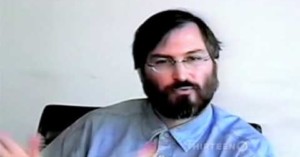
Here’s an old clip in which Steve Jobs talks about how he sees the world:
When you grow up you tend to get told the world is the way it is and your life is just to live your life inside the world. Try not to bash into the walls too much. Try to have a nice family, have fun, save a little money.
That’s a very limited life. Life can be much broader once you discover one simple fact: Everything around you that you call life was made up by people that were no smarter than you and you can change it, you can influence it, you can build your own things that other people can use.
Once you learn that, you’ll never be the same again.
All the most famous and powerful images captured throughout history were shot by ordinary human beings as well…
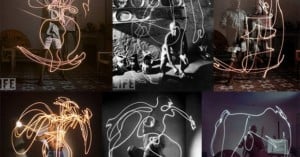
Did you know that Pablo Picasso was a light painter? His most famous light painting image shows him drawing a centaur in the air, but there are quite a few lesser-known photos showing the master dabbling in the art. LIFE writes,
Renowned LIFE photographer Gjon Mili, a technical genius and lighting innovator, visited Pablo Picasso in the South of France in 1949. Mili showed the artist some of his photographs of ice skaters with tiny lights affixed to their skates, jumping in the dark — and Picasso’s lively mind began to race. This series of photographs, since known as Picasso’s “light drawings,” were made with a small flashlight or “light pencil” in a dark room; the images vanished almost as soon as they were created.
Head on over to LIFE to check out a gallery of the light painting photos.
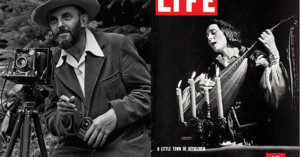
Did you know that in addition to making his famous landscape images, Ansel Adams made ends meet by shooting commercial work? Although he made photos for clients as large as IBM, AT&T, and LIFE, Adams didn’t like his job. In a 1938 letter to a friend, he wrote,
I have to do something in the relatively near future to regain the right track in photography. I am literally swamped with “commercial” work — necessary for practical reasons, but very restraining to my creative work. [#]
It was around this time that one of his photos was chosen for the cover of LIFE magazine — a cover that’s now considered one of the publications 20 worst covers. LIFE notes, that shortly after the issue was published, “the photographer stopped taking pictures of lutists and began photographing Yosemite.”