The Filmmakers Behind ‘Primetime’ Printed the Entire Movie on 16mm and Rescanned It

Primetime, a feature film about Chris Hansen and his hit TV show To Catch a Predator, keeps viewers gripped not just by the intense story brought to life by actors Robert Pattinson and Merritt Wever, but by the striking cinematography.
One of the biggest reasons for its distinct filmic look is that director Lance Oppenheim and cinematographer David Bolen opted to shoot the majority of the movie on an Alexa 35 before printing it onto a 16mm Kodak 50D and rescanning it to 6K, a process known as digital-to-film-to-digital.
Writing for American Cinematographer, Bolen explains that he shot most of the film at 6400 ISO to “add as much noise and texture as I could.”
The crew used London-based Cinelab, which has a third-generation 16mm Cine-Mitchell recorder built in-house. Once the film print was created, it was scanned back into digital using an Arriscan, which delivers “perfect edge-to-edge focus.” The resulting footage was then regraded.
“Primetime is also a period film, in a way, and working with the film print helped make the visuals far more immersive,” says Bolen. “Any feeling of artifice in the image seemed to disappear after printing to film.”
Bizarre Cameras
However, the film wasn’t shot entirely with the digital-to-film-to-digital method: Oppenheim and Bolen utilized a few obscure, frankly bizarre, cameras as they searched for a way to recreate that early 2000s aesthetic and also communicate the plot to the audience.
One such camera was a 2005 MiniDV camera, the Panasonic AG DVX 100B. Bolen used this for the hidden camera shots, and it is a very similar technology that was used to film the original show, To Catch a Predator.

“These cameras are a challenge, because unlike modern cinema cameras, they can’t shoot in a LOG color space,” Bolen says. “We didn’t really alter their baseline settings; we decided to lean into the cameras’ built-in contrast. To Catch a Predator has such a strong look, and we tried to match it as closely as possible in-camera. Even in the final grade, we made very few adjustments.”
But that distinct look posed a problem in the editing room: how to blend the shots taken by different cameras together. After all, DV cameras are not cinematic.
“We couldn’t get them to match,” says Bolen on the Mark Bone YouTube channel. “Like, no matter what we did with the settings, some would skew red, some would skew green, on some the exposure seemed off.”
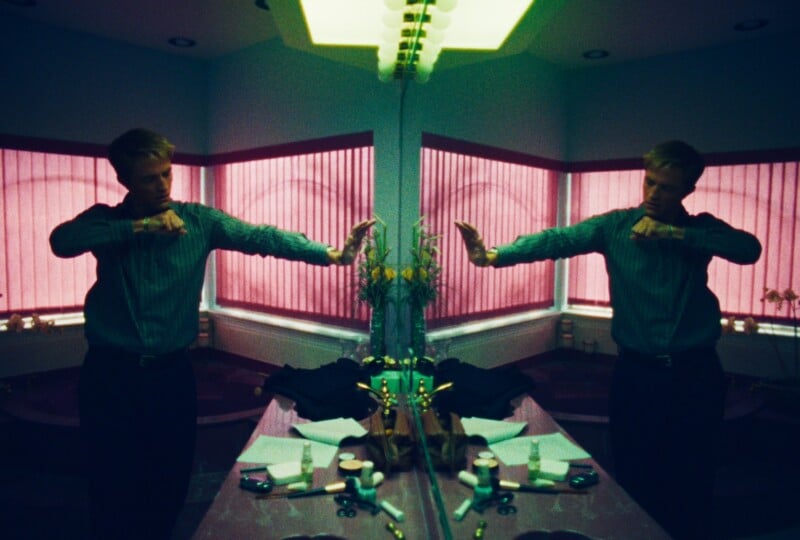
But Oppenheim didn’t care and threw the rules out of the window. In fact, he would film the same scenes on different cameras, and then in the edit, choose whichever one he liked.
Speaking of other cameras, there were two more that Oppenheim and Bolen used: a Plumbicon tube camera and a medical camera — the kind used for colonoscopies.
Archer Green points out that the Plumbicon tube camera actually dates back to the 1980s.
“It was meant to serve as a ‘spiritual’ camera rather than a period-accurate one,” Bolen writes for American Cinematographer. “These cameras use vacuum RGB tubes that split light into red, green, and blue, and the beautiful thing is that the tubes age and burn out over time. In a way, it’s a camera that feels like it has a soul — it decays over time, just like a human does.”
The creators of ‘PRIMETIME’ explain how they shot a scene using a 480p colonoscopy camera 🎥🤯https://t.co/Z8m4aT7YM0
— Complex Pop Culture (@ComplexPop) September 27, 2026
For one of the close-ups of Pattinson, Bolen used a doctor’s colonoscopy camera. The crew even built a rig to hammer home the effect.
“That was a scary one because that camera does shoot 480p and I was like, ‘How am I going to get this approved?’ But to A24’s credit [the film distributor], they were like, ‘this is awesome’,” Bolen says
“There are no rules. We don’t have to shoot 6K. 480p looks awesome on the big screen; I love it. It’s my favorite part of the movie.”
Image creditsA24
Affiliate Disclosure PetaPixel articles may include affiliate links; we may earn a commission if you buy through one.