

Researchers Pinpoint the Exact Location of First Ever Photo of a Human
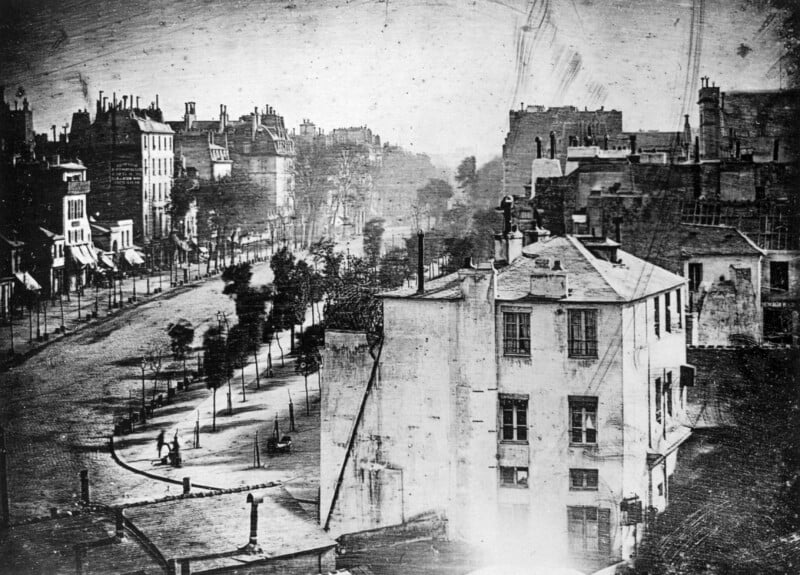
Researchers have pinpointed the exact location of Louis Daguerre’s 1838 View of the Boulevard du Temple — the first photograph to capture human beings.
188 years ago, Daguerre — the French scientist who invented the Daguerreotype process — set up his camera at the upstairs window of his Paris studio to photograph the street below.
At first glance, Daguerre’s image View of the Boulevard du Temple seems to show a deserted street, but two individuals were captured during the four- to five-minute-long exposure time.. These two people — a shoeshine boy and his client — inadvertently became the first two human subjects to appear in a photograph.
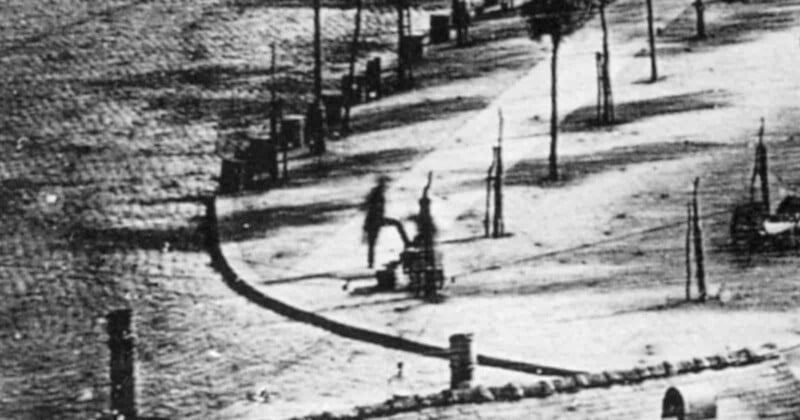
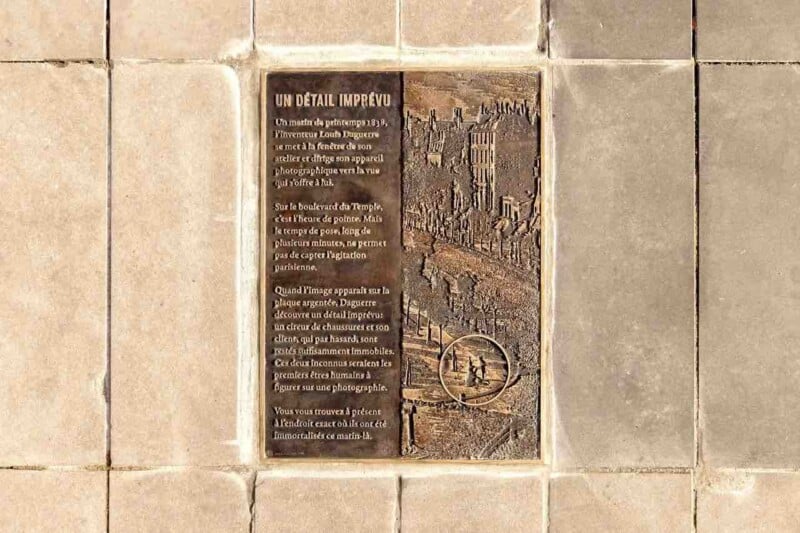
Three researchers, Maximilien Van Aertryck, Axel Danielson, and Kalle Boman, spent two years digging through historical archives and building 3D models of 19th-century Paris to work out exactly where Daguerre took his landmark photograph. Their research has now led to a bronze plaque being placed at the spot where the shoeshine boy and his customer were captured by Daguerre’s camera. The plaque at Place de la République has been installed as France celebrates its bicentennial of photography.
According to French news outlet Le Monde, the researchers first discovered that the archived version of Daguerre’s photograph was reversed. Like all daguerreotypes, it shows a mirror image of the scene as it appeared in real life.
To work out where the photograph was taken, Boman, Danielson, and Van Aertryck hired a surveyor to create a model of the neighborhood as it looked in 1838. The model drew on historical records from the Archives of Paris, including property and tax documents, maps, land surveys, prints, engravings, and paintings. Their research revealed that Daguerre’s studio stood on the site now occupied by the Caserne Vérines military complex.
The team also found that only three buildings from the original neighborhood survived the major redevelopment of Paris led by Georges-Eugène Haussmann during the Second Empire. These surviving structures provided reference points for two architecture firms, one French and one Swedish, which independently calculated where the shoeshine boy and his customer had stood. The pair are believed to have been positioned along the extension of Rue du Faubourg-du-Temple, close to the center of today’s Place de la République.
The Search for a Negative
The bronze plaque was installed to mark the site of Daguerre’s historic photograph and explains that the shoe shiner and his customer “are believed to be the first human beings to appear in a photograph.”
However, Boman, Danielson, and Van Aertryck aren’t finished with their research. According to a report by Radio France, a major challenge is that the trio faced is that the original photograph of View of the Boulevard du Temple has not survived intact. Daguerre sent the original plate to Ludwig I, King of Bavaria, in 1839, but it was badly damaged during Allied bombing in World War II. Today, the image is known primarily through a copy made in 1937 by Beaumont Newhall, a curator at New York’s Museum of Modern Art. The researchers are now searching for a negative that could help them get closer to the original image.
“In collaboration with the Bavarian National Museum and the Getty Center in Los Angeles, we are also reading and cross-referencing all the letters sent at the time, in which Beaumont Newhall asked the museum to take a photograph,” Van Aertryck tells Radio France. “They sent him the negative, and he apparently traveled quite a bit in the United States. He must be somewhere; we don’t know exactly, but we are continuing our investigation.”
Affiliate Disclosure PetaPixel articles may include affiliate links; we may earn a commission if you buy through one.


