Vivo’s Mid-Range V80 Smartphone Has Impressive Zeiss-Engineered Cameras
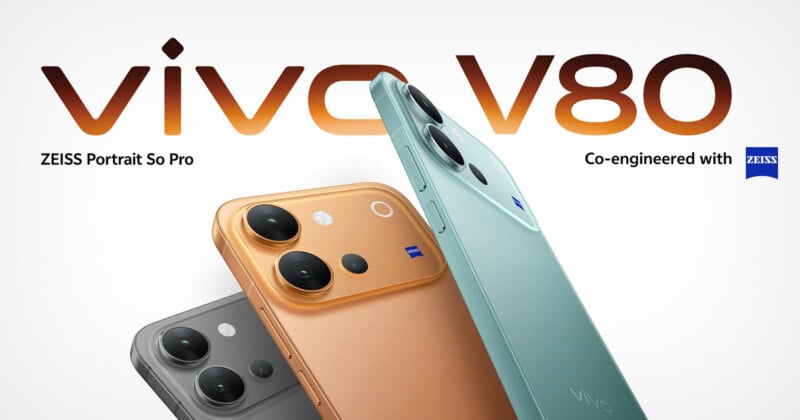
Vivo has announced the V80, a new mid-range smartphone with a camera system co-engineered by Zeiss.
Compared to Vivo’s recently announced X Fold6 and X500 Series smartphones, the V80 has a decidedly less advanced camera system. This is little surprise, given that the phone costs about 580 euros, or about $650, rather than the 720 euros ($810) of the base X500. The even better X500 Pro Max is about 910 euros ($1,020).
That said, the V80 still has reasonably impressive main and telephoto cameras. The 50-megapixel main camera has a Type 1/1.56 image sensor and a 23mm f/1.9 lens. The 50-megapixel telephoto camera is also solid on paper. It uses a Type 1/1.95 chip and a 73mm-equivalent periscope telephoto lens.
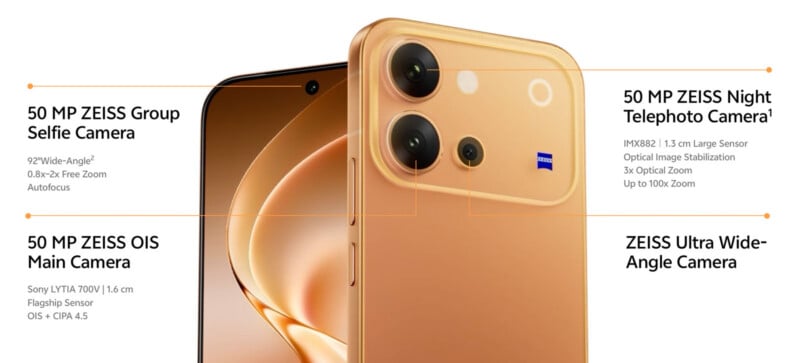
The V80 really fails to measure up with its ultrawide camera. This camera is only 8 megapixels, and although Vivo doesn’t specify the sensor size, it’s likely very small. It has a 115-degree field of view.
Zeiss Center-Stage Portrait mode replicates the bokeh of classic Zeiss lenses, including a 100mm equivalent mode with Planar-style bokeh and a soft, low-saturation tone, and an 85mm mode with Sonnar-style bokeh.
While these cameras match the V70 released earlier this year, the V80 embraces an all-new design. Vivo has unified its mid-range model into a single, one-piece design.
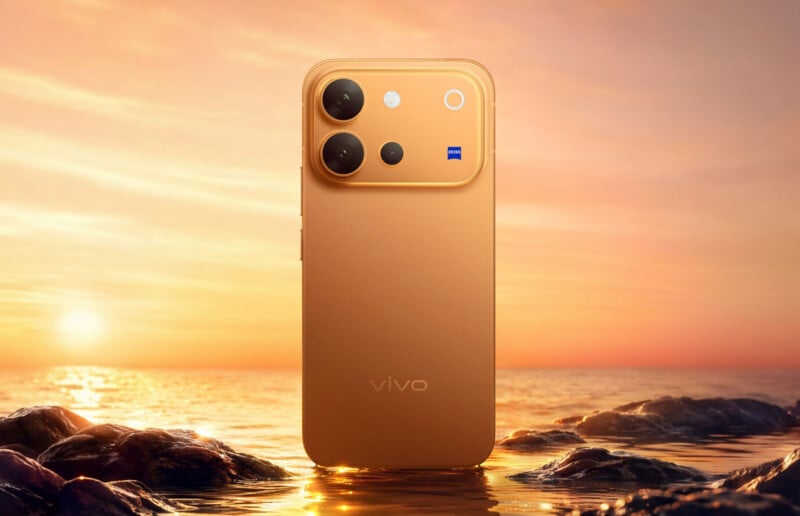
“Vivo V80 features a refined design that prioritizes comfort, durability, and visual simplicity. It uses Flagship One-Piece Cold-Carved Glass, in which the back and camera area are shaped from a unified piece of glass,” Vivo says.
“This creates a seamless transition around the Floating Camera Module, with a smooth surface that feels natural in the hand. Cold carving also makes the glass significantly stronger than traditional hot-bent glass, and its form helps protect the lens assembly during a fall,” the company continues.
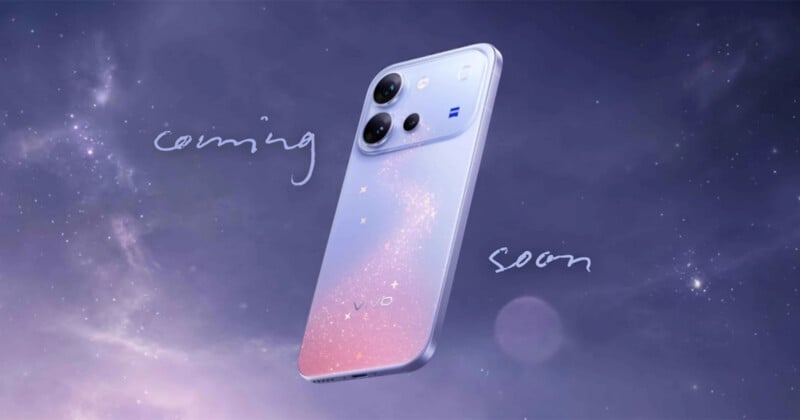
The V80 also marks the industry debut of a laser holographic lithography finish with the Starwish Purple colorway. The company spent two years testing over 20 custom materials to etch more than 3,600 4K-resolution images onto the back cover using nano-scale lithography. The result is a “True 3D Stellar Design” with what Vivo describes as real spatial depth. While it’s impossible to show in photos, the finish changes color and texture with every movement, and it looks like a star-filled galaxy.
The Vivo V80 has a 6.59-inch AMOLED display with a 5,000-nit peak brightness (locally). Its full-screen max brightness is 1,800 nits.
As mentioned, the Vivo V80 is about 580 euros, or around $650. It’s avaliable in some global markets now.
Image creditsVivo