NASA Photos Show Before and After of Massive Asteroid Impact on the Moon
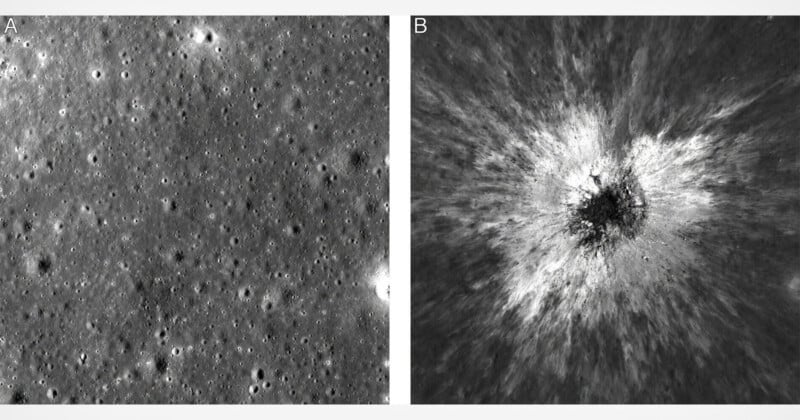
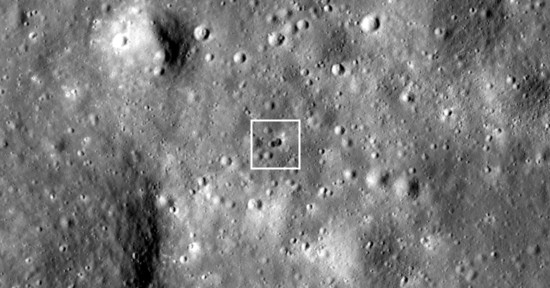
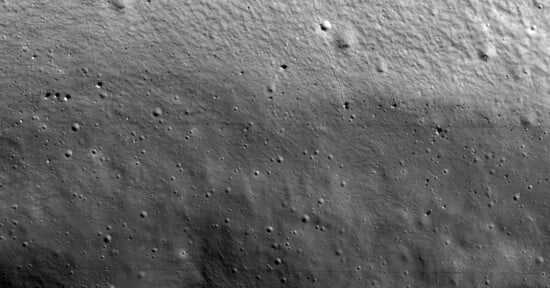
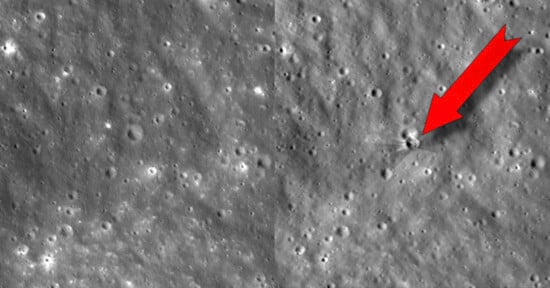
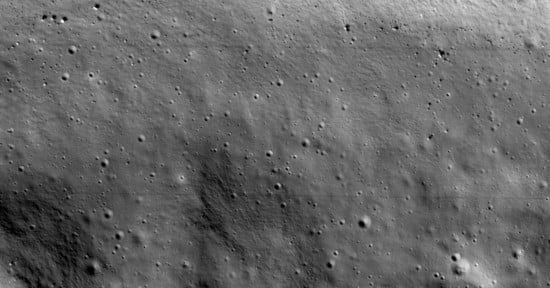
NASA scientists have published before-and-after photos of a newly formed crater on the Moon that provides an unusually detailed view of what happens when a large object strikes the lunar surface.
Named McGetchin crater after Thomas McGetchin, a former director of Houston’s Lunar and Planetary Institute, the crater measures about 728 feet (222 meters) across and reaches roughly 141 feet (43 meters) deep.
It is the largest newly formed impact crater identified by NASA’s Lunar Reconnaissance Orbiter (LRO), and researchers say an impact capable of producing a feature of this size occurs on the Moon only about once every century.
“This event constitutes a statistically rare, effectively once-in-a-lifetime observation,” the scientists write in one of two studies published in the journal Science Advances, per the Associated Press.
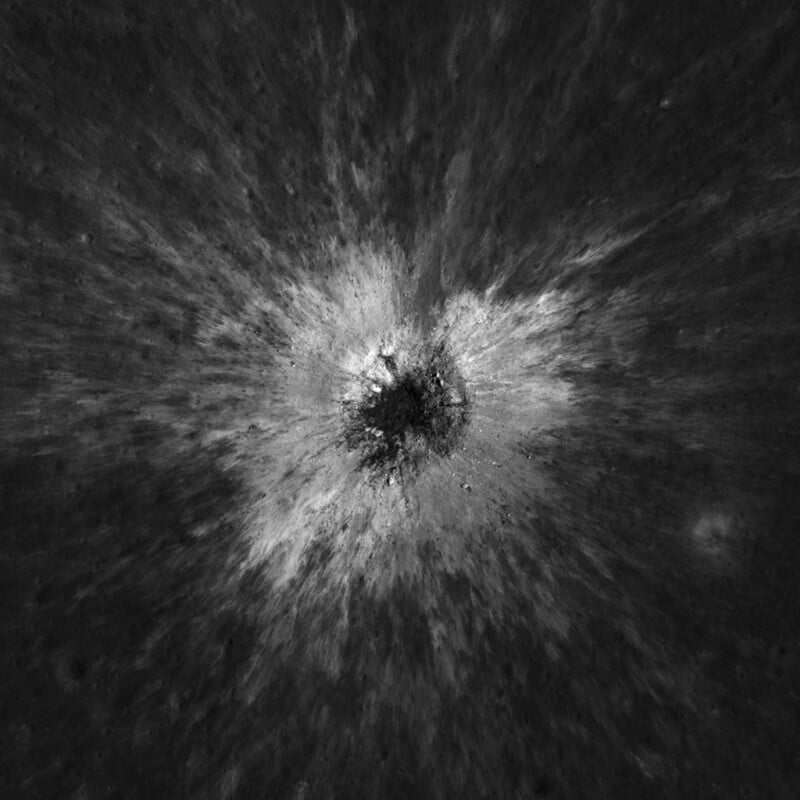
The crater formed sometime between April 11 and May 22, 2024, when a fragment of an asteroid or comet struck the Moon. The incoming object may have been several storeys in size. The impact occurred on the Moon’s near side but was not detected in real time by telescopes on Earth or in space.
The crater was eventually identified through LRO data. During a routine data-quality check in May 2024, LRO researcher Robert Wagner noticed an unusually bright area surrounded by a dark halo in a lunar map. The feature suggested that the surface had recently been disturbed.
“I just stopped, dropped everything, and started looking into what that spot was,” Wagner says in a NASA blog post.
The initial wide-angle LRO images were not recognized as evidence of a new crater until August 2025, when researchers identified the feature while examining the large volume of data collected by the spacecraft. Further observations provided higher-resolution images, and the discovery was confirmed earlier this year.
McGetchin is about three times wider than the previous record-holder for a newly formed crater found by LRO. The impact also affected a much larger area than the crater itself, throwing dust and broken rock across more than 60 miles of the lunar surface.
Most lunar craters are extremely old and have been modified by later impacts and the effects of exposure to space. McGetchin is different because researchers have images of the region from before and after the event. That gives scientists an opportunity to compare the surface directly and study changes that would otherwise be difficult to distinguish.
The crater is also located near the boundary between the moon’s darker basalt-covered plains and its brighter highlands. Researchers say this setting could allow future missions to examine how the same impact process affects different types of lunar terrain.
A rover or crewed mission could provide observations that cannot be obtained from orbit alone.
“Observations from the surface would be really valuable because they would allow us to correlate what we see and map from orbit with small-scale changes to surface texture, the distribution of ejected material, and other properties that can only be studied in detail from the surface,” Tyler Powell, lead author of one of the studies, tells Space.com. “This would improve our understanding of many aspects of the impact cratering process.”
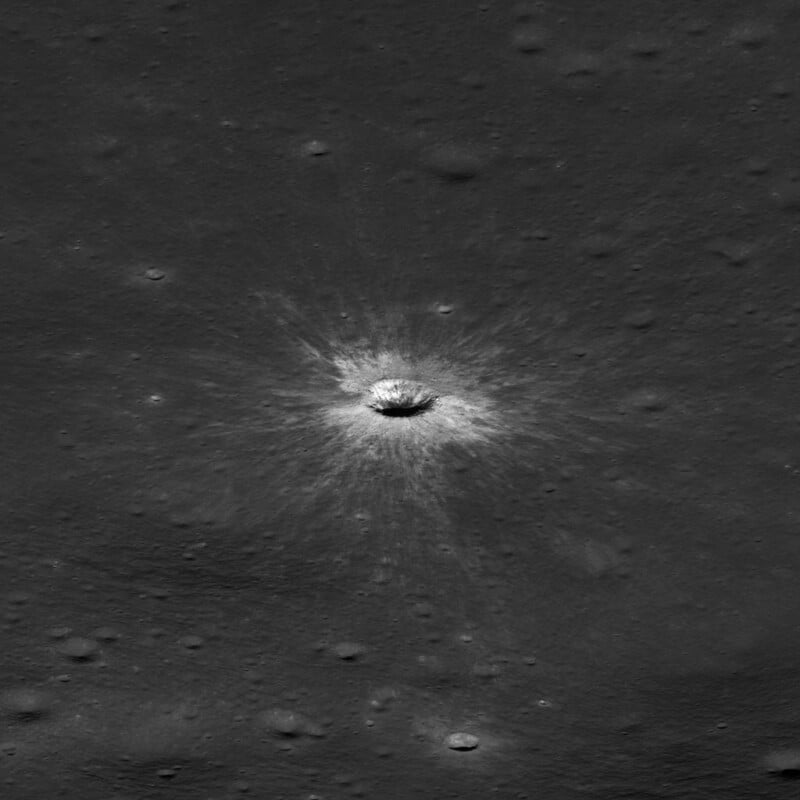
Earlier this year, the LRO photographed another lunar crater. This one, however, was manmade, created by a SpaceX rocket.
Affiliate Disclosure PetaPixel articles may include affiliate links; we may earn a commission if you buy through one.