While At First Unimpressive, Rollei Superpan 200 Is a Bag of Tricks
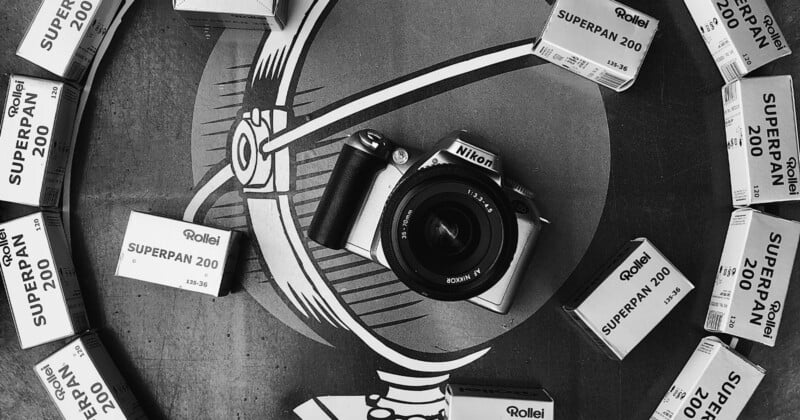
Rollei Superpan 200 is a curious sort of film, making it all the better reason to feature it today. The first impression we would give you of Superpan 200 is that on the surface it can be easily unimpressive, but dig a bit deeper and Superpan quickly reveals that it has quite a bag of tricks at its disposal.
Rollei Superpan 200 is a super panchromatic black and white film that not only has sensitivity out to about 775nm but also cuts off dramatically at the other end of the spectrum, right about 340nm (more on that below). Additionally, Rollei Superpan boasts a very clear polyester base that has helped earn it the title of successor to the famed Agfa Scala 200 film as a prime candidate for reversal processing. We’ll talk a bit more about that below as well, but first let’s cover just the basics of Rollei Superpan 200.
Despite the Rollei brand name, the film is made by Agfa-Gevaert in Belgium and distributed by Maco Direct in Germany. Rollei has little to do with this film other than licensing its name.

Rollei Superpan 200 seems to be identical to Agfa Aviphot Pan 200, which is an industrial, technical, and aerial surveillance film. We say “seems to be” because the two share the same data sheet, but in the world of European film manufacturing and the somewhat opaque deals involved, you never quite know for sure, and we hesitate to present what are essentially well-educated guesses as being too certain.
Whether Maco Direct simply buys rolls of Aviphot Pan 200 and has them reboxed with their brand name, or if they have a special contract for Agfa-Gevaert to coat special batches to their tweaked specifications using the Aviphot emulsion, we cannot say for certain. Generally speaking, it is safe to assume that the two films are more or less interchangeable. This is important to remember because if you go searching the Internet for 4×5 sheets of Rollei Superpan 200 you don’t turn up anything. However, if you instead search for Aviphot 200 4×5 you can find boxes of the stuff on eBay.

While knowing a bit about the history of a film can be helpful, let’s set Superpan’s origins aside now and concentrate on what you can do with the film today.
Yes, you can shoot Rollei Superpan straight up, unfiltered, as a normal black and white ISO 200 film. That said, this is not our preference.
It is cool to have another ISO 200 option out there as they are not common. You can count them on one hand, in fact: Fomapan 200 and Ilford SFX 200 (and now Kentmere Pan 200 and BWXX, more or less). When we are looking to shoot an ISO 200 film, we usually turn to Fomapan, or we will occasionally pull Tri-X a stop to serve that need. In short, Superpan 200 does offer another option in that category of speeds, but the results it brings in this fashion generally aren’t what gets us excited.
So let’s get into where Superpan 200 does deliver interesting results: the infrared.
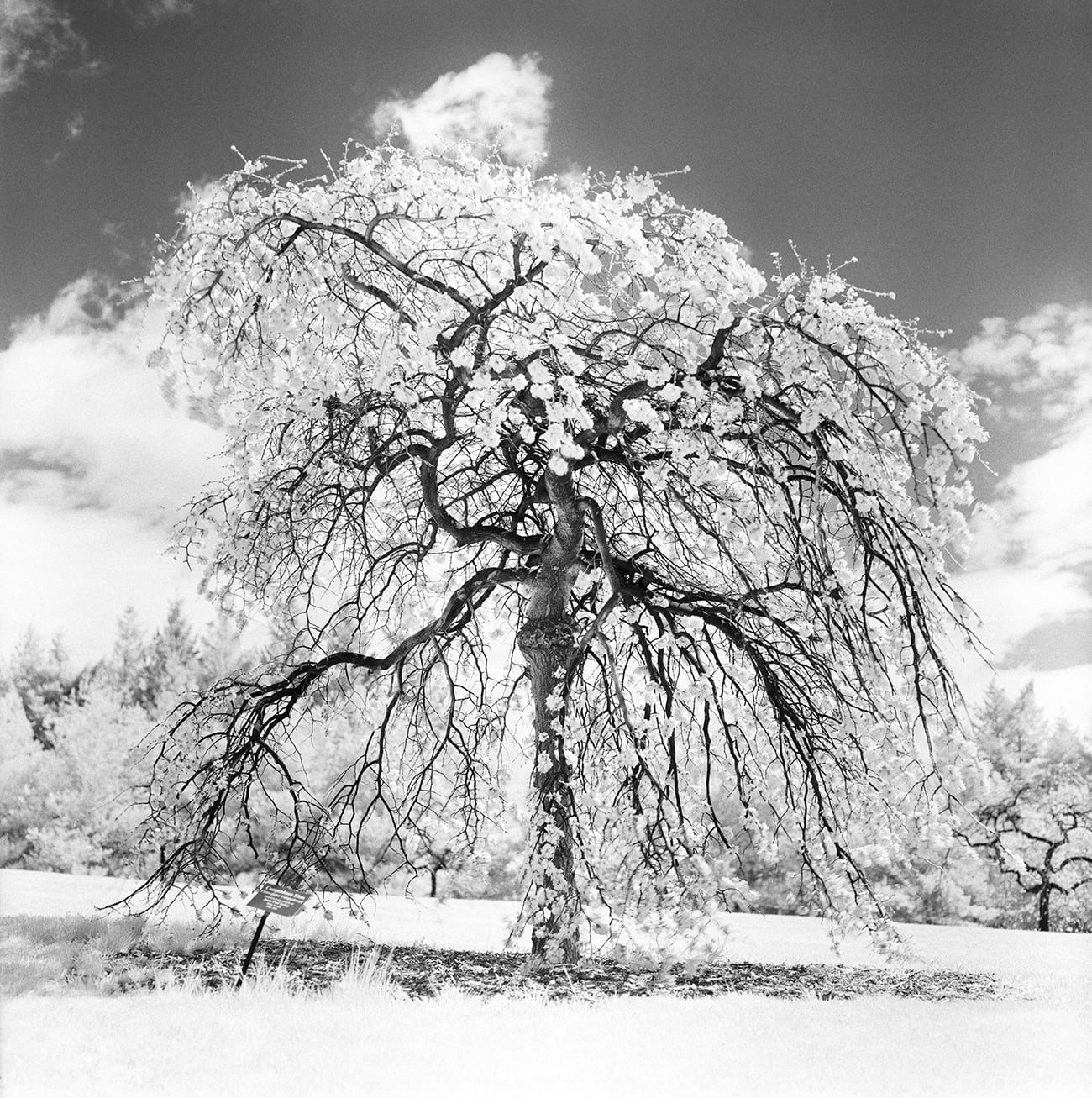
Every film should have a hook — that reason you show it to another photographer and say, “you really have to try this stuff because ______.” With Superpan 200, its hook for us is its infrared capabilities. There are a few other black and white infrared films out there on the market, most notably Ilford SFX and Rollei Infrared, so it’s worth comparing Superpan 200 to those two films as a means of helping place it in this context.
In regard to Ilford SFX, Superpan 200 has roughly the same level of IR sensitivity, as both films extend out to about 750nm. Each can be used in pretty similar fashion for making infrared images. Both films are also available in 35mm and 120. Grain is where they differ, with Superpan 200 being so much less grainy than SFX.

Meanwhile, Rollei Infrared has the higher IR sensitivity, stretching out to about 820nm but, counter-intuitively, Rollei Infrared seems to slow down more behind IR filters. This is perhaps due to the sensitivity it has at the very far right end of its sensitivity scale and translates into filter factors. When we shoot Rollei Infrared, we typically use an R72 filter and rate the film at about ISO 6: a six-stop filter factor compensation from the film’s “native” ISO 400.

With Superpan 200, we initially exposed it with the same six-stop factor and quickly noticed we were producing overexposed negatives, so we dialed that back to a five-stop factor. Thus, we rate Superpan 200 at the same ISO 6 as we do Rollei Infrared behind the same type of filter. A point in Rollei Infrared’s favor is that it is available in 4×5 sheet film. As an aside, there are some theories out there that Rollei Infrared, Retro 400S, and Superpan 200 are really all the same film. The fact that it exposes the same at ISO 6 as Rollei Infrared behind an R72 may or may not be a point in favor of this theory.

For those new to infrared photography, allow us a quick digression to explain how filtering infrared films work. Infrared films are what are sometimes called “super panchromatic.” They have sensitivity not only to the visible spectrum of light but also beyond the red end and into near infrared. When you use infrared film without any filters, you pick up exposure both from visible and infrared light, with the former typically drowning out the exposure of the latter.
The typical process with infrared film is to place a red, or deep red, filter in front of the lens to block out as much of the visible exposure as possible, allowing through only the IR light to expose the film. This is how you produce images that have the “wood effect” where vegetation glows a snowy white. Using infrared film with only a red filter will darken blue skies and make skin glow but typically will not produce the white grass and leaves you see in the IR examples here. The catch is that those deep IR filters cut out a lot of light and therefore require a lot of extra exposure, hence the filter factor we mentioned above.


While we worry we may be pigeonholing this film a tad, its strength really does lie in making infrared images, much in the same way that most photographers don’t use Rollei Infrared for “normal” black and white photography. But Superpan 200 does have another arrow in its quiver worth mentioning, and that is as a successor to Agfa Scala 200 for reversal processing.
Agfa Scala 200 was a somewhat popular film over a decade ago (it is actually still around in a slightly different modern update, but that is a topic for another day) as a film optimized for black and white reversal processing. It is easy to think of slides as solely the realm of color photography, but it is in some ways easier to process black and white film as slides than it is color. While pretty much any black and white film can be reversal processed, not all do so equally.

Agfa Scala made its name as a film that produced beautiful black and white slides, and now Rollei Superpan 200 has taken up that mantle. A big part of it is that Superpan’s emulsion lies on a clear polyester base. The clarity of the film base is really important for black and white slides, as it is this clear base that will produce the film’s black DMAX. Any density and the resulting slides will suffer from blacks that are less deep and rich. But Superpan 200 also reversal develops into images with lovely tonality and sharpness. The country’s leading expert on black and white processing, the DR5 lab, praises Superpan 200 as being the closest thing out there to Agfa Scala. So it doesn’t have to be solely about infrared photography with Superpan 200, this stuff would be a great candidate for experimenting with a roll of black and white slides as well.
If this is something you have never tried, we cannot recommend it enough, they are things of beauty. We don’t have any samples to share with you, but honestly, even if we did, mere digital scans would never do the depth of the original slide justice. Take our word on it and make it a goal to process a roll of Superpan as slide sometime this summer. You’ll be glad you tried it.
Let’s round out some of Superpan’s other features now as a way of wrapping this review up. In terms of grain, we would say that Superpan is average. We wouldn’t call it fine grain, but it also is not normally quite as grainy as most ISO 400 films either. It has a cubic grain structure, so it does have a classic look to it.
But Superpan is not a forgiving film.
It has a pretty narrow latitude and doesn’t really like much over- or under-exposure. We have noticed while shooting this film that it does not let you get away with nearly as much as most other black and white negative films will. Likewise, it doesn’t care to be pushed or pulled much. You can push it up one stop, and that helps bump the contrast, but we don’t recommend going beyond that. We also noticed that if you do err on the side of overexposure, Superpan 200 gets really grainy, really fast. So if you want a super gritty look, then overexpose and/or push the developing.

While Superpan may be quick to show grain, the film is also very sharp and seems very detailed. This would make sense given its history as a surveillance and industrial film where sharp detail is generally desired. In the process of prepping these sample images, we were frequently surprised by how sharp fine details were in the images as we zoomed in to clean up dust introduced during scanning. While we could not find any published data on resolution, having worked closely with many other black and white films in similar fashion, we feel like Superpan 200 does a good job of holding its own in this department.
Since a popular method of using Superpan 200 is for infrared photography behind a deep R72 filter, it is relevant to give mention to the film’s reciprocity characteristics. Again, there is no real official data out there, just collected experience from Superpan 200 users like us. Our experience is that Superpan 200 does pretty well for exposures between one and 30 seconds. As a rule of thumb, we add one stop of exposure in this range and generally end up with healthy negatives. In fact, some of those heavily overexposed images resulted in us adding more than one stop of extra exposure while also calculating a filter factor of six, instead of five, stops. The gist is that even though you will likely have to do some long exposures with Superpan of multiple seconds if you intend to shoot it IR, the film doesn’t mind much at all and requires an average, if slightly less, amount of correction for those long exposures compared to many other films.
That is our pitch/review of Superpan 200. While the film can be used in a few different ways, our favorite is clearly as an infrared film, and we’d encourage you to try it this way as well. The sunnier days make for great opportunities to do some infrared photography! Just make sure you pick up an R72 filter to get the full effect, or as deep a red filter as you can find. Word of caution though, we don’t recommend getting any IR filter beyond R72, otherwise you risk blocking out too much of the spectrum and ending up with blank film! That would not be any fun.

It is also worth mentioning that Superpan 200 is the middle sibling in Rollei’s Retro line of films that includes Retro 80S and Retro 400S. We will eventually do Film Fridays on both of these films as well, but much of what we said today applies equally to these other films as well, scaled up or down for their respective speeds. It is something to keep in mind.
Now get some film and get out there!
This story is brought to you by Blue Moon Camera and Machine in Portland, OR. Blue Moon offers film, development services, printing, and even an ever-rotating line of film cameras and lenses. PetaPixel Members receive 10% off all lab services with Blue Moon: Join today!
Image creditsAll photos are individually credited and courtesy of Blue Moon Camera and Machine.
Affiliate Disclosure PetaPixel articles may include affiliate links; we may earn a commission if you buy through one.