
How Intention Changes Your Photography
I was four years old when my parents took me on my first mountain climb, to the summit of Fairview Peak. By six, I’d climbed my first fourteener, Mount Sherman. Climbing became my proving ground for most of my childhood, and it set a foundation I wouldn’t fully understand the value of for another forty years.
Then life took me away from it: college, years lost to online video games, a marriage under strain. The birth of my son Quinn in 2007 was the wake-up call. In 2008, I set out to climb Colorado’s 100 highest peaks, known as the Centennials. The Centennials include the state’s 53 fourteeners but go well past them, into a list most people have never heard of. I finished ten years later, in 2018, on the summit of Thunder Pyramid, camera in hand, crying in a way that mixed real triumph with something closer to loss.
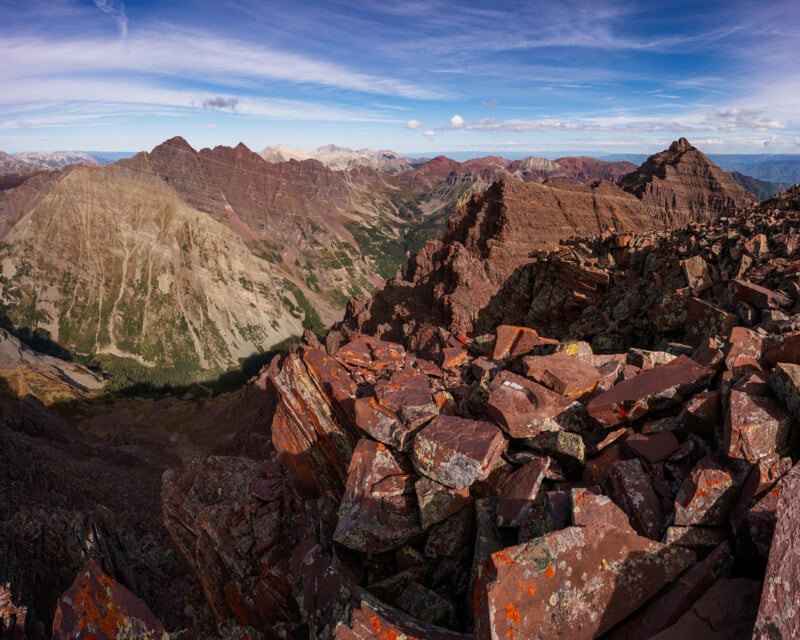
I went into that decade as a photographer. The goal was never just the summit. It was to come home from each one with a photograph worth the climb. What I didn’t understand until much later was that the project had never asked my camera a real question. Every peak carried the same assignment: get up, get the shot, move to the next one. Ten years of that made me disciplined. It didn’t make me curious.
The Conversation That Changed the Assignment
The shift didn’t come from the mountains. It came from a conversation on my own podcast. When I interviewed Sean Tucker for episode 334, he described Carl Jung’s idea of the two halves of life: the first half spent constructing an identity, buying the gear, learning the techniques, imitating the photographers you admire, and a crisis point later on when all of that stops being enough to answer the questions you’re actually asking. His words stuck with me since: everything you’ve built up until now, you eventually have to let some of it go to move into a greater openness where you find more meaning. He put it more directly too, asking the question underneath all the gear and technique: what am I actually after with this camera? What do I want to say with it? What legacy do I want to leave behind?
I remember telling him, in that same conversation, that I was thirsty to understand how to become more creative, how to extend the life of this pursuit, and how to tap into my own internal longings to make something that actually meant something to me. I didn’t fully know it yet, but I was describing the exact crisis point Jung named, the one where ten years of construction stops being enough.
Later that year I found myself standing at a genuine crossroads, deciding whether to leave a stable nonprofit leadership job for the uncertain life of a full-time photographer. That conversation was part of what gave me the confidence to also commit to something I’d wanted for years: hiking the entire Colorado Trail in one summer. Making the career leap and planning the hike happened in the same year, which was no coincidence. The Centennials were my first half: construction, accumulation, a decade of gear and discipline. The Colorado Trail was where I finally asked Sean’s question of myself.
What a Decade of Climbing and Photographing Peaks Actually Taught Me
I don’t want to undersell those ten years. They gave me the physical base, the preparation habits, and the stubbornness that made the Colorado Trail possible at all. In 2010, climbing Longs Peak and Mount Meeker with my father, I came across the remains of a climber named Jeffrey Rosinski, a 29-year-old pastor and father of two, who had died on that mountain. It shook me enough that I spent years afterward tracking and analyzing mountaineering deaths in Colorado, studying patterns in fatalities, not out of morbid curiosity, but to understand the fine line between adventure and tragedy well enough to stay on the right side of it. That project taught me real caution and real humility, and it likely kept me alive more than once.
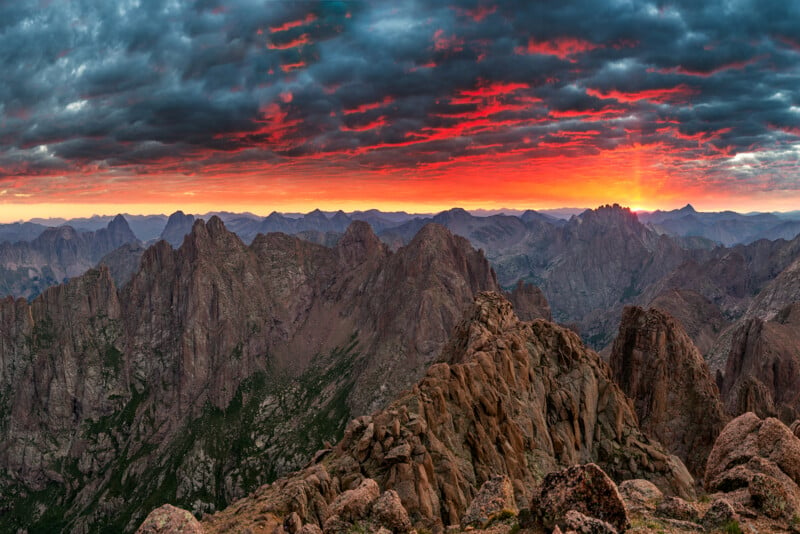
But even that project was reactive. It was research bolted onto a goal that was still, at its core, about finishing a list. My photography followed the same pattern: show up, respond to the light and the terrain in front of me, make the best image the conditions allowed. That’s a legitimate way to work, and most of my career has been built on it. It just isn’t a way of working that asks anything of you beyond skill and presence.
What the Colorado Trail Asked Instead
The Colorado Trail didn’t ask me to finish a list, or to bring home one good frame per peak. It asked me, every single day, what I was going to think about, and only then what I was going to photograph. Each evening after making camp, I’d set up a wireless mic and my Sony A7R5 on a tripod and record a reflection: how my body felt, what had happened that day, and a specific psychological or philosophical concept I’d chosen to sit with, some picked the night before, some chosen on the spot when the day handed me something I hadn’t planned for.
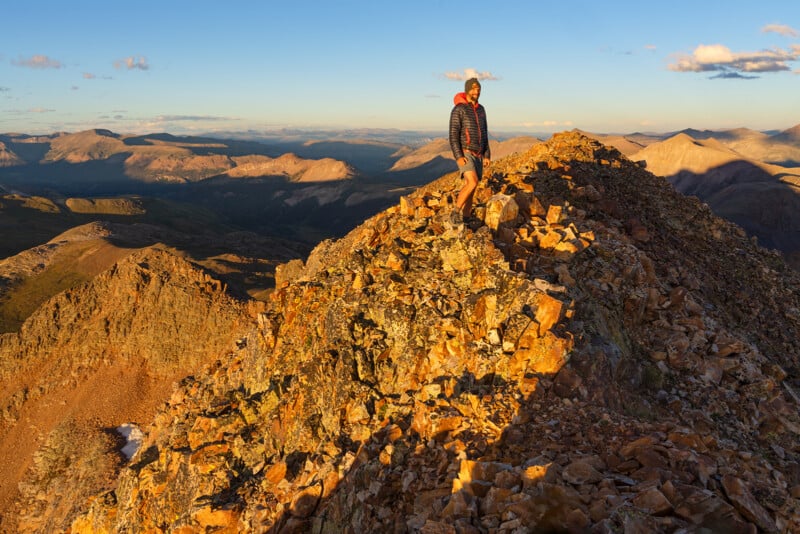
Before I left, I’d identified more than 50 peaks along the route as flexible “extra credit” climbs, knowing I’d never get them all, but giving myself room to chase the ones that made sense as they came. Through the San Juans, Sections 20 through 25, where the peaks were densely packed, I adjusted my plan constantly: shorter days, more food, more deliberate pacing, so I could climb and photograph without wrecking the hike itself. I ended up summiting 30 peaks along the way. That number exists because I’d decided in advance the peaks mattered enough to plan around, not just enough to photograph if they happened to appear.
Humility Found Me on Day 7 of the Colorado Trail
Not every lesson came from planning. On Day 7, after a cold, exhausting day of climbing in the rain, I got a cryptic text from a friend as I approached the town of Keystone. Over several miles, I convinced myself my wife and son had arranged to meet me there as a surprise. I built the entire reunion in my head before I’d earned any reason to believe it was real.
They weren’t there. I’d invented the whole thing out of exhaustion and hope, and I felt something I hadn’t felt in years: tears, over something that was never real to begin with. I’ve spent a long time priding myself on being even-keeled, someone who doesn’t get shaken easily. That afternoon taught me how much I actually depend on other people, whether I want to admit it or not. It wasn’t a concept I’d chosen to think about that day. It found me instead. In the weeks that followed, it’s also what pushed me to think harder about gratitude, not because the trail handed it to me directly that day, but because the letdown made me notice how much I lean on people I don’t always credit out loud.
Hormesis Gave Me a Word for What I Was Already Doing
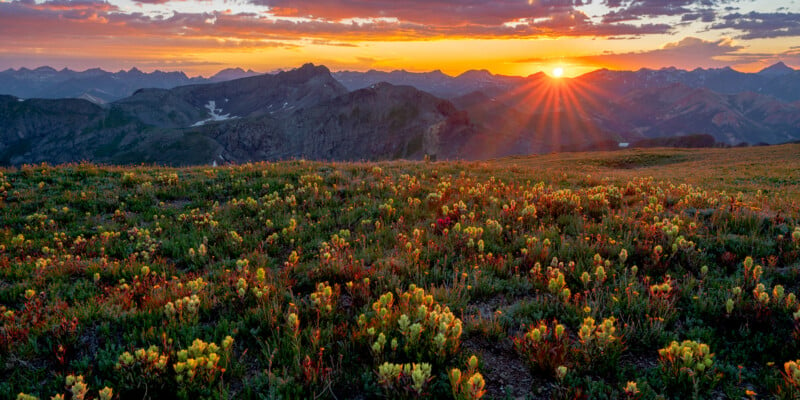
Days 24 and 25 were two of the hardest of the entire hike. Day 24: 16.5 miles, 5,200 feet of climbing, five summits including Baldy Lejos and Point 13,510. Day 25: 15.7 miles, two more peaks, a fox that walked straight up to me mid-photograph, and that night, a bull moose with a cow and calf twenty yards from my tent.
I’d been circling the concept of hormesis, the principle that small, controlled doses of stress make you stronger rather than weaker, alongside Anna Lembke’s research on why effort-based reward lasts longer than passive pleasure. Those two brutal days gave me the clearest possible evidence for both. The discomfort wasn’t a cost I paid for the reward. It was the actual mechanism producing it. I didn’t invent that idea on the trail. But naming it, out loud, into a camera, on the hardest physical days of the hike, changed how I experienced the exhaustion itself while reframing my personal relationship with the dopamine treadmill I never knew I was on.
From Video Footage to a Coffee Table Book
When I finished the trail, I had 35 nights of raw video reflections and no plan for what to do with them. The idea to make them into something more came almost a year later, when I saw a call for grant applications for the Inspired Creator award through Nic Stover’s Nature Photography Collective. I decided to apply, mostly on a whim, and winning it gave me a kind of permission I hadn’t given myself: the confidence to actually build the book, not just talk about it.
On a vidoe call, Nic pushed me to expand the scope further than I’d planned. My instinct was to make it a record of the Colorado Trail specifically. He encouraged me to widen it into the whole arc, the Centennials, the decade before the trail, the trail itself, and the psychology threaded through all of it. That conversation is the reason why my book, The Colorado Way, became an account of the entire journey rather than just 35 days of it.
What This Means If You’re Not Writing a Book
I don’t think the lesson is that every photographer needs to hike 500 miles, apply for a grant, and write a book. The lesson is smaller and more portable: deciding, before you start, what questions your photography is actually asking. Without that decision, you’re documenting whatever happens to be in front of you. With it, you’re building something, even if you don’t know yet what it is.
I spent a decade climbing mountains without asking myself that question once. I don’t regret it. But I know now what I was missing, and it’s changed how I approach every photography project since. Decide what you’re actually trying to understand before you start. The camera will still be there either way. The difference is what you’ll have to say about what it saw, and you never know where that approach might take you.
If any of this resonates, the full story, and the other twenty-four questions the mountains and the trail ended up asking me, are in my book The Colorado Way. You can read the Uncertainty chapter for free here.
Affiliate Disclosure PetaPixel articles may include affiliate links; we may earn a commission if you buy through one.