Some of the First-Ever Photos Taken in Space Have Been Lovingly Restored

After the Soviet Union launched the first satellite into orbit and followed it up by sending the first person into space, the U.S government responded by forming NASA, and later President John F. Kennedy declared, “We choose to go to the Moon.” The Apollo missions are famous, but they were preceded by Mercury and Gemini.
For photo restorer Andy Saunders, these early American efforts are treasure chests of source material for him to work with. Having previously released a book on the Apollo missions, he turned to Mercury and Gemini for his latest project — the missions that carried the first Americans into space.
Saunders trawled through 5,000 photographs taken by Mercury and Gemini astronauts, he looked for photographs that held beautiful aesthetic qualities, were historically significant, or just poignant photos that tell a human story. The entire process took three years.


Saunders reveals to the BBC Sky at Night Magazine that he was able to get access to the original negatives held by NASA. The photos are some of the first-ever taken from space of the Earth.
“The RAW files aren’t ready-to-view straight from the scanner, but buried within them is an extraordinary amount of visual information, just waiting to be revealed by applying digital processing, and some time and effort,” Saunders tells the BBC.
Like his Apollo project, Saunders also included data from the 16mm motion picture film the astronauts shot. He stacked the frames to bring out extra detail, a process he calls “painstaking” but rewarding.
“When color leaps to life, when long-lost detail reappears, it’s a thrill. It feels like archaeology: brushing dust off a hidden treasure and revealing something extraordinary buried for decades,” Saunders adds.


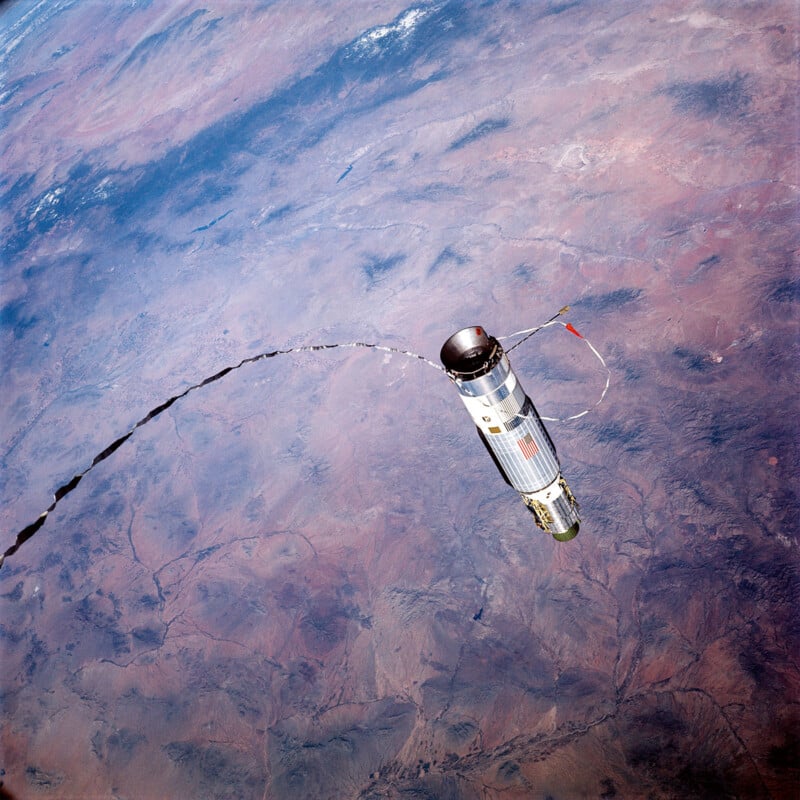
The Gemini missions are particularly noteworthy for the lofty altitudes achieved. Gemini 11 flew over 800 miles (1,290 kilometers) above the Earth, a record that was only recently surpassed in 2024 by Polaris Dawn. For reference, the International Space Station flies at 250 miles (400 kilometers).
“The photos have a unique aesthetic, clearly referenced in modern sci-fi. The suits and spacecraft look retro yet somehow futuristic,” Saunders says. “And the internal shots, now restored, of these brave astronauts risking everything, have an emotional depth that may never be replicated. All this, combined with the warmth and tonal richness of film, perfectly captures the era.”
No AI
Saunders is at pains to point out that absolutely no AI tools were used during his process, saying that doing so would undermine the entire project.
“This is historically important imagery, if you apply AI, all the provenance is gone. You can call it a piece of art if you’d like, but it’s not a photo,” he tells Space.com.
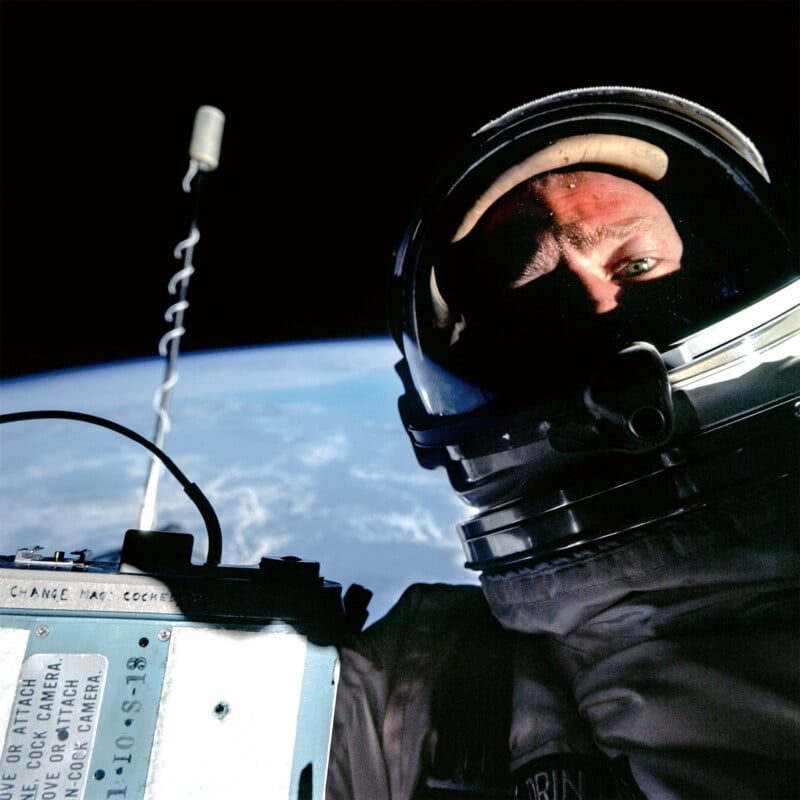
Saunders sees his Gemini and Mercury Remastered book as more than a restoration project. “It’s the visual record and the story of when we humans first left Earth, seen through the eyes of those who risked all to make it happen,” he says.
Gemini and Mercury Remastered by Andy Saunders is published by Black Dog & Leventhal Publishers in the United States, an imprint of Hachette.