Sony’s New 100mm f/2.8 Macro GM Is Its Best Macro Lens Ever
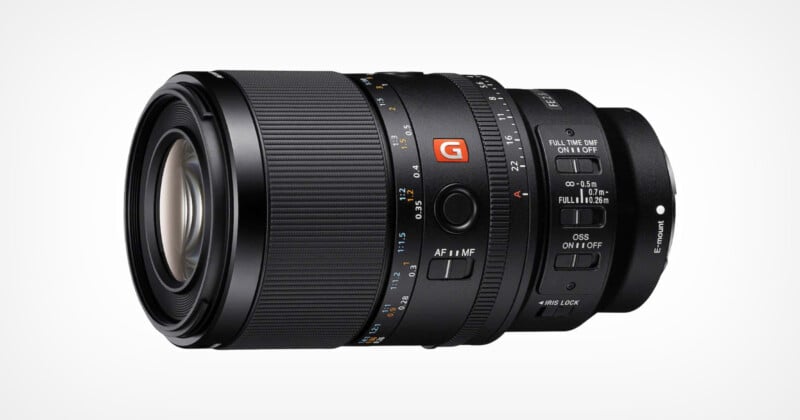
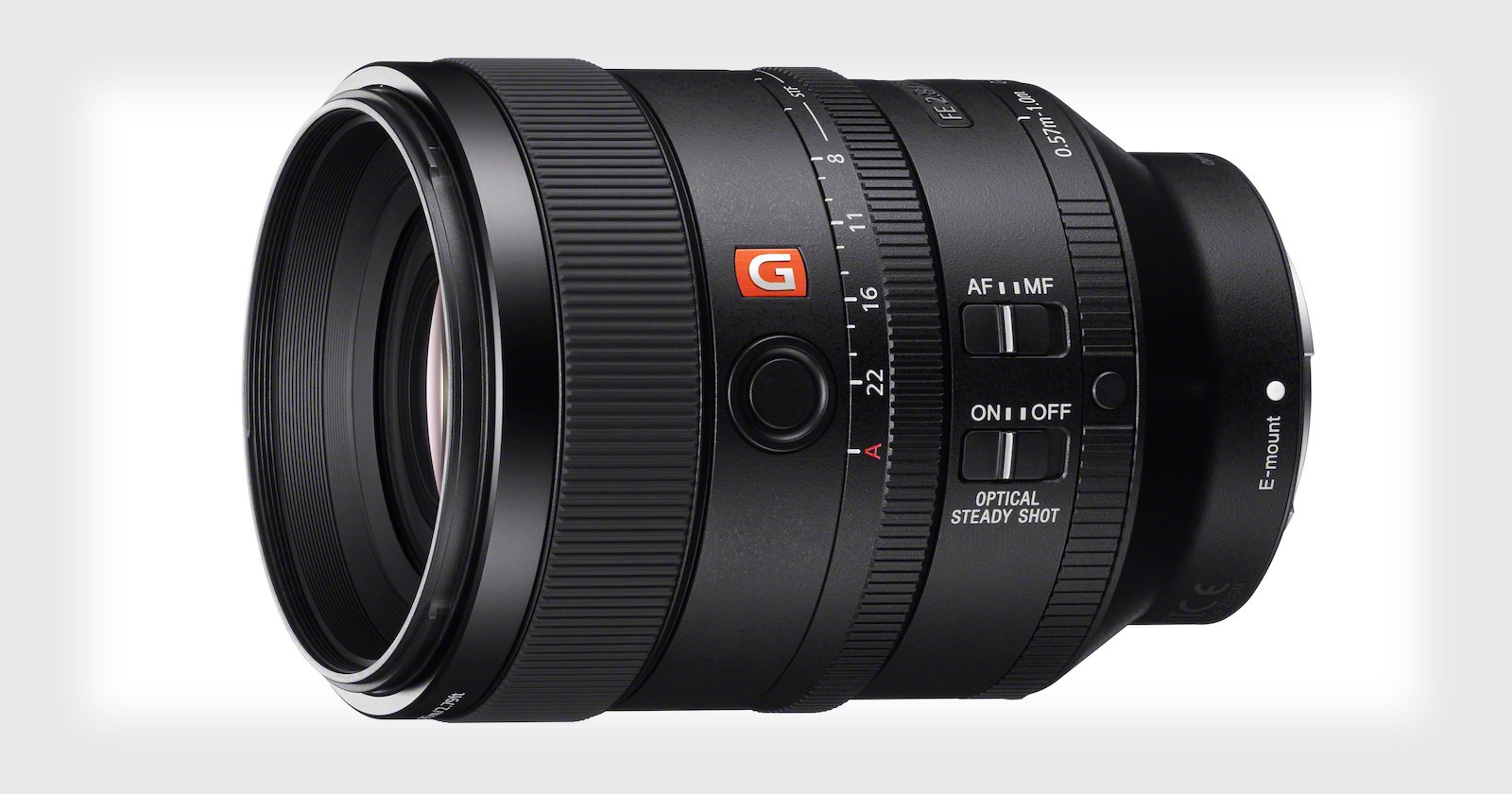
Sony has announced its first G Master lens dedicated to macro photography, the Sony FE 100mm f/2.8 Macro G Master OSS. It arrives a decade after Sony’s 90mm f/2.8 G Macro OSS, a lens celebrated for its excellent sharpness and close-focusing capabilities. Sony’s new lens promises to be superior in every meaningful way and aims to be the best macro lens for full-frame mirrorless cameras, period.
Sony’s First Macro G Master Lens Pulls Out All the Stops
The Sony 100mm f/2.8 Macro GM is built for demanding professional photo and video applications, and incorporates many of the optical technologies Sony has developed in the years since the original 90mm f/2.8 G Macro launched. Chief among these advancements is the move to a G Master design, which means the new macro lens features Sony’s best optics, including XA elements. The lens sports a pair of XA elements, ensuring that the bokeh is exceptionally clean and devoid of any onion ring artifacts.
Bokeh is a significant focus of all G Master lenses, as is exceptional sharpness and resolution across the focal plane. Although the new macro lens is designed for close-up photography, its mid-telephoto focal length should also work well for other types of photography, including portraits and weddings. In these cases, the lens must not sacrifice overall image quality for the sake of close-up performance. Sony promises that the G Master’s trademark sharpness for in-focus areas and softness for the out-of-focus ones will make the new 100mm f/2.8 Macro GM an excellent choice for non-macro photography. The lens features an 11-bladed circular aperture diaphragm.
In total, the lens features 17 elements arranged across 13 groups, including a pair of ED elements to suppress aberrations and fringing, in addition to the two aforementioned XA lens elements. The lens also features Sony’s Nano AR Coating II, which minimizes flare and ghosting in backlit scenes.
Autofocus, Close Focusing, and Stabilization
Another aspect of the lens that adds to its versatility is its autofocus system. Back when Sony launched the 90mm f/2.8 G Macro, it was still a ways off from developing its Linear XD autofocus motors. There are four of these motors, which Sony describes as the best in the industry, in the new 100mm f/2.8 Macro GM OSS lens. This means the lens is fully compatible with 120 frames per second photography on the Sony a9 III and 4Kp120 recording on select Sony cameras.
Sony promises quick, quiet, and, importantly, precise autofocus. The company claims that its new macro lens focuses 1.9 times faster than the 90mm f/2.8 Macro lens. However, real-world testing is necessary to gain a deeper understanding of the overall advancements in autofocus performance, including stability and smoothness, particularly at close focusing distances.
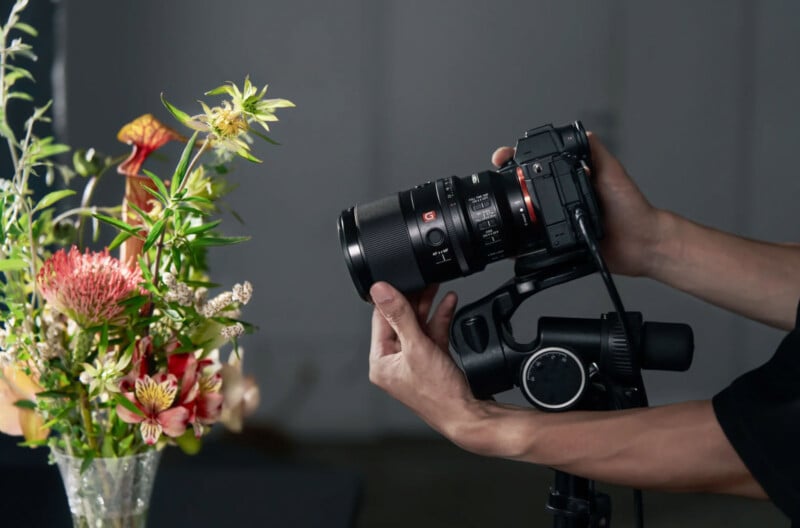
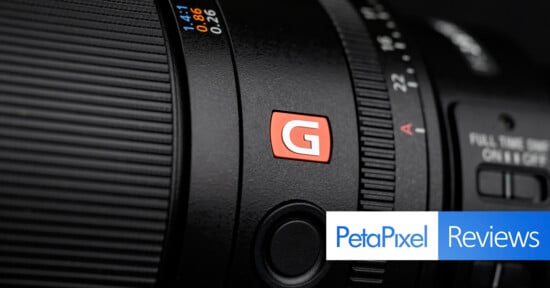
Speaking of close focusing distances, while the 90mm f/2.8 G Macro delivers 1:1 magnification, which is typical for full-frame macro lenses, the new 100mm f/2.8 GM takes it up a notch. Out of the box, without teleconverters or extension tubes, the new macro lens achieves a native magnification of 1.4:1. This corresponds to a minimum working distance of 3.5 inches (89.9 millimeters) at 1.4x magnification.
Unlike the Canon RF 100mm f/2.8L IS Macro lens, which also has a 1.4:1 maximum magnification ratio, the Sony FE 100mm f/2.8 Macro GM OSS can accept teleconverters. This has two obvious, immediate benefits.
Attaching either the Sony 1.4x or 2x teleconverters to the lens enables even greater magnification ratios (2:1 and 2.8:1). Furthermore, the teleconverters also allow for longer working distances at 1:1 and 1.4:1 magnification ratios, which can be particularly helpful when working with certain lighting setups or photographing sensitive subjects, such as insects.
With the 1.4x teleconverter attached, the macro lens becomes a 140mm f/4 prime capable of 2:1 magnification. Meanwhile, with the 2x teleconverter, Sony shooters get a 200mm f/5.6 macro lens with 2.8:1 magnification, which is dramatic. In either case, the lens retains full autofocus performance. PetaPixel will test the new 100mm f/2.8 Macro GM lens with teleconverters to determine what level of sharpness drop-off is experienced in exchange for the expanded magnification.
As mentioned earlier, Sony has brought out all the stops in terms of adding its most recent optical technologies to its new G Master macro lens. However, it has also done something altogether new with its 60th full-frame lens and 23rd G Master lens. Like its predecessor, the 100mm f/2.8 Macro GM OSS features “Optical SteadyShot,” Sony’s terminology for optical image stabilization. However, while OSS typically works based on focal length, Sony has tweaked the system to perform better when doing macro photography.
Instead of being tuned just for a 100mm focal length, the lens takes the focus distance into account to deliver improved stability for macro photography. Sony promises that the OSS, which coordinates with in-body image stabilization in Sony Alpha cameras, significantly reduces macro-specific shake, making it even easier to nail precise focus and framing in challenging macro scenarios.
A G Master Design for Macro Photography
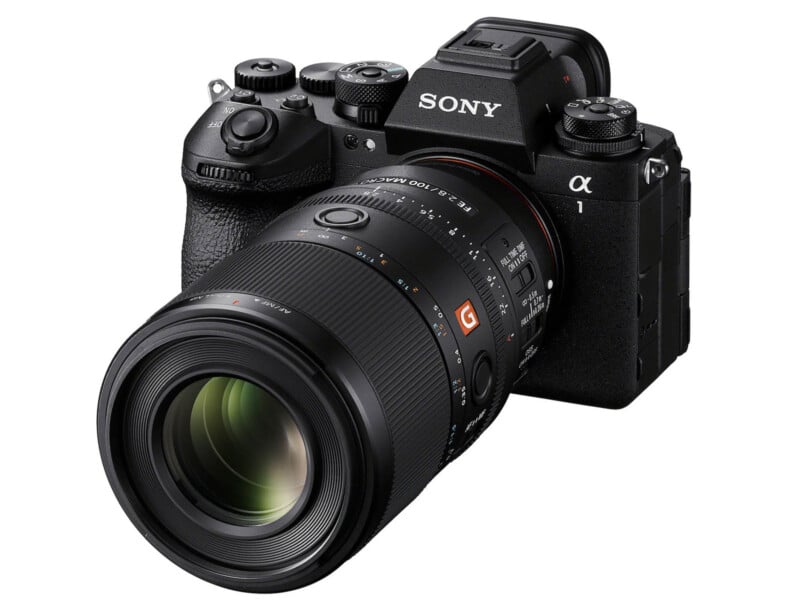
In terms of its physical design, the Sony 100mm f/2.8 Macro GM OSS is nearly the same size as its 90mm f/2.8 G Macro sibling. The new lens measures 147.9 millimeters (5.8 inches) in length and weighs 646 grams (22.7 ounces). It has a maximum diameter of 81.4 millimeters (3.2 inches) and accepts 67mm front filters. The 90mm lens is a bit shorter (130.5 millimeters / 5.1 inches) and lighter (602 grams (21.2 ounces), but looks quite similar.
It is worth noting that the Sony FE 100mm f/2.8 Macro GM OSS lens is an internally focusing lens. This means that, unlike some macro lenses on the market, the lens’s length remains constant as the focus distance changes. Some macro lenses, especially older ones, get longer as photographers focus closer.
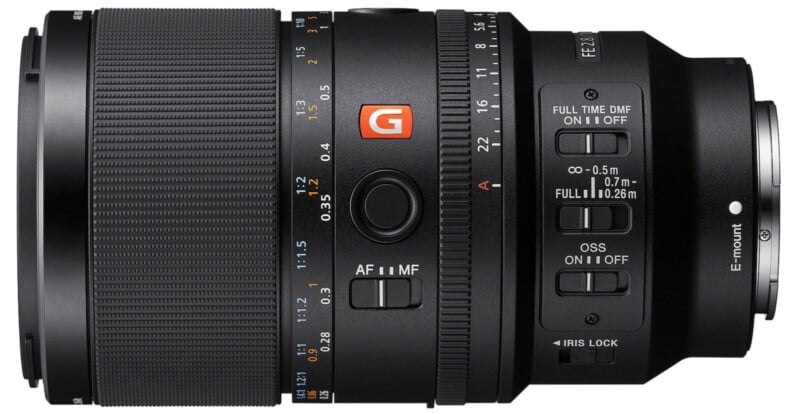
The new macro lens retains the focus clutch design, allowing photographers to slide the focus ring forward and backward to quickly switch between autofocus and manual focus modes. It also still features an indexed focus ring, which enables the lens to be labeled with focus distances and depth of field markings in both imperial and metric units. The indexed focus ring may also prove useful for videographers, as it could make precise focus pulls much easier to repeat.
As a G Master lens, the new 100mm f/2.8 Macro incorporates a dust- and moisture-resistant design, built to withstand the rigors of professional work out in the real world. All the seams are sealed, and all buttons and switches have silicone rubber gaskets. The front element also features a fluorine coating, and the mount is sealed.
The macro lens also has the accoutrements photographers expect in a G Master lens, including focus hold buttons, focus mode switches, a focus range limiter, an aperture ring click switch, full-time DMF, and on-barrel OSS controls.
Sample Images


The Sony FE 100mm f/2.8 Macro GM OSS Arrives Soon for $1,499
The Sony 100mm f/2.8 Macro G Master OSS lens will be available to preorder starting today, an unusual move for Sony, and will retail for $1,499 in the United States and $1,799 in Canada. The lens will begin shipping on November 13.
Image credits: Sony