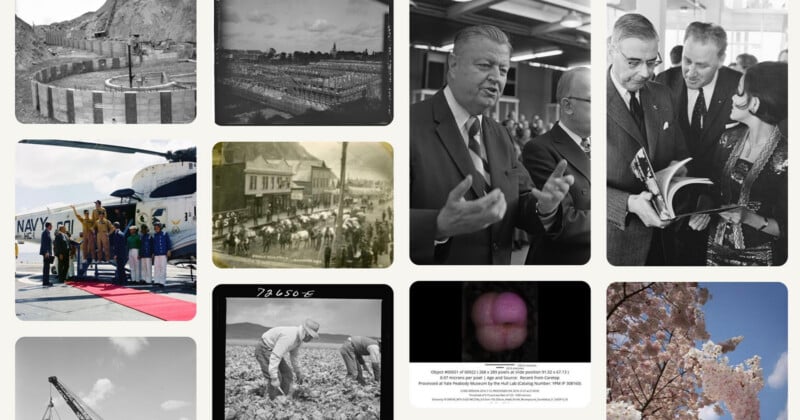
A new website called Arkivism aims to make searching for historical imagery considerably easier by bringing more than four million public domain images and videos together in one place.
The free-to-use archive (requires sign-up) includes historical photography from the Library of Congress, NASA imagery, and vintage film reels. Users can search the collection using natural language, describing what they want to find rather than having to know the exact title or filename of an image.
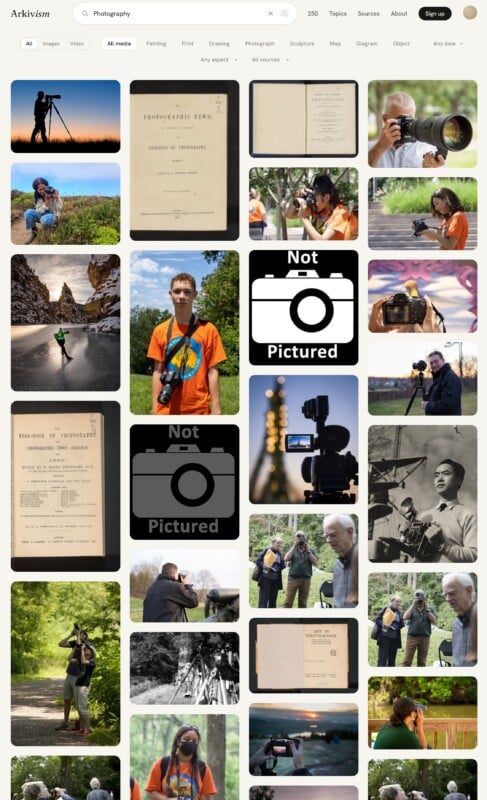
Arkivism also has an interface that will feel familiar to Pinterest users, with an infinite scroll, visual discovery features, and the ability to save images and videos to personal boards. Users can also extract high-resolution stills from archival video clips.
According to its creator, James, the archive currently contains more than four million full-resolution images and over 27,000 searchable film clips. Each asset also includes a backlink to its original source.
“Arkivism started as a fix for my own problem,” James tells PetaPixel, who explains that he used to edit long-form video documentaries on YouTube for the channel History of the Earth.
“There are millions of incredible public domain assets out there, but they’re scattered across slow, dated archives. Unless you knew the exact filename, finding one specific image could take hours. I wanted one place where I could describe what I needed in plain English and search everything at once.”
The project has been developed independently in James’s spare time since July. Despite its size, Arkivism is largely a one-person operation, with AI coding tools helping to make the development process more manageable.
James says the biggest challenge has been building systems capable of collecting material from numerous online sources while ensuring that every asset is properly validated as public domain.
“Above all, every asset has to pass validation checks confirming it’s public domain, because that’s the whole point of the site,” he says.

That emphasis on historical material is also part of the motivation behind the project. With AI-generated imagery becoming increasingly prevalent online, James believes there is particular value in making authentic historical photographs and footage easier to discover.
“I’m not anti-AI, obviously, but there’s real value in looking back, and I think that’s where the site really shines: you can dive endlessly down historical rabbit holes,” he says.
Although Arkivism borrows some of its interface design from Pinterest, James sees it as both a searchable archive and a visual discovery platform. Unlike traditional institutional archives, users can browse the collection without necessarily knowing what they’re looking for. Unlike Pinterest, however, the experience is not driven by an algorithm and contains no advertising.
“The site and archive will stay free,” James adds. “But further down the line I plan to build optional paid tools, such as After Effects and Figma plugins that bring the archive straight into editing software.”
The intended audience extends beyond photographers and filmmakers. Researchers, designers, and anyone looking for historical imagery can use the platform to find and download material, with the reassurance that assets have been checked for public domain status.
Arkivism is available now at Arkivism.com.
Affiliate Disclosure PetaPixel articles may include affiliate links; we may earn a commission if you buy through one.