China’s First Fully AI-Generated Film is Crashing and Burning at the Box Office
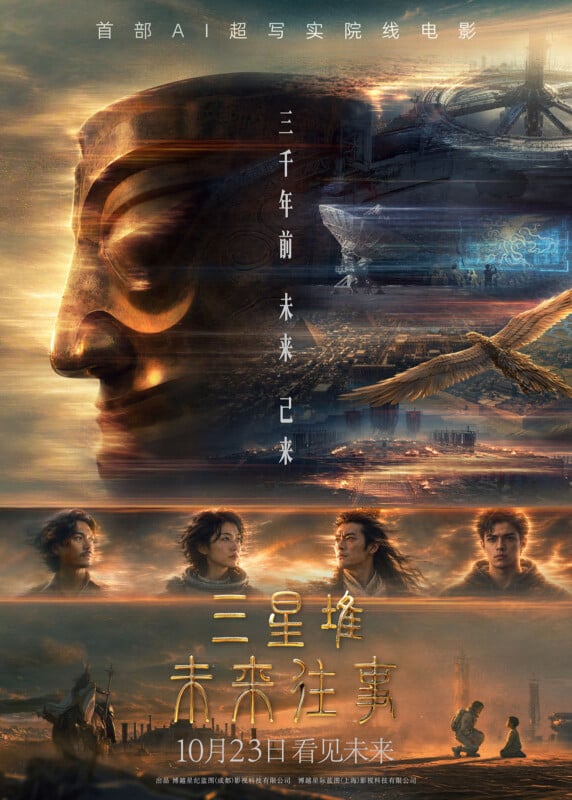
China’s first fully AI-generated feature film has been released nationwide in theaters, but despite 10,000 screenings on opening day, the movie is struggling to gain traction.
Sanxingdui: Future Past, a science-fiction thriller produced by Bona Film Group, opened in Chinese cinemas on October 23. Ticket sales have been weak: the film earned an estimated $181,000 as of Monday, according to ticketing platform Maoyan, per AFP.
The reported production budget was approximately $1.5 million, making a return on the investment unlikely.
The film reportedly follows an archaeologist tasked with saving a future world enslaved by artificial intelligence. Bona says nearly 100 people worked on the production for more than two years, although the actors’ performances and all of the scenes were generated by AI.
Jiang Defu, an executive at Bona Film Group, acknowledged the film’s poor reception in an interview with Chinese film industry outlet Yuli but described the release as an important experiment.
“We are the first to try it, the first to get a theatrical release permit and the first to be tested by the audience,” he says. “I think that is not easy at all.”
According to AFP, one Chinese social media user who went to see the film wrote that it “totally traumatized me.”
Films released in China must adhere to guidelines set out by the Chinese Communist Party (CCP), leading to complaints from movie fans in the country that productions are often second-rate, as the messages behind them are blatant CCP propaganda.
Earlier this year, a crude cartoon movie called Niu Lai that was made by a mother and son for a reported budget of $200 became a phenomenal success, raking in close to $10 million at the box office. It appears that part of the film’s success was due to the fact that it wasn’t a “beautifully packaged, mega-budget super-flop,” as one Weibo user calls films made in China.
But the failure of Sanxingdui: Future Past contrasts with the rapid growth of AI-generated short-form entertainment in China. Microdramas, which are designed for mobile and social media platforms, have increasingly adopted AI tools to reduce production costs.
According to Fortune, more than 95% of the over 120,000 Chinese microdramas, known as duanju, released in the first quarter of 2026 were AI-generated, compared with almost none a year earlier. Production costs for some of these titles have fallen to around $3,000.
However, the popularity of AI-generated short videos and dramas has not necessarily translated into demand for full-length theatrical productions.
In the U.S., there is an AI-generated science-fiction feature titled Gods Don’t Give Gifts scheduled for release on December 4. Tilly Norwood, a virtual actor whose interviews have attracted attention and raised concerns about the future of human performers, is also set to appear in an upcoming film titled Misaligned.
Affiliate Disclosure PetaPixel articles may include affiliate links; we may earn a commission if you buy through one.