

Webb Photographs a ‘Turbulent Cauldron of Star Formation’
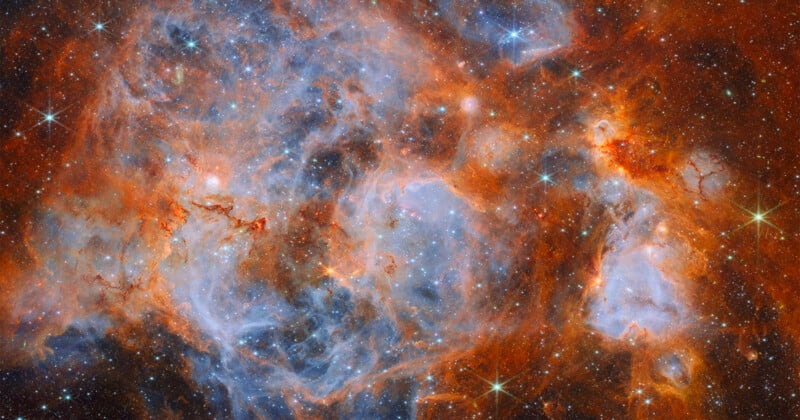
The James Webb Space Telescope’s (JWST) newest Picture of the Month shows what the European Space Agency (ESA) describes as a “turbulent cauldron of star formation.” The star-forming region named LHA 120-N 159, also known as N159, is located 161,000 light-years away in the Large Magellanic Cloud (LMC).
The Large Magellanic Cloud is one of the satellite galaxies orbiting the Milky Way galaxy. N159 itself is what astronomers call an “H II region,” which means it is an area of space filled to the gills with ionized hydrogen gas. Giant molecular clouds of cold hydrogen gas inevitably collapse under gravity, forming new stars.
Many of these new stars, seen in Webb’s new photo, are “extremely massive and hot,” and their powerful ultraviolet radiation continually ionizes the surrounding gas. This photo spans about 230 light-years.
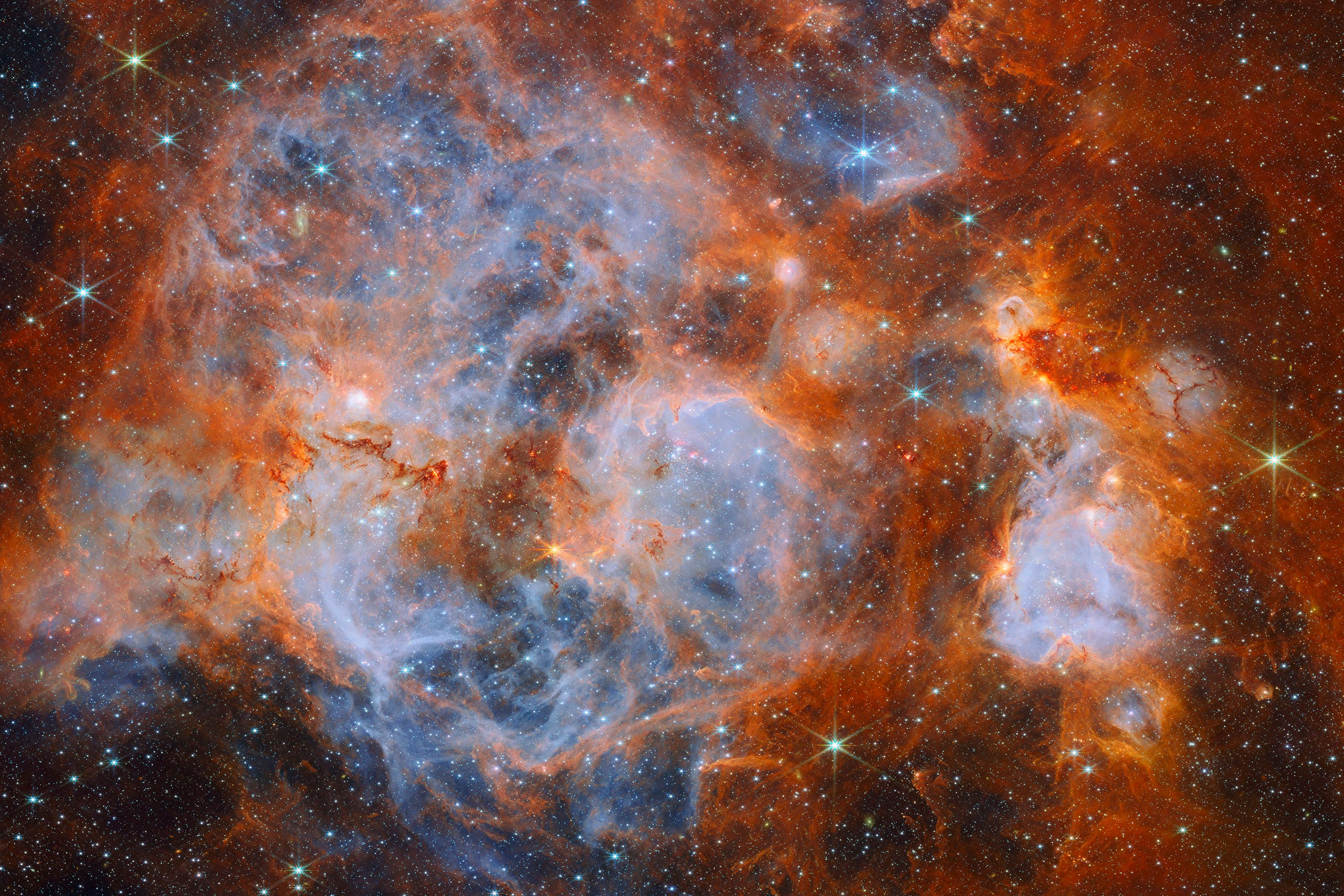
As ESA explains, H II regions mark active star formation, and the resulting ionized gas practically glows, making them beautiful and serving as a beacon that new stars are being born there.
N159 is a particularly young star-forming region in the LMC. It’s not even three million years old, a cosmic infant of sorts. Because it’s so close to Earth, scientists have long studied N159. Since the first telescope went into space, astronomers have captured images of N159.
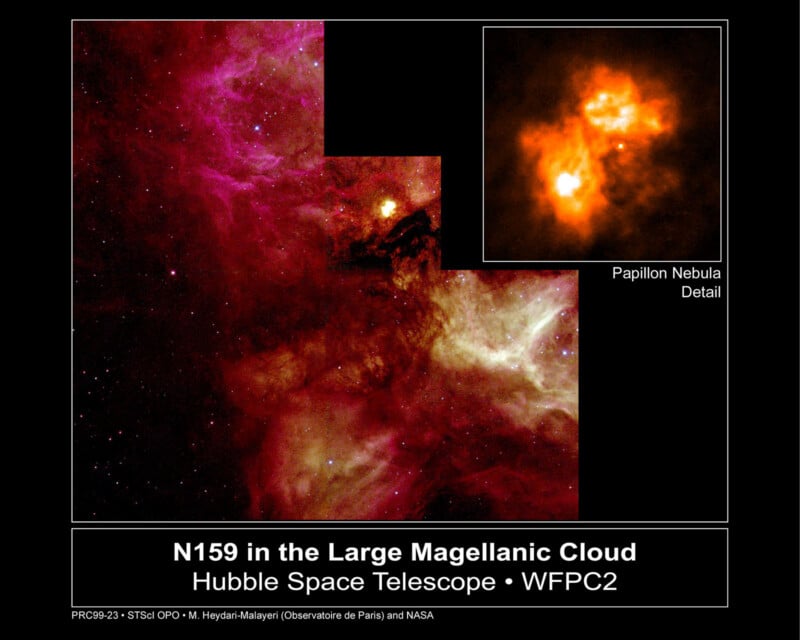
The brightly glowing spot on the left side of the image is the Papillon Nebula, ESA says, an “exceptionally compact blob of ionized hydrogen” that scientists believe is closely related to massive star formation. Hubble first imaged it back in 1999.
In Webb’s new shot, the thick, billowing orange clouds show light emitted by polycyclic aromatic hydrocarbons, a particularly important carbon-based molecule in space. The pale blue areas are H II gas clouds. ESA notes that the dark red filaments are cool molecular hydrogen. These red string bits are the densest parts of N159 and effectively protect new, growing stars from the harshest radiation and strongest stellar winds.
“By zooming in, you can see stars as points of light embedded in these filaments and in the small pillars of orange gas that reach out into the blue bubbles,” ESA says. Eventually these protective structures will vanish, revealing the grown-up stars.
Image creditsESA/Webb, NASA & CSA, E. Sabbi, M. Zamani (ESA/Webb). Acknowledgement: M. H. Özsaraç
Affiliate Disclosure PetaPixel articles may include affiliate links; we may earn a commission if you buy through one.


