Land of the Free: Photographer Visits 37 Prisons in 17 States
It’s been a big week for execution: in Tennessee, they botched one. In Texas, they’re making plans to televise another.
As a result, everybody has their mind on prison. Which makes sense: the United States has so very many people in jail. At just shy of two million, we have more than any other nation in the world and, per capita, only four nations (Turkmenistan, Rwanda, Cuba, and El Salvador) best, or perhaps worst, us.
We have more people in prison than we have military members, or police officers, or doctors, or sanitation workers.
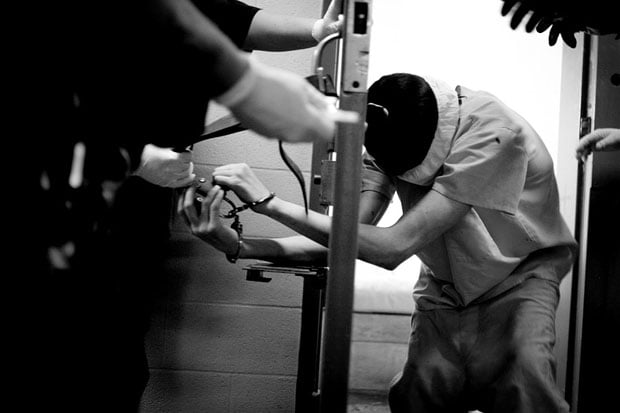
For the last two years, I have explored this common occupation, crisscrossing the nation to produce a project called Land of the Free, which has enjoyed access that I do not know of any photographer before being fortunate enough to receive: with the often reluctant permission of corrections officers, public affairs officers, wardens, departments of correction, and often governors, I visited 37 prisons in 17 states, to sit down with about two hundred men, women, and even children locked inside of them.
The photographers and journalists among us are, now, likely stopped in their tracks: this is an impossible thing. Prison is a tempting topic for photographers, but access is unheard of. Almost all imagemakers are willing to make easy and complete concessions — people who’ve just gotten out, people who’ve been out a long time, people who walked past a prison one time and thought menacing thoughts, and so on, and so forth — that allow prison officials to avoid scrutiny. It’s cheap, but it satisfies the endless appetite for punishment that the public rewards. And prisons, which have nothing to gain from allowing journalists in, are famously just about the hardest thing in the world to cover. That anybody can get into one is unlikely; that somebody can get into dozens is an insurmountable, nigh on absurd task. The explanation is straightforward, however: the world is small. After a couple, wardens and prison directors began referring me to one another. There’s a reason for that, which we’ll get to later.
Most days in most prisons begin the same way: at the motel down the road. Prisons are, generally, set on public land — there’s state warehouses next door, or a cemetery. It is not a desirable patch of earth. But as soon as the land gives way to commerce, the very next building (almost without fail) will be, in its way, the carceral waiting rooms, in the form of a motel.
All across the country, motel vacancy signs are moaning for America, no more so than next to its many prisons: there are always a few near every major state facility, mostly populated with girlfriends, wives, mothers, fathers, small children waiting to see someone they love behind a thick pane of glass. There’s also, periodically, me.
Most prison days for me begin the same way: by waking up in a motel and heading down to wait in line with those same mothers, those same lovers. We’re all searched. We’re all exhausted. We’re all trying to be useful. We’re all trying to be of service to someone.
Vincent Van Gogh — the man invariably on the bookshelf next to me, whose work is the bait that people breeze past mine to get to, wrote to his brother Theo in June 1880: how can I be useful, of what service can I be? Vincent worried his life was meaningless, and would never know it wasn’t. He wanted to leave behind a “souvenir” of his raw emotion — and never know that he would.
Photographers need to be, by definition, in the world. The incarcerated are demanded to be, by definition, outside of it. The role of the photographer is twofold and always has been: we are documentarians but, in the best of us, also polemicists. The work always begins, especially in our low age of artificial slop, at the same place as Vincent, so many years ago: to ask how can I be useful?
The State considers crime a debt, and declares the subsequent sentence an obligation. So, too, does the photographer — for whom access is so difficult — take on a debt and then an obligation: to try to be useful.
It is no secret that photographers love sadness. That people do, in general. That curators do, and award panels do. Suffering is keenly rewarded — everybody sees the prizes, everybody knows who gets them — because in photography it is what the public loves. There are many kinds of photojournalism, but the kind that looks down is often the most successful.
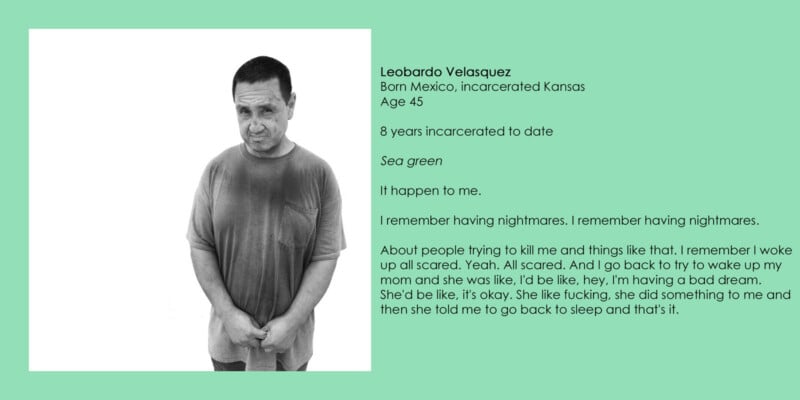
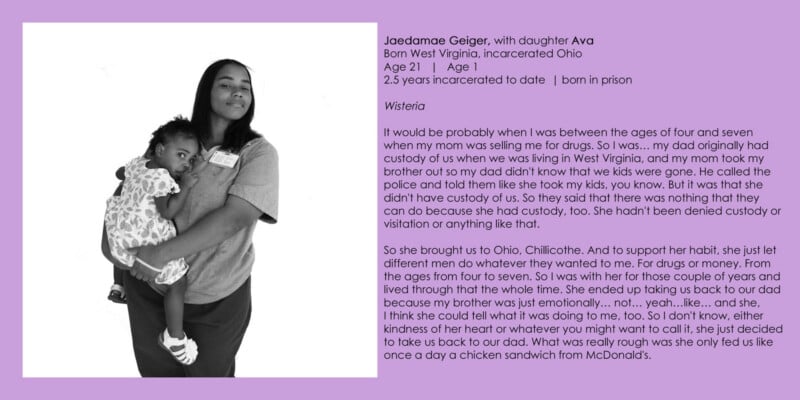
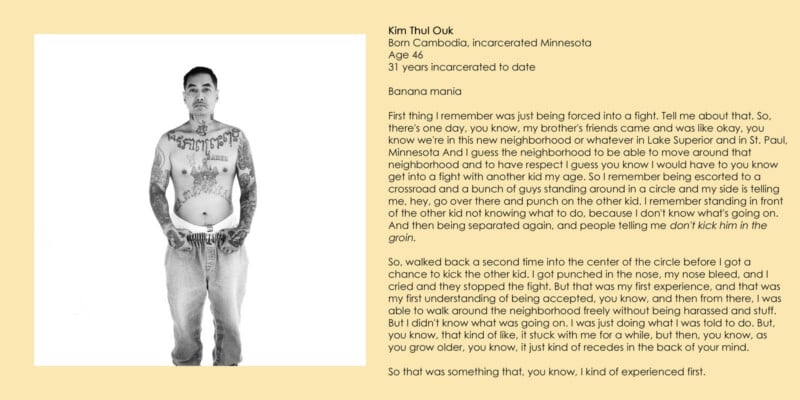
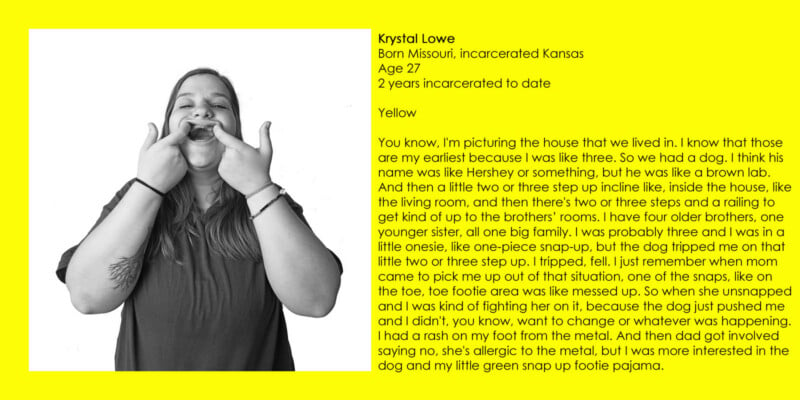
Most of the people I sat down to interview and photograph, within the meager circumstances allowed by prisons (generally: no lights, no tripod), were in for very, very long sentences. Some were on death row. A few professed innocence; at least two, their wardens told me, probably are innocent.
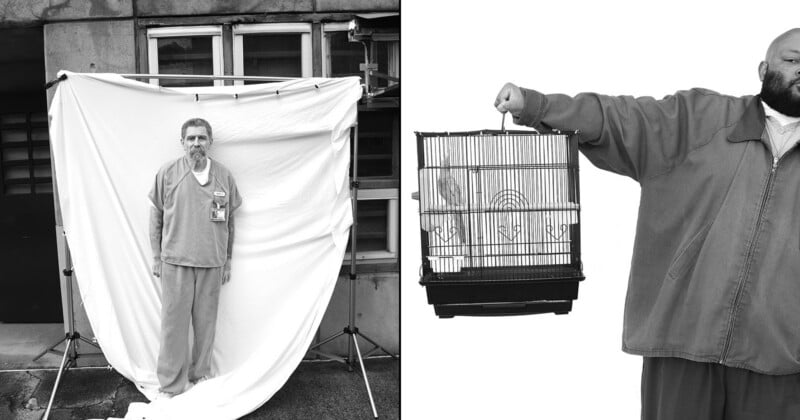
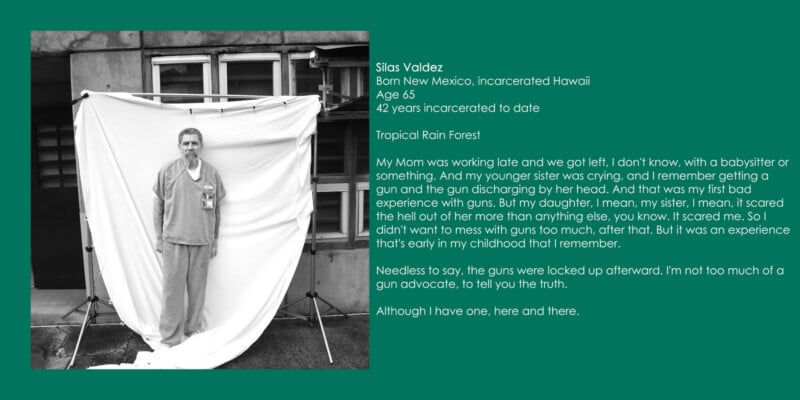
The requirements of the locations created a necessity: a void. My backdrop was simply a white sheet, as that was what I was allowed to bring in. My portraits are lit by the weather and, when I could, a scrim, or in the many rooms I was locked into, by the buzzing light of overhead fluorescents. The good side is that it let me photograph them neutrally, just who they were, without focusing on the grit or mud of it: most of the folks you’d meet in Land of the Free are surrounded by a lot of noise and a lot of people. There are hecklers. There are men and women in uniform.
There’s a tower. It’s got a sniper.
I don’t like everybody I met working on this project, many of whom did many crimes with celerity and sometimes with celebrity. Some were horrible people I adored. Some were, at most, benign but unlikable. I purposefully walked in perfectly ignorant. I did not know their names, their origins, their ethnicities, their reasons for conviction, or their sentences before sitting down with anyone. But most importantly: I didn’t ask what anyone had done to earn their debt to the state. I felt I had an obligation not to.
If you do a project about prison, anybody who sees the photographs is going to ask you, immediately, and with some urgency, what each and every person pictured has done. They want it to be tawdry. They’ll look at people in prison as gruntlings and guess their crimes. They’ll ask blunt questions about rape and murder. They want to know if I was scared. They want to know if the people I was sitting down with were, as well.
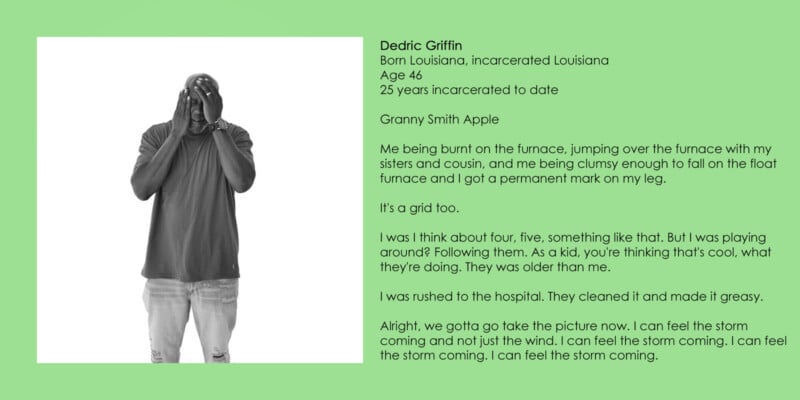
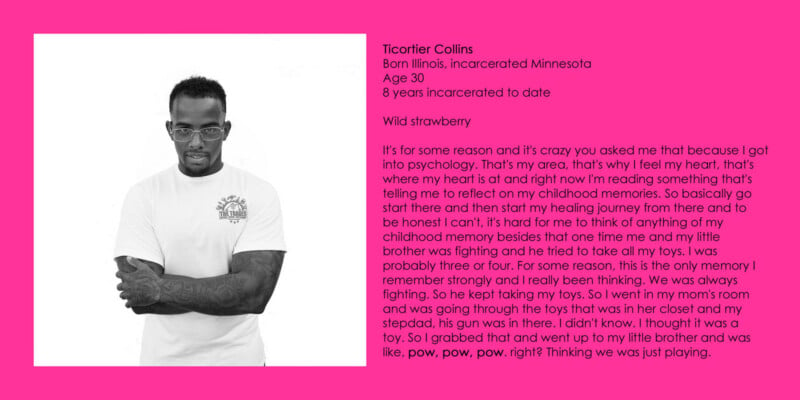
Most everything everybody knows about prison, they know from movies. But prison, in real life, is boring. Exceptionally boring. You go there for your time, you do nothing while you’re there, and when you look back on your life, you realize that this time wasted has taken it all. Aesthetically, the easiest way to describe most of the dozens of state correctional facilities I’ve been to is pretty straightforward: prison is high school you can’t leave. It looks like high school, often feels like high school. It has the same high school drama. And the same high school posters, by the way, as prisoners in their sophomore slumps are surrounded by the same messages as teenagers in the same mood: Read more. Get your degree. Please stop doing drugs.
The pull of the filmmaker, or the photojournalist, is always to show everything in its biggest, more outrageous self, a sort of sesquibiographical rendition of the mundanity of life. Everybody in the movies with a love scene seems destined for the most raucous sex of their lives; if you go to a bank, there’ll be a robbery. Prisons need to have a jailbreak, a stabbing, officers going to beat their wards. Those wards are going to find justice. Et cetera. Et cetera. Et cetera.
Nobody is going to make a movie about prisoners waiting in line for pills, or working at a metal shop, or re-reading a novel for the seventh time. Very little cinema about the laundry room. Not so much interest in cafeteria meals.
At its core, I wanted to focus on the underlying humanity of all these subjects by sharing something we all have: we are many people living many lives. What is more meaningful than looking at the whole of those most cast to our margins?
I sat down with these several hundred men, women, and children, and made a point not to ask a single one of them the reason for their incarceration. It’s all anybody seems to want to know; it’s the one thing I chose not to learn. We have a habit of reducing people to their single acts — and yes, some of those single acts are terrible — rather than on their whole.
In recorded interviews, and in privacy in all but one prison, I sat down and talked with people about where they’ve come from and how they grew up. Many were in education programs; I asked them what they were learning. And I talked about where they began. Always, where they began.
While I was working on Invited to Life, almost all of the Holocaust survivors I met had, as their very earliest childhood memory, either arriving at a concentration camp or being released from one. There’s something to this; our invitation to the world often becomes the signal flare for who we’ll one day be.
In Irwin Shaw’s Voices of a Summer’s Day, he states that “it is only with greatest care that memory can be kept from becoming a prison or a gallows.” With this in mind, I made the last question of every interview — often while getting up from my chair, like Detective Columbo asking his “one more thing…” on the way out the door: What is your earliest memory?
I wasn’t sure it would work. But at the first location, on the first day, with the first interviewee, I began a journey of revelation: some of them were transcendental. Some of them were really dumb. The same can be said for most of us, I suspect.
It was done with challenging funding. While I received generous support from the Leonian Foundation and the New York State Council on the Arts, it did not meet the extent of my expenses. It’s been a challenging, pleasant, awful, illuminating experience that I’m so glad I did, and one I hope never to repeat.
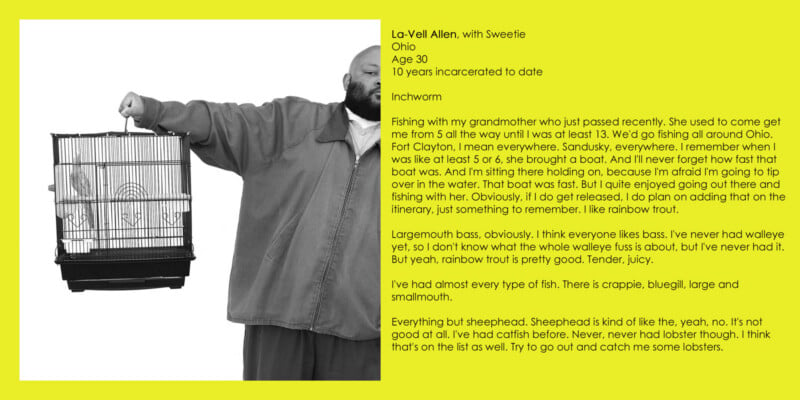
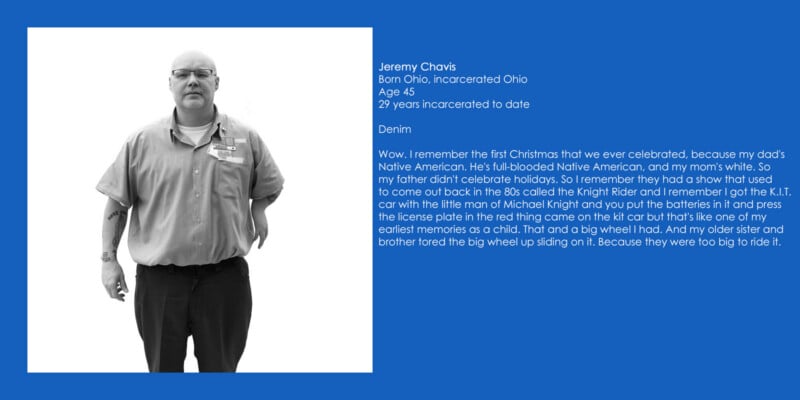
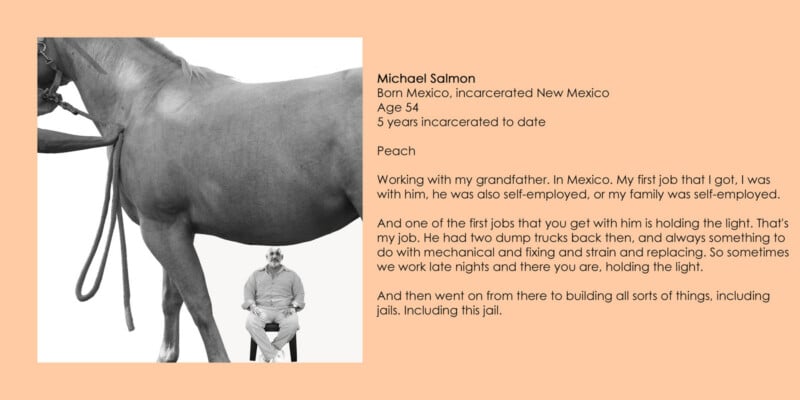
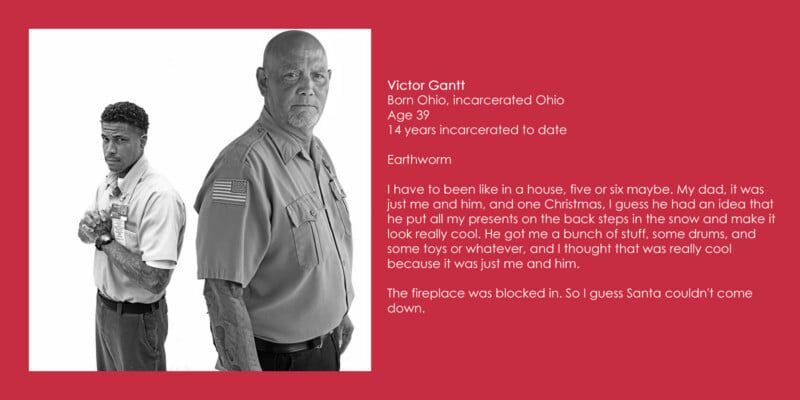
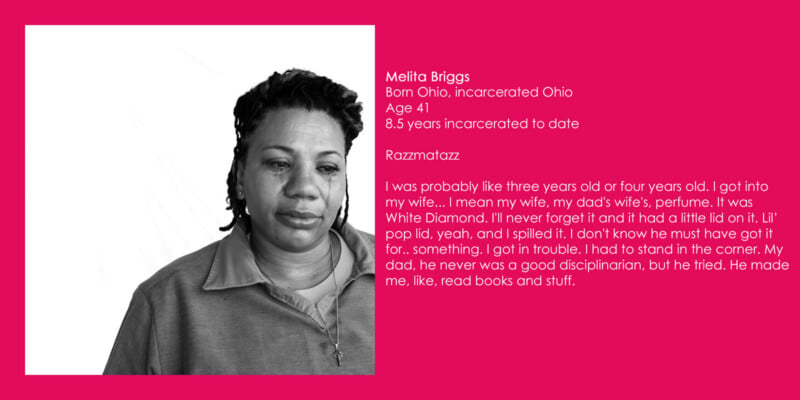
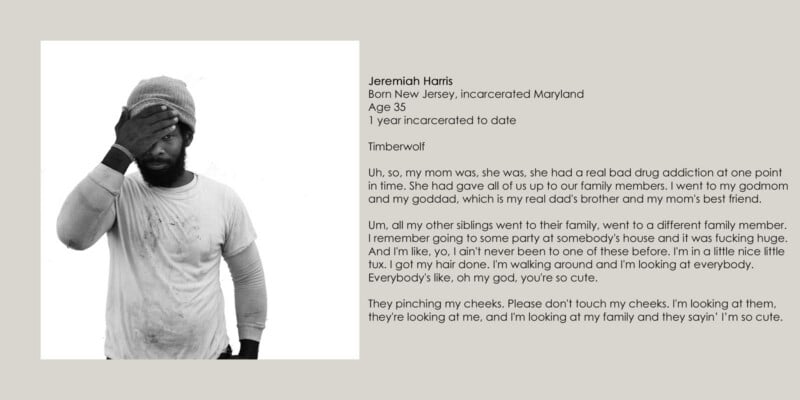
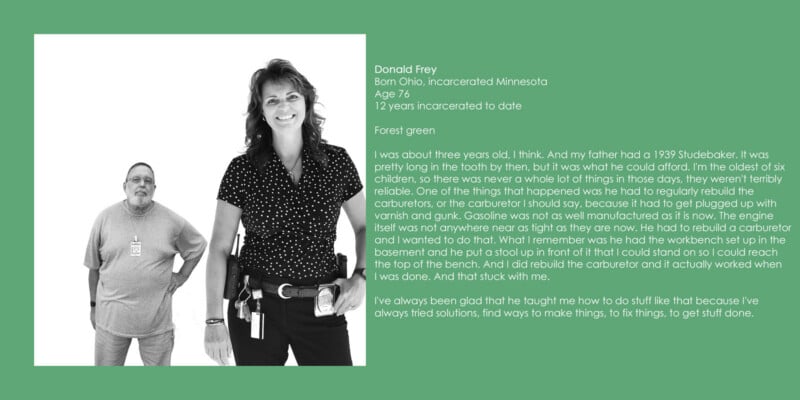
One day, hopefully, there’ll be an exhibition. One day, I suspect, there’ll be a book. The images are paired with the inmates’ birthplaces, ages, years of incarceration to date, and their choice of one of the few items allowed into a maximum-security prison: a 256-color box from a certain crayon company that I’m forbidden to name. It includes their answer to my question. It won’t tell you the answer to everybody else’s.
Many of the sitters are shown in forced perspective images. However, in reality, in prison, all perspective is forced, with corrections officers and wardens on site. While I’m thrilled with the autonomy I earned, lots of officials showed up, shocked that I didn’t want to show their prisons (often more than a little weathered) or to create purposefully insulting images of the folks in their custody and often care. They’d tell other officials, sometimes at my asking and sometimes of their own initiative, that they should consider letting me in.
Prisoners would talk, often, about how they couldn’t leave. Wardens and corrections officers, too, would often point out that, for the time being, I couldn’t either. But leave to what? In the real world, medium- and maximum-security prison is inescapable in any practical way. Not because there’s some omnipotent force standing in anybody’s path but because prison is functionally isolated and isolating. Even if you manage to chew through six feet of cement and get out of your cell, there are six more concrete buildings, sally ports, and fencing around you, and once you get through that there’s about 600 miles of Texas, or wherever, in every direction, except for, of course, the small motel down the road.
At the end of every day — I’d generally try to sit down with about a dozen people in each long session — I’d be exhaustively searched again: my little white backdrop, my camera, my audio recorder, my clothing. And I’d head down to that same little motel, with its neon sign, and I’d lie out on my bed with a can of seltzer, and I’d open up my computer. And then, I’d go into a search engine and ask the same awful thing that everybody else does: what did they do?
And I’d read with horror about my new friends. And I’d know forever. And I’d wonder: How can I be useful? Of what service can I be?
Image creditsB.A. Van Sise