See the 2026 Total Solar Eclipse From Space
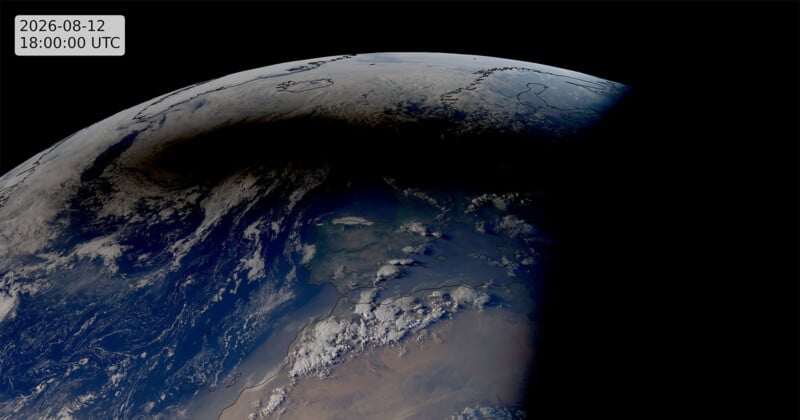
Satellites captured the August 12, 2026 total solar eclipse in spectacular fashion.
The European Organization for the Exploitation of Meteorological Satellites (EUMETSAT) is typically focused on using its satellites to monitor the weather and study the climate. However, on August 12, as a total solar eclipse covered Greenland, Iceland, Spain, and a part of Portugal, the EUMETSAT Meteosat-12 was ready to capture it.
The Meteosat-12 is in geostationary orbit 22,236 miles (35,786 kilometers) above Earth, as Forbes reports. The satellite is constantly monitoring Europe and northern Africa, putting it in perfect position for the total solar eclipse. It’ll also be well-suited to see some of the next total solar eclipse in August 2027, in fact.
As night raced toward Europe from the east, the Moon created a massive shadow that traveled south. The darkest central portion of the shadow, the umbra, was just an 180-mile-wide (290-kilometer-wide) swath of the larger shadow. In much of the shaded region, viewers only saw a partial eclipse.
Where were you when the eclipse hit today? 🌖✨
While millions watched from the ground across Europe, we had a view from space. 🛰️Did you catch the total or partial eclipse where you are? Let us know in the comments – and check back tomorrow for more imagery and information! 💬 pic.twitter.com/DZBdXtcXV8
— EUMETSAT (@eumetsat) August 12, 2026
Totality lasted at most 2 minutes, 18 seconds, with many areas along the path experiencing significantly shorter durations. In Station Nord, Greenland, totality was only 16 seconds.
Meteosat-12 wasn’t the only satellite to get in on the eclipse action. NOAA’s GEOS-19 satellite captured multiple video sequences of the eclipse’s umbra traveling across Europe, all of which are featured below.
Like Meteosat-12, GOES-19 is a geostationary environmental satellite. Instead of looking at Europe and northern Africa, GOES-19 points toward North America. It offers quite a different perspective of the eclipse, catching it on the very eastern edge of its field of view. It’s also approximately 22,236 miles above Earth.
On Earth, many photographers in Europe captured incredible images of the total solar eclipse, including wide-angle shots and close-ups of the Sun’s prominence. PetaPixel has a couple more feature stories in the works related to the total solar eclipse, so there are even more fantastic photos to look forward to.
The next total solar eclipse is on August 2, 2027, and will pass over Spain again, as well as northern Africa, Saudi Arabia, and Yemen. There’s no question photographers will deliver some incredible photos then, too.
Image creditsHeader and feature photo by EUMETSAT. Additional videos from the NOAA GOES-19 program.
Affiliate Disclosure PetaPixel articles may include affiliate links; we may earn a commission if you buy through one.