‘Seems Like AI Slop’ Button Added to LinkedIn

One of the most frustrating aspects of online discourse in 2026 is not knowing whether the email, social media post, or video you just read or watched was AI-generated.
Despite growing infrastructure being put in place that can detect synthetic content, many online users are suspicious about virtually all digital artifacts nowadays.
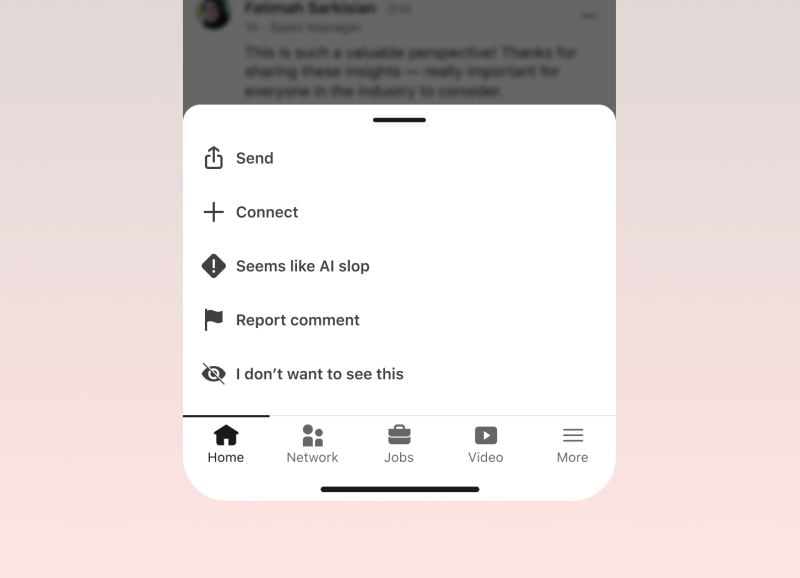
But now users on LinkedIn can act on those suspicions after the business-focused social media platform added a “seems like AI slop” button to posts.
LinkedIn’s Chief Product Officer Hari Srinivasan says that AI slop is a top priority for the platform.
“We are ramping up a series of new and improved classifiers that identify if a post is AI-slop or generally low-quality content,” Srinivasan writes. “This will reduce the amount of AI slop you might see in suggested content and content from outside your network.”
“We are ramping the ability for members to tell us if they believe a post or comment seems like AI slop. Slop is hard to define and the definition changes; this lets us tune our models and make better feeds,” he adds.
The Scourge of AI Bots
LinkedIn has been getting a reputation for vacuous posts that were clearly written by an LLM. Some of them are generated automatically by bots, which is a major issue for all platforms. But companies are fighting back: this month, Substack added a tool that supposedly identifies when an email newsletter has been written by AI.
The problem of agentic bots is huge. Cloudflare, a company that provides internet infrastructure, says that website traffic from bots now outnumbers traffic from human users.
Detecting AI slop on visual platforms like Instagram and TikTok is a little easier compared to written text. That is mainly due to two systems: Google’s SynthID and the C2PA protocol. The former is an invisible watermark that’s imperceptible to humans but shifts pixels in such a way that it is detectable to Google’s tools. C2PA, meanwhile, is a cryptographically signed manifest that logs a piece of media’s provenance, recording information like the camera used to create the image, whether AI was used, and what edits were made to it.
Image creditsHeader photo licensed via Depositphotos.
Affiliate Disclosure PetaPixel articles may include affiliate links; we may earn a commission if you buy through one.