

Fender Mix Headphones Review: Versatile Connectivity but Middling Performance

Often, videographers and video editors are forced to use two separate headphones: one for production and one for personal use. Fender’s new Mix headphones are somewhat unique in that they seem designed to adapt to whatever you might need in a given moment with minimal complexity to get there.
Before we get too far into this, it’s worth noting how Fender’s name found its way onto headphones, since it’s not a company that is well known for consumer electronics. While Fender still exists as a guitar and amplifier company, it has also licensed its name to Singapore-based Riffsound to create consumer-facing personal audio devices under the Fender Audio brand.
This licensing agreement doesn’t appear as wide-reaching as what we see out of Kodak, for example, though. Fender isn’t licensing its name out as broadly, and Fender Audio seems to understand the weight of using the name “Fender.” All that said, it’s unlikely that the original Fender is all that involved in what Fender Audio is doing.
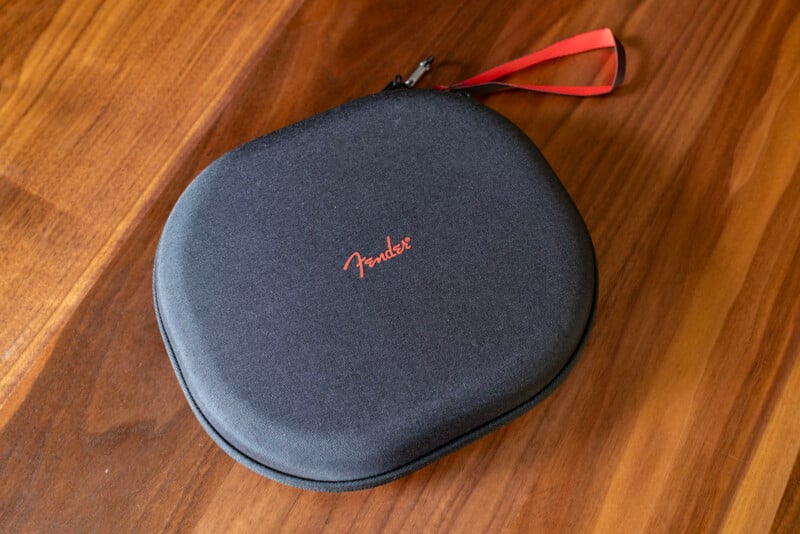
Licensing agreements aren’t always bad either, so it’s only fair to give Fender Audio a fair shake. So, let’s give the $299 Fender Mix headphones — the first over-ear headphones for the brand — a closer look.
Fender Mix Headphones: Design and Build Quality
The Fender Mix headphones have a nice, understated overall design. Out of the box, they ship in one of two colors at the time of publication: Skyscraper Black and Olympic White. For the purposes of this review, Fender Audio supplied the white version. It looks like Fender Audio plans to release a few other colors along with a set of differently colored ear cups. To that end, the company also sent along a set of brown cups, which are what you see in the images in this review.

What is unfortunate is that these cups aren’t available at the time of this review and, as mentioned, neither are the other color options. That means I can’t say if the price is worth it, since I have no idea how much Fender Audio intends to sell them for.
The headphones have a “fully modular” design, so the earcups, band, and other components can be swapped and switched out at any time. The two earcup units easily pull off (they are held in place with magnets), and inside the headband, you can see that they are connected by USB-C. It’s all USB-C, all the way down. The only piece that seems pivotal to function is the right ear cup unit, as that will continue to play even if you disconnect it from the rest of the headset. It’s also where Fender has all of its onboard controls.
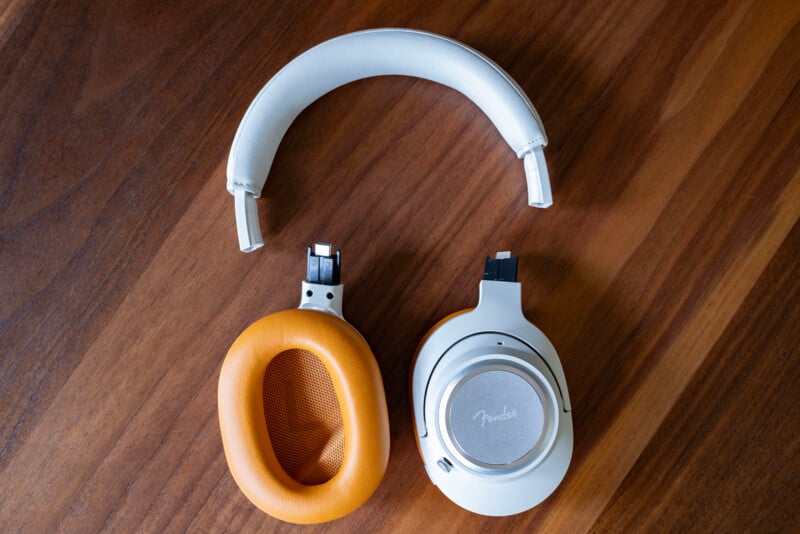
There are two buttons on the right ear cup, and one is a multi-directional toggle. I’ll get to how those perform in the section below, but as far as design is concerned, the toggle is easy to reach and use, and is quite responsive.
Looping back to the versatility, these headphones can connect to any device using one of three possible options. First, and perhaps most obviously, is Bluetooth 5.3. Even better, the Mix headphones support Bluetooth Multipoint, so they can be connected to up to two devices simultaneously and can switch between them seamlessly.
But what if you’re on an Airplane and want to watch a movie through the entertainment system? You’re covered because, under the left ear cup, Fender Audio hides a tiny USB-C dongle.

This dongle attaches to any source that takes that connection and can transmit the audio signal via USB-C. It works with computers, phones, you name it. Connection is immediate, and it overrides the Bluetooth connection, so even if I’m connected to my phone wirelessly, it won’t try to pull that audio. That’s pretty smart, because why would I have the dongle attached to anything if I wasn’t intending to use it primarily? Active Bluetooth connection resumes once the dongle is not actively plugged into anything.
The Fender Mix headphones also support Auracast.

Finally, there is the option to use the classic 3.5mm headphone port, and Fender Audio includes a corded 3.5mm to 3.5mm cable with the headphones. When using this connection, no power is needed, so the 3.5mm headphone jack allows these headphones to be used even if the internal battery is dead. It also means that these can be used in the field for monitoring audio during video production.
That’s a really nice, versatile set of connection options that allows these headphones to be used for every part of a videographer’s and editor’s life.
Build-wise, these feel robust and high quality. They are mostly plastic, so that comes with some level of inherent fragility. They probably won’t break during everyday use, but I could see them snapping if they were, say, sat on.
The material of the ear cups and headband is nice, but I do worry that the faux leather Fender Audio is using may flake over time. It’s not something I can test during a review period, but it’s a material I’m familiar with, and it doesn’t feel particularly thick, so keep that in mind.
Fender Mix Headphones: In Use
That leads directly into how those materials feel, and I’m happy to report that the Fender Mix headphones are quite comfortable. They do fit a bit snugly, so if you’re sensitive to pressure from both sides of your head, you may run into fatigue faster than I did, but I found these perfectly nice to wear for hours at a time.

I will say that they are a bit hot, though. The ear cups are small, and the aforementioned snugness means there isn’t any room for air to move around, so I found my ears will start to sweat pretty quickly, even in an air-conditioned room. After 20 minutes, there was definitely moisture in there.
Let’s loop back to those two buttons I mentioned above. The simpler button is the active noise cancellation switch, which has three functions: on, transparency, and off. For starters, because these ear cups cling pretty tightly to my head, the passive noise isolation is already pretty great. Put some music on, and you’re unlikely to have issues with noise bothering you. So, if you really need the battery to last as long as possible, turning ANC off isn’t a bad way to go.

If you’re on an airplane or in a shared office space, the noise cancellation does a very good job of cutting sounds down even further. I’d say the overall active noise cancellation is quite good, albeit not to the level of Sony’s WH-1000XM5 or XM6 headphones. But when these are $100 cheaper, that’s a great result.
It’s the transparency mode that leaves a lot to be desired. Apple has set the bar incredibly high with its AirPods line, so it’s hard to listen to an inferior transparency mode and give it a pass. Can you hear yourself and those around you with the Mix’s transparency mode on? Yes. Is it good? Does it sound like your natural hearing? No. It’s functional, but it is obviously a lower-fidelity version of reality. The volume of it seems too low as well, so it never competes well with anything I’m listening to. I would rather slip the headphones off if I need to hear what is going on around me versus using transparency.
Moving on to the multi-directional toggle, and this is where all of the other controls reside. Pressing down and holding this toggle for five seconds turns the headphones on and off. Pressing and holding while on for two seconds activates Bluetooth pairing mode. Short pressing this button plays and pauses music.
Fender says the next few controls aren’t “press” but are instead “push,” which I find to be unhelpful language to distinguish between these functions. I’m going to go with “flick.” Flicking the switch up and down increases and decreases the volume. Flicking it forward and backward skips forward a track or back a track. Double-clicking down toggles on Auracast.
Those are all the controls you get, and for most, that will be enough. I do wish that there was an app, as I would like to be able to control the EQ of these headphones, as I don’t love the sound quality for music.
The best way I can describe the sound profile of these headphones is “tight.” This is not uncommon for closed-back monitors, but the dual 40mm graphene drivers don’t do a great job with sound separation or dynamic range at the high end. Audio, to me, sounds like it is slightly compressed and lacking detail. Midtones can blend together with the highs, which can give complex sounds and music a muddled overall tone. Neutral headphones, these are not.
I wouldn’t say these are for bass-heads either, although the Fender Audio Mix headphones are better at projecting the lows than they are at the highs. You never feel the bass, but it is present and, I argue, over-represented. It’s the same complaint I level at Beats headphones, although Fender’s headphones do it to a far less egregious degree.

You probably don’t need to push the volume on these particularly high, thanks to the very good noise isolation and the noise cancellation option, and that’s a good thing because I can start to hear distortion when these are pushed to about the 75% max volume area. Sticking to around 50% of max felt like the sweet spot.
Battery life is outstanding. Fender rates them for up to 100 hours with ANC off and 52 hours with ANC on, and I haven’t found any reason to disagree with these numbers. They also feature quick charging, so 15 minutes of plugged-in power results in eight hours of playback with ANC on. They’ll fully charge from dead in two hours.
The microphone in these is not great. It’s fine, it gets the job done, but those listening to you won’t rave about the quality. They also don’t really isolate your voice well in loud environments.
Versatility Is the Selling Point
There are better-sounding personal headphones on the market, but versatility is where the Fender Audio Mix headphones shine. I really like the USB-C dongle, especially since it’s so hard to lose since it tucks neatly behind the earcup. While they come with a case, it doesn’t feel like a situation where you have to use it because if you don’t, you’d lose something.
I also like that these work without battery power with a 3.5mm headphone cable. Having Bluetooth, USB-C wireless, and a wired option in one headset is really nice, and while not unique, it is uncommon.
So while I wish these sounded better, they don’t sound bad by any stretch of the imagination and are more than serviceable for use in the field to monitor video recordings, will work just fine for video editors on the go, and are excellent for entertainment purposes.
So while it is easy to spend a lot more than the $299 that Fender Audio is asking for the Mix headphones, I feel like it doesn’t quite earn that price. I would have liked to have seen wear detection (where the headphones pause music when you remove them), adaptive ANC of some kind, and a way to adjust EQ to better fit my personal taste.

Are There Alternatives?
In the headphone space, alternatives abound, although the connectivity options found in the Fender Audio Mix headphones are unusual. If you want the option to use a 3.5mm headphone jack in addition to Bluetooth and get all of those extra features that I complained were available in the Fender Mix, then the Sony WH-1000XM5 or XM6 headphones are my top recommendation. The XM5 headphones are $280 now (because they are no longer Sony’s top-end option), which makes them a really compelling alternative.
The Bose QuietComfort headphones are also solid, as are the Sennheiser Momentum 5. All of these are way more expensive than the Mix, however.
If all you care about is a solid, wired option — wireless be damned — then the Sony MDR-7506 or the Sennheiser HD 300 are better fits.
If Fender were to drop the price by $50 or $75, then the Mix headphones would be far more compelling.
Should You Buy It?
Maybe. The Fender Audio Mix headphones do a decent job standing out from the pack with the range of connectivity options available out of the box, but the price doesn’t quite match the level of the features and performance on offer.
About PetaPixel Headphone Coverage: Wait, headphones? On PetaPixel? You bet. PetaPixel is expanding coverage into headphones specifically through the lens of what best serves video editors. Whether they work in a studio, on a plane, or at home on the couch, video editors all use headphones at some point. With our coverage, we intend to keep those editors informed of what’s new and, over time and as we test them ourselves, recommend the best options when your favorite cans finally need replacing.
Affiliate Disclosure PetaPixel articles may include affiliate links; we may earn a commission if you buy through one.