First-Ever Film Depicting a Robot Discovered in Old Storage Chest
A long-lost 19th-century film featuring what is believed to be the first on-screen robot has been restored after being discovered in an old trunk in Michigan.
Before it arrived at the Library of Congress’ National Audio-Visual Conservation Center, Gugusse and the Automaton — a 45-second motion picture made in 1897 by French film pioneer Georges Méliès — existed only as ten deteriorating reels of nitrate film.
The reels had been kept for the past two decades by Bill McFarland, a retired teacher from Grand Rapids, Michigan. They were stored in a trunk that once belonged to his great-grandfather, an itinerant showman who traveled through rural western Pennsylvania around the turn of the 20th century, showing early motion pictures.
McFarland said he tried to give the films to museums and antique stores, but many would not take them because nitrate film is highly flammable. He was also unable to safely watch them himself as it could not be safely run through a projector. After years of searching for a solution, a lab technician suggested he contact the Library of Congress. McFarland then drove about 700 miles to the Library to deliver the reels in person.
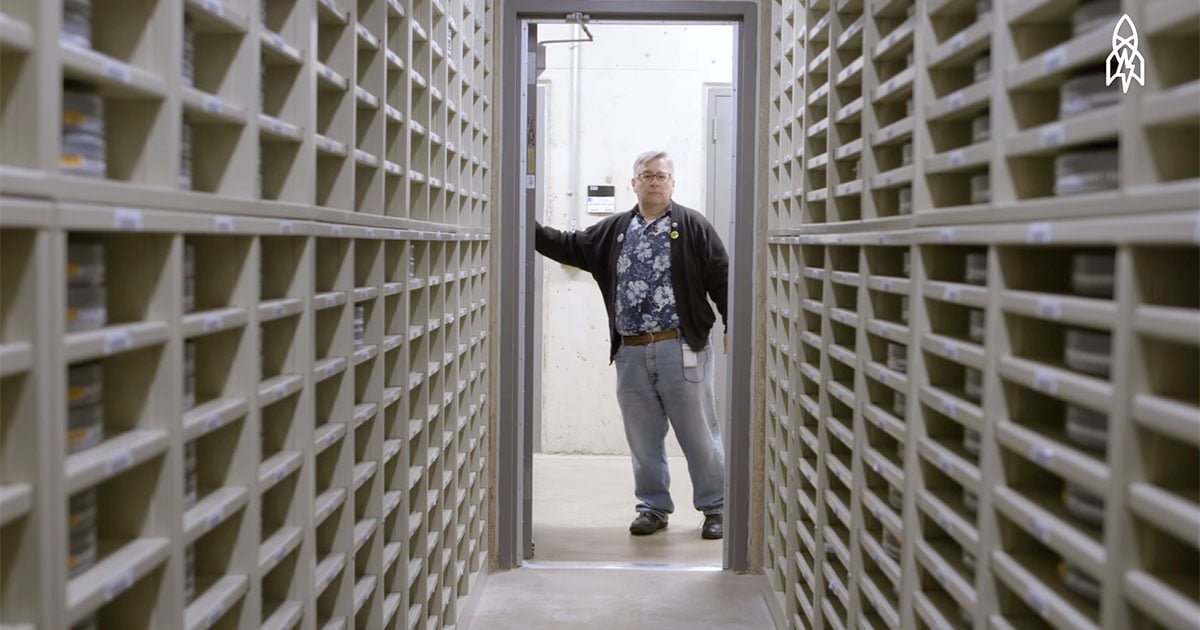
“The moment we set our eyes on this box of film, we knew it was something special,” says George Willeman, the Library of Congress’ nitrate film vault leader.
The reels were in poor condition. Some were rusted or misshapen, while others had crumbled or become stuck together. Librarians carefully separated the strips and examined them frame by frame before identifying the footage as the long-lost Gugusse and the Automaton now regarded as the first appearance on film of what could be described as a robot. The film had long been known by reputation among science fiction enthusiasts but had not been seen.
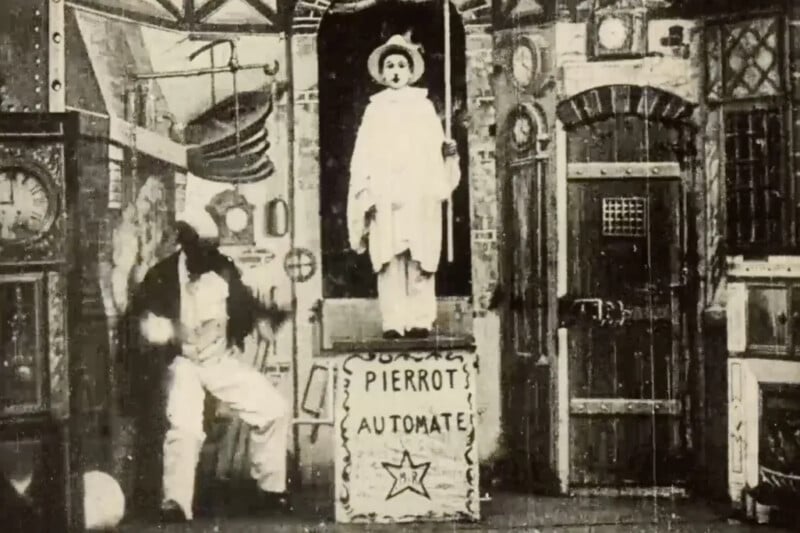
The film shows a magician, played by Méliès, interacting with a mechanical humanoid called Pierrot Automate, which stands on a pedestal decorated with a black star.
Technicians at the Library of Congress spent more than a week scanning and stabilizing the film into a digital format. Gugusse and the Automaton is now available to view online in 4K resolution. The extraordinary discovery was made last September but was only recently publicly announced.
Méliès, who started as a stage magician, turned to filmmaking after seeing early films by the Lumière brothers in Paris in 1895. At the time, the idea of moving images was still new. He later built his own camera and a glass studio, where he began experimenting with film techniques.
He found that stopping and restarting filming could create visual changes on screen. This led him to develop techniques such as double exposure, black screens, and forced perspective, which became widely used in early cinema. His films often showed characters appearing, disappearing, or transforming. One of his best-known films, A Trip to the Moon, includes the well-known image of a rocket landing in the moon’s eye.
Gugusse and the Automaton is a single-shot short film set against a painted backdrop of a workshop filled with clocks and mechanical figures.
Around 300 of Méliès’ films are known to still exist today, partly because copies continued to circulate even as originals were lost. The Library of Congress holds about 60 of them. The Gugusse and the Automaton print McFarland gave to the Library is a duplicate at least three times removed from the original.
Image creditsHeader photo via National Audio-Visual Conservation Center/ Library of Congress.
Affiliate Disclosure PetaPixel articles may include affiliate links; we may earn a commission if you buy through one.