Anamorphic Lenses Are Everywhere in Hollywood, Even Animated Movies
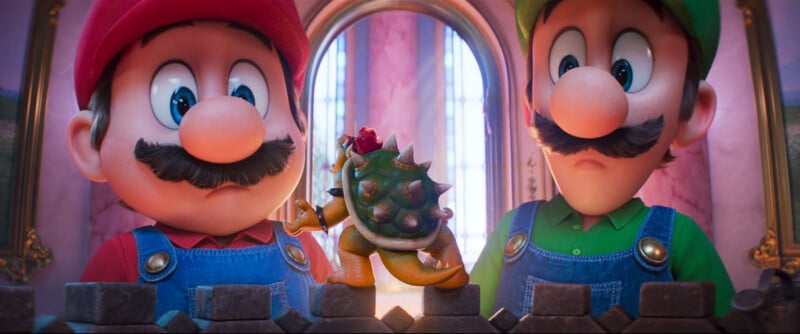
Anamorphic lenses are everywhere these days. From the small screen of television to the big screen of IMAX theaters, cinematographers often reach for anamorphics. These lenses not only deliver an ultra-wide, cinematic look but also feature distinct oval bokeh and exaggerated flare. The look is so prevalent in live-action filmmaking now that even animated movies, like the brand-new “The Super Mario Galaxy Movie,” are following suit and simulating the “look” of anamorphic lenses.
The fact that animated feature films are mimicking the look of anamorphic lenses is not too surprising. As I said, many new television shows and movies are shot, at least in part, with anamorphic lenses, so viewers have grown accustomed to the specific look and likely associate it, perhaps unconsciously, with a “cinematic” style.
CGI movies have long simulated things like chromatic aberration and noise to look more “cinematic.” Video games, for their part, have done the same. However, “The Super Mario Galaxy Movie” embraces realistic optical simulations for a very specific type of lens in a way I’ve never seen before.
When I was watching the “Super Mario Galaxy Movie” last night, like the faithful Nintendo nerd I am, I was admittedly distracted by how faithfully the CGI film replicates the look of anamorphic lenses, including optical limitations.
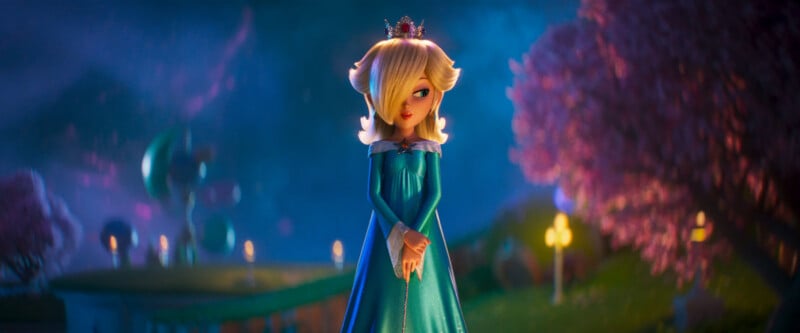
Very early in the movie, there’s a sequence set against a backdrop of streetlights and stars, and I couldn’t help but notice that the simulated bokeh didn’t feature circular out-of-focus highlights, but rather oval ones, like what happens when you shoot in real life with an anamorphic lens. Not only was the bokeh shaped in an anamorphic style, but it was also imperfect, with a cat’s-eye effect. The talented team at Illumination Studios did not use, or more likely craft in-house, an optically perfect simulation, but rather an imperfect one. Like light does not travel perfectly through a real lens, the computer-generated “light” in the “Super Mario Galaxy Movie” doesn’t either.
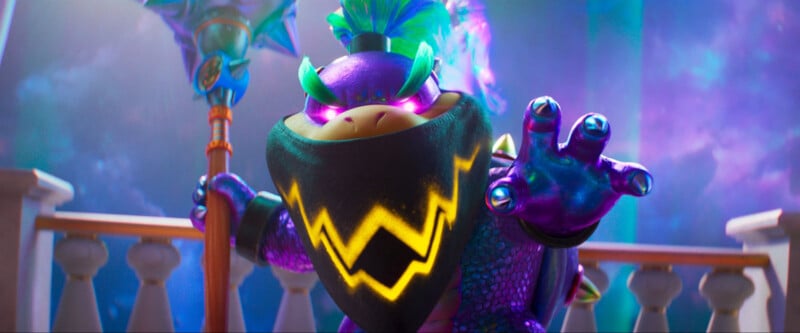
These optical imperfections, and I use the term “optical” very loosely, don’t stop at the shape of the bokeh. Just like when light fails to converge at a single point with an actual lens shooting a movie in real life, the “lens” in Nintendo’s latest blockbuster exhibits aberrations, fairly realistic ones no less. There are chromatic aberrations, color fringing, and softness near the edges of the frame. Then, of course, there’s the classic anamorphic lens flare. Thankfully, unlike in J.J. Abrams’ “Star Trek,” the “flare” slider for the “Super Mario Galaxy Movie” wasn’t set to 11.
Even though “The Super Mario Galaxy Movie” is aimed at families and falls into many of the same trope traps as most other animated, kid-friendly movies, including a threadbare plot and frenetic pace, it fully embraces elements of the cinematic look seen in Oscar-winning films.

There was something equal parts jarring and impressive to me about seeing aberrations, simulated cat’s eye bokeh effects, and light falloff seen with many cinema lenses in a movie featuring an evil turtle (sorry, Koopa), gallivanting across the cosmos while being chased by a pair of mustachioed plumbers in overalls, a green dinosaur wearing sneakers, and an anthropomorphic mushroom.
However, at the end of the day, “The Super Mario Galaxy Movie” is a big-budget Hollywood movie. Why shouldn’t it look like the rest of them? Just because it’s animated doesn’t mean it can’t embrace the look of live-action movies, physical optical limitations and all.
Image credits: Nintendo, Illumination Entertainment, Universal Studios