
This Failed Kodak Digital Camera From 2001 Was a Smartphone Precursor
These days, it’s easy to take for granted that a smartphone does just about everything. They run games, they make calls, they play music and movies, and, of course, they capture great photos and videos. But long before smartphones arrived on the scene, Kodak was actually at the cutting edge of combo camera devices. 2001’s Kodak mc3 was Kodak’s first foray into multi-function digital cameras, and the weird little device captured photos and videos and played MP3s.
“The new Kodak mc3 is the first portable unit that combines digital video with virtually unlimited recording, an MP3 player, and a digital still camera together for less than $300,” Kodak said in a press release in February 2001. “… the Kodak mc3’s unique combination of today’s most popular mobile features will appeal to active, Internet-savvy individuals who want to connect with their friends through video, music and pictures. And, it works with both Macintosh and Microsoft Windows computer platforms.”
“The mc3 offers an entertaining and simple way to create movies and share them with friends. It brings multimedia sharing to a single, fun, easy-to-use unit,” added Willy Shih, then president of Kodak’s Digital and Applied Imaging group. “It’s about much more than capturing images or listening to music. The mc3 provides flexibility, mobility and versatility it’s much more than the sum of its parts.”
But why are we talking about the Kodak mc3 now, almost exactly 25 years after its unveiling? The fine folks over at Tech Tangents just released the video seen at the top about the Kodak mc3, describing it as “everything but a smartphone in 2001.” It is a fun and interesting trip down memory lane and a good opportunity to look at a strange little multi-functional digital camera that, while not necessarily good in any meaningful way, offered a notable preview of what was to come in the tech industry.
As Tech Tangents explains, the Kodak mc3 is pretty bad at most of its core functions, but it was also the very first consumer device that could play media, play music, capture photos, and shoot video all in one. It was a groundbreaking device that helped set into motion many trends that persist to this day. For that alone, the Kodak mc3 is worth thinking about.
The mc3 is also interesting from a photographic history perspective. Given what happened to Eastman Kodak during the 21st century, including its very public collapse, it is easy to think that Kodak totally blew it when it came to digital camera technology. But that is a gross oversimplification. Yes, the rise of digital photography and consequential fall of analog photography did directly lead to Kodak’s dramatic fall and force the company into bankruptcy and a top-to-bottom retooling, but Kodak was also itself a hugely innovative digital photography company that reacted quite quickly to the coming digital revolution.
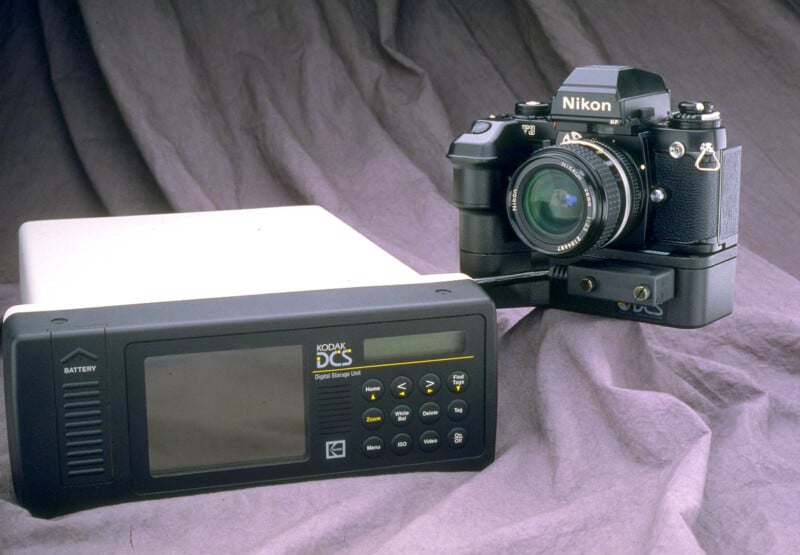
A 24-year-old Kodak engineer, Steve Sasson, created the world’s first digital camera in 1975, for starters. Kodak’s Digital Camera System was pioneering digital imaging technology in the 1990s, too. Kodak was there at the beginning of digital photography and was a key reason why it started to take off as a legitimate alternative to analog.
However, rather than remain an instrumental part of the burgeoning digital camera industry it helped create, Kodak ultimately failed to keep pace with its Japanese competition. Kodak started the digital revolution and, for a long time, lived at the front of the pack. But as Canon and Nikon gained momentum, Kodak lost it and never recovered. Kodak had great digital camera sales for years, but its market share steadily slipped, and the company went into a downward spiral.
What does this have to do with the Kodak mc3?
The mc3 was actually Kodak’s very first product to feature a Kodak-developed CMOS image sensor. The company was very good at CCD image sensors, but CMOS was becoming more common, and Kodak needed to figure out the technology.
The mc3’s KAC-0310 CMOS sensor itself is not that interesting, capable of taking low-quality 640 x 480-pixel photos and equally terrible video. But it arrived at a time when Kodak was trying desperately to make money from digital photography. The company had no issue selling cameras at first, but it lost money for each unit sold.
In 2000, Eastman Kodak attempted to stem the bleeding by entering the merchant image sensor business. As the company said at the time, it had been making image sensors for decades by the turn of the millennium. But it had not yet ever sold those image sensors externally. In 2000, more than half of the products that Kodak’s image sensor solutions unit made were used in Kodak cameras, which didn’t directly contribute to revenue generation, given that Kodak cameras were costing the company more money than they were making on the market.
“We want to change this operation from a cost center to a profitable business,” said Chris McNiffe in 2000. McNiffe was then vice president of marketing and sales for Kodak’s image sensor unit.
Until this point, Kodak had been using its CCD image sensors for its own cameras or selling them to industrial and medical imaging customers. The company refused to sell its sensors to competing camera companies.
“Our business model has changed,” McNiffe said. “We have not previously pushed into the digital camera market, but now we are willing to sell to anybody. We will let the market define our focus.”
As part of this shift, Kodak was actively developing new CCD and now CMOS image sensors, which it was developing alongside Motorola. The company’s KAC-0310 was among the very first CMOS sensors announced in 2000, and then found its way into the mc3 the following year.
Ultimately, for many reasons, the mc3 itself was a failure, but it hinted at something just on the horizon, another digital imaging revolution that would see multi-function devices — smartphones — completely transform and nearly destroy the digital camera market.
Kodak could have been one of the companies that benefited from this, thanks to its image sensor business. The company had a sense of what was coming, had shown innovation in the digital image sensor space many times before, and was willing to sell its image sensors to competitors.
But instead of capitalizing, Kodak tried to survive in the low-margin world of digital cameras. It did not work.
The company failed to adapt in the right ways and took the wrong risks at the wrong times. Kodak’s downfall is often depicted as the company being too slow to deal with digital photography, but I don’t think that’s really what happened. It wasn’t a lack of innovation or speed. Kodak was consistently a key player in the very beginning of important moments. It created digital photography, it made some of the first digital cameras, and as the mc3 shows, Kodak was even ahead of the curve with do-it-all digital cameras.
With the Kodak mc3, Kodak showed that a consumer digital camera can be so much more than just a camera. It even beat the iPod to the portable music player market by almost a year. But just like with digital cameras overall, being first wasn’t enough for the Kodak mc3 or Kodak as a company. Kodak chased digital cameras for too long when it should have pursued the underlying imaging technology.
It is not that hard to envision a world in which the first smartphones used Kodak-developed image sensors and Kodak cameras. It could have happened, and how different things might have been for the once-legendary Kodak.
Image creditsTech Tangents
Affiliate Disclosure PetaPixel articles may include affiliate links; we may earn a commission if you buy through one.