Canon R6 III vs Sony a7 V Dynamic Range: Which Mid-Range Camera Reigns Supreme?

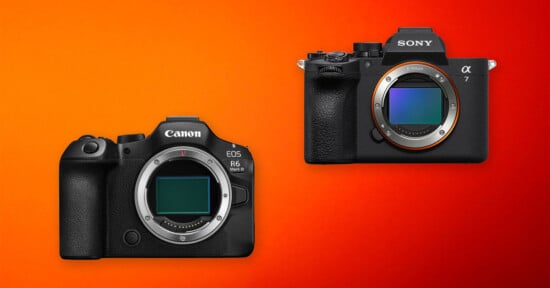
The ongoing battle of the latest superb mid-range cameras has a new chapter. Photons to Photos has published Canon EOS R6 Mark III dynamic range test results, enabling pixel-peeping photographers to see how the Canon R6 III stacks up against the Sony a7 V. Both cameras employ 33-megapixel full-frame sensors and target similar audiences at nearly identical prices, but they do many things differently, including image sensor technology.
Sony a7 V Dynamic Range: Dual Gain Output Powers the a7 V’s Success
In one corner is the Sony a7 V, which William “Bill” Claff of Photons to Photos tested last week. The a7 V and its brand-new 33-megapixel partially stacked image sensor delivers fantastic dynamic range, on-par with some medium-format cameras at base ISO, thanks to the utilization of Dual Gain Output (DGO). What initially looked like baked-in noise reduction turned out to be cutting-edge sensor technology. However, DGO is only utilized when using the mechanical shutter, so the a7 V’s electronic shutter dynamic range performance falls off dramatically.

Nonetheless, at its absolute best, the Sony a7 V tops out with a photographic dynamic range (PDR) of 12.47 at ISO 100 with its mechanical shutter. When using its electronic shutter at ISO 100, the a7 V’s PDR is 10.99, a sizable decrease made more prominent by the camera’s use of DGO with mechanical shutter to elevate its dynamic range above what would otherwise be possible. The a7 V requires the electronic shutter to shoot at its fastest continuous shooting speeds, and is otherwise capped at 10 frames per second with its mechanical shutter.
Canon EOS R6 III Dynamic Range: Not the Best but Better Than Before
Enter the Canon EOS R6 III, which does not use a partially stacked sensor. Instead, the R6 III gets the same new non-stacked 33-megapixel full-frame sensor that Canon originally debuted in the Canon C50 just a couple of months before the R6 III’s reveal. Like the Sony a7 V, the Canon R6 III requires the use of its electronic shutter to shoot at its fastest continuous shooting speed, which is 40 frames per second versus the a7 V’s 30. The R6 III also drops to 12-bit RAW capture at its fastest shooting speeds, while the a7 V retains 14-bit RAW capture. The real-world significance of this difference is debatable, but worth noting. After all, the dynamic range discussion about to play out is of significantly varying relevance in real-world photography situations, too.

When using its mechanical shutter, the Canon R6 III peaks at 11.61 PDR at its base ISO (100), which is impressive. While the a7 V’s DGO tech elevates the camera’s dynamic range, the R6 III is still performing very well here. However, it is worth noting that the Canon R6 III employs baked-in noise reduction at base ISO. This, common to Canon cameras, can improve apparent dynamic range performance. It’s not necessarily a good thing to have baked-in noise reduction in RAW files, but it is worth pointing out that the R6 III’s RAW image quality with its mechanical shutter remains excellent, noise reduction and all.
When the R6 III switches to its electronic shutter, which is necessary for shooting speeds above 12 frames per second, the dynamic range takes an expected hit, bringing peak dynamic range down to 10.5, per Claff’s testing. The R6 III also uses noise reduction with its electronic shutter below ISO 200, like the camera’s mechanical shutter capture mode.
While the R6 III can’t match the a7 V’s peak photographic dynamic range, it is nonetheless an impressive performer. It is better in the base-case scenario than its predecessor, the outstanding R6 Mark II, for example, albeit not by a massive margin. The R6 II tops out at 11.52 PDR with its mechanical shutter. However, the R6 II utilizes noise reduction across a wider ISO range, up to just below ISO 1600.

But there is much more to this story. The R6 II’s electronic shutter dynamic range tops out at 9.59, which is pretty low. Granted, unlike the R6 III, the R6 II doesn’t use noise reduction at any ISO speed with its electronic shutter, but the R6 III betters its predecessor in this arena by nearly a full stop. That is a significant difference, albeit one that must be tempered by the inclusion of noise reduction in the R6 III. At ISO 200, where neither camera uses noise reduction with its electronic shutter, the R6 III’s advantage drops to about one-third of a stop.
Dynamic Range Showdown: Takeaways
As soon as Bill Claff published his Sony a7 V dynamic range results, PetaPixel has been clamoring for the R6 III to be added to the charts. As expected, the a7 V is the better performer in dynamic range with both mechanical and electronic shutters.

There are a couple of obvious takeaways from the results. The Sony a7 V’s Dual Gain Output (DGO) offers significant benefits in certain situations, particularly when using the mechanical shutter at base ISO. In the best-case scenarios, the a7 V delivers superior dynamic range compared to the R6 III. PetaPixel already described the a7 V’s image quality as superior to the R6 III in its Sony a7 V Review. On paper and in real-world use, the a7 V’s image quality is a bit better.
Beyond DGO being highly beneficial in overcoming traditional image quality and dynamic range limitations of partially stacked and stacked image sensors, Photons to Photos results are interesting for the R6 III in a vacuum. Despite increasing the megapixel count from 24 to 33, the R6 III offers better dynamic range than its predecessor. It isn’t much better, but it’s better nonetheless.
So where does that leave photographers seeking the best 33-megapixel mid-range camera in 2025? Well, dynamic range is but one factor of overall image quality, and image quality is itself just one thing photographers must consider when weighing their options. Both the Sony a7 V and Canon EOS R6 Mark III offer tons of performance to photographers and videographers.
The Canon R6 Mark III won both PetaPixel‘s Camera of the Year Award and the People’s Choice voting. The R6 III also won the “Best Photographic Camera” category in PetaPixel‘s annual Best and Worst show.
Across the board, the Sony a7 V came in just barely behind the R6 III, but it’s far from a consolation prize. It’s a fantastic camera, especially for photographers, and as the detailed testing shows, it takes the dynamic range crown in its showdown with the Canon R6 III. For some photographers, that’s more than enough. For everyone else, the Canon R6 III and Sony a7 V are both among the best, most versatile cameras ever made.
Image credits: Canon and Sony. Dynamic range testing and charts by William J. Claff at Photons to Photos. Header photo created using assets licensed via Depositphotos.