Sony a7 V Has New 33MP Partially Stacked Sensor and Faster Processor
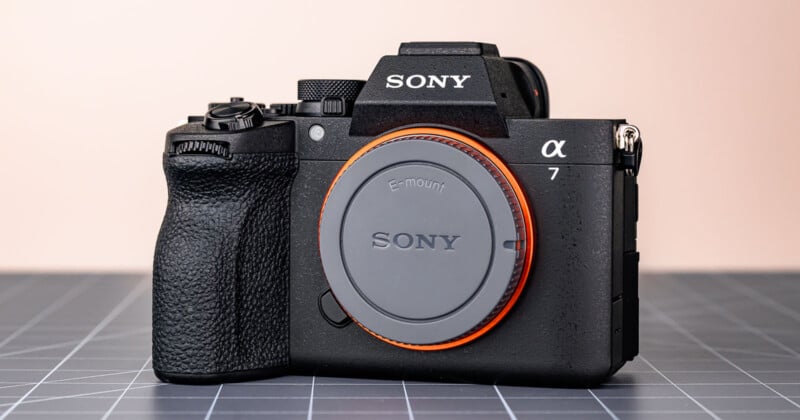
The long-awaited Sony a7 V has finally arrived, just over four years after its predecessor, the a7 IV. Much has changed in the camera landscape, not just for Sony but also for its primary competitors. The Sony a7 V promises a wide range of improvements, including a new image sensor, faster processor, better autofocus, and much more.
Since Sony unveiled the a7 IV in October 2021, the company has released its fair share of full-frame interchangeable lens mirrorless cameras. The a7R V, for starters, ushered in the era of dedicated AI processors in Sony’s high-end cameras in October 2022. The Sony a9 III and its global shutter sensor kickstarted a new camera body design in late 2023, a trend the flagship a1 II continued last fall. The new Sony a7 V embraces many of the changes and improvements Sony has made over the past four years.
For example, the heightened emphasis on AI processing power has led to a brand-new Bionz XR2 processor that combines image and AI processing in a single unit. The a7 V, despite being aimed at enthusiasts, is Sony’s first camera to incorporate the new Bionz XR2.
Slight Design Tweaks Promise Usability Improvements
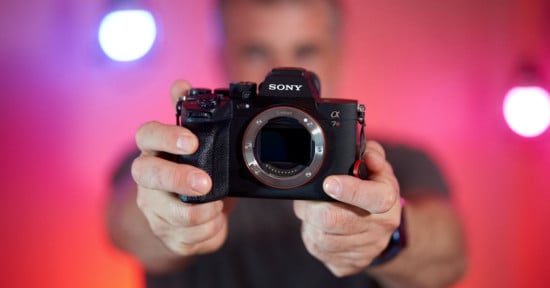
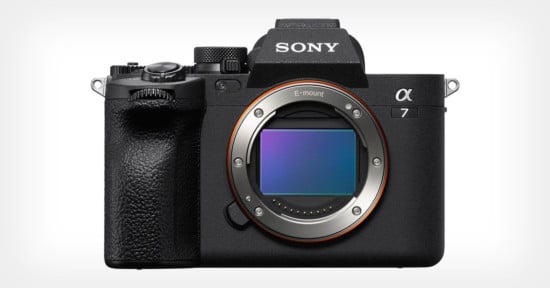
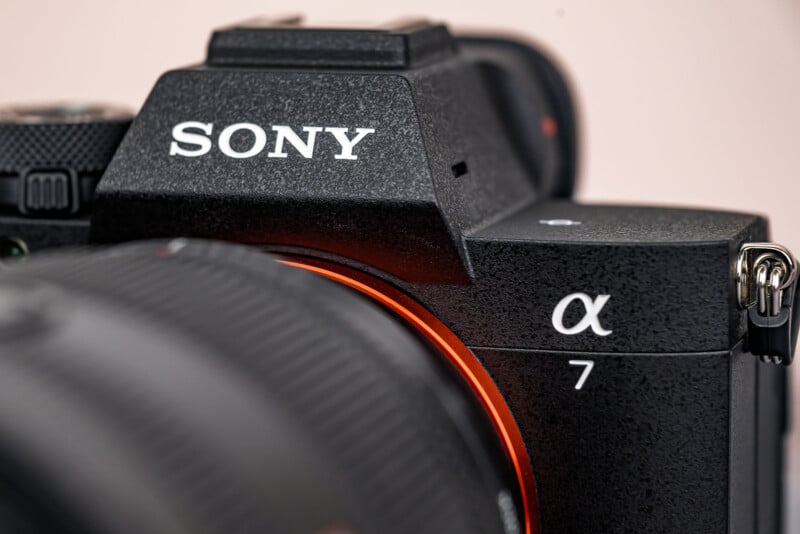
The a7 V doesn’t get the a9 III and a1 II’s all-new body design, which is not surprising given that it is not a professional-oriented camera. Still, the a7 V does borrow the a7R V’s tweaked grip shape, promising improved ergonomics and comfort. Other aspects of the a7 V’s body are familiar, including the four-axis multi-angle monitor and the 3.68-million dot Quad-VGA OLED EVF. The four-axis screen is upgraded. It is 3.2 inches diagonally and has 2.1 million dots and DCI-P3 wide-gamut support, borrowed from the a7R V.
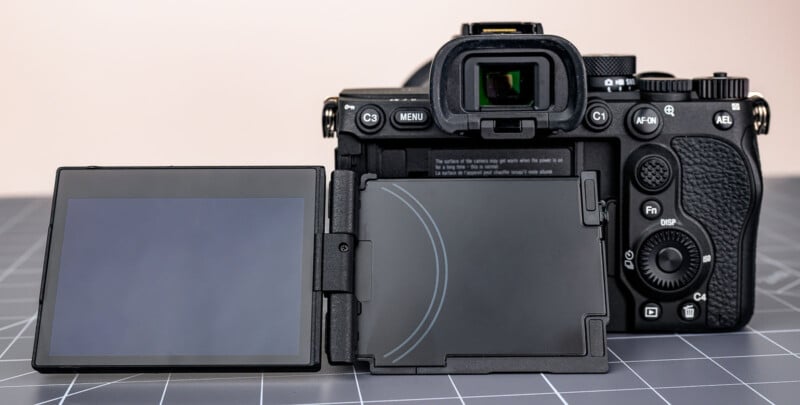
While the EVF itself is unchanged, still offering the same 0.78x magnification and resolution, it is functionally improved thanks to the a7 V’s new processing power. The a7 V, unlike its predecessor, offers blackout-free shooting through the EVF at up to 30 frames per second.
The Sony a7 V features a dust and moisture-resistant design. It has reinforced sealing around its buttons, doors, mounts, and seams to ensure durability, although it is not quite as rugged as the a9 III or a1 II. Sony notes that the a7 V has a unique graphite heat sink built into its stabilization unit, which helps ensure consistent performance when recording 4K video. The camera is rated to capture 4Kp60 video for 90 minutes at room temperature (68° F) and for an hour at 105° F.
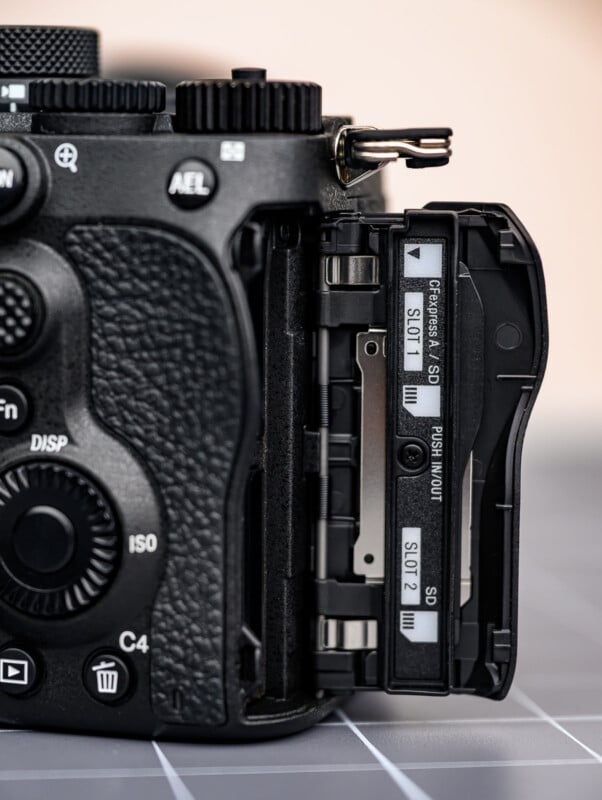
The a7 V features dual card slots, one that accepts CFexpress Type A and a second that takes a UHS-II SD card.
The Sony a7 V weighs approximately 695 grams (24.5 ounces) and is nearly the same size as its predecessor. It is 130 x 96 x 72 millimeters (5.1 x 3.8 x 2.8 inches).
New 33MP Partially Stacked Sensor Powers All-New Imaging Pipeline
The Sony a7 V has the same megapixel count as the a7 IV, but its 33-megapixel image sensor is different. The new partially-stacked backside-illuminated image sensor promises improved sensor readout speed, better performance, and superior image quality compared to its predecessor.
Sony promises up to 16 stops of dynamic range when using the mechanical shutter and nearly as good of performance when using the electronic shutter that is required for the a7 V’s top-end shooting speeds of 30 frames per second. The camera remains fast when using its mechanical shutter, too, by the way, capable of shooting at 10 fps, which was the a7 IV’s top shooting speed even when using its electronic shutter.
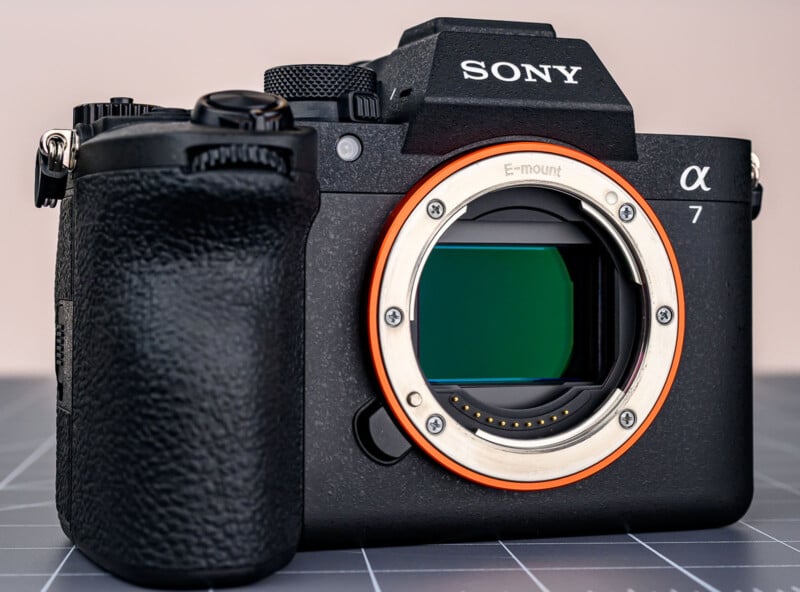
Much like the a7 V is the first Sony Alpha camera to incorporate the new Bionz XR2 processor and its unified design, so too is the a7 V Sony’s first camera to sport a partially stacked image sensor. A partially-stacked design promises much of the speed of a fully-stacked sensor at a lower price point, making it a wise choice for a mid-range model like the a7 V. Compared to the non-stacked sensor in the a7 IV, the a7 V’s new 33MP sensor is also significantly faster, and the camera is better up to the task of action photography, including sports and wildlife.
The Sony a7 V also offers features for photographers seeking even more resolution or cleaner files. The camera supports composite RAW shooting to produce 199-megapixel final composite files and includes a multi-shot noise reduction mode. These require using Sony’s desktop software, though.
Improved AI: Autofocus, Auto White Balance, and More
With the new Bionz XR2 processor and its integrated AI processing unit, the a7 V promises improved autofocus performance. The camera has a 759-point hybrid autofocus system that covers about 94% of the full-frame image area. The a7 V’s autofocus system is rated down to -4 EV, an improvement over the a7 IV’s -3 EV rating for low-light AF.
While the a7 IV had some basic subject-detection features, the a7 V offers much more robust capabilities. The camera has automatic subject detection and specific modes for human, animal, birds, insects, cars, trains, and planes. The a7 V also includes automatic framing based on subject detection.

Sony notes that the a7 V’s autofocus is faster and more effective than its predecessors, especially in subject detection and tracking.
Thanks to the integrated AI processor, the a7 V also offers AI-based automatic white balance, promising improved accuracy and color rendering. The AI also drives body pose estimation, which improves performance when photographing people.
Speed and Performance
As mentioned, the a7 V has a new partially stacked image sensor and a new Bionz XR2 image processor. Together, these improvements enable faster continuous shooting than before — 30 frames per second versus 10 when using the electronic shutter.
The a7 IV’s traditional, non-stacked 33-megapixel sensor received its fair share of criticism for its lack of speed. Sony notes that the a7 IV’s rolling shutter is 67ms, while the a7 V has rolling shutter just over 12ms.
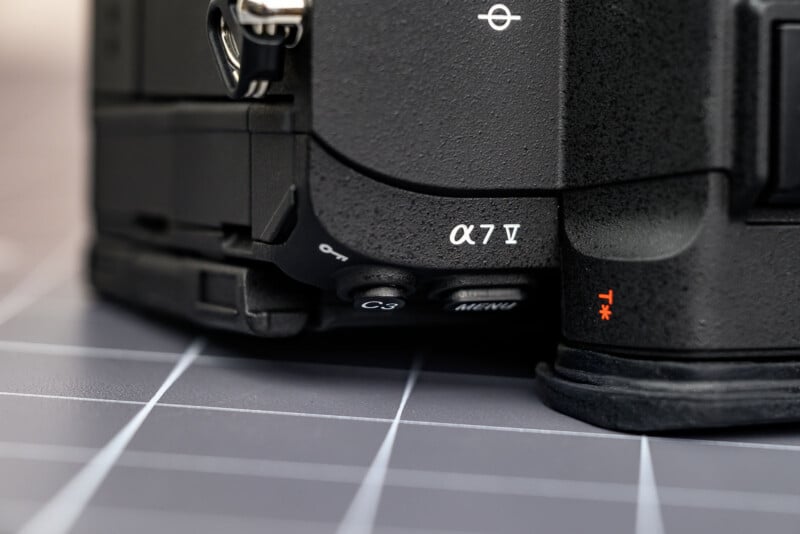
The a7 V, in addition to having a blackout-free EVF, also has another performance feature the a7 IV lacked: pre-capture shooting. The a7 V’s new pre-capture mode works with any selected drive mode and captures up to one second of RAW/JPEG frames (a maximum of 30) before the photographer fully presses the shutter. This is a handy feature for capturing action sequences, especially unpredictable wildlife and sports ones.
The a7 V also includes Sony’s Speed Boost function. While it lacks the dedicated front function button for Speed Boost, meaning photographers must custom set the function, it means that photographers can shoot at 30 frames per second only when it’s required rather than shoot consistently at speedy frame rates.
The Sony a7 V has an improved five-axis image stabilization system, promising up to 7.5 stops of correction in the center of the frame, up from 5.5 stops on the a7 IV.
Thanks to the a7 V’s new, more efficient processor, it also offers better battery life. The camera is rated for up to 630 shots with the EVF and 750 with the LCD, though real-world performance is expected to exceed CIPA ratings.
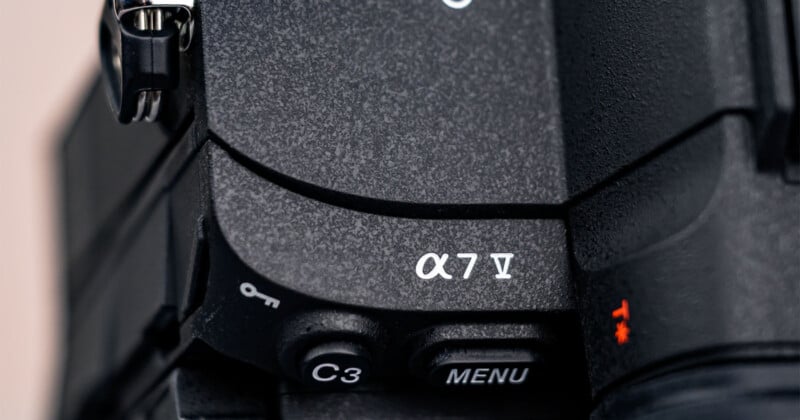
New Video Features: Still No Open Gate
The Sony a7 V records 7K-oversampled 4Kp60 video using the full width of its sensor and 4Kp120 in a Super35 crop.
This is a notable improvement compared to the a7 IV, enabled by the a7 V’s new partially stacked sensor. The a7 IV’s full-width 4K recording topped out at 30p, while 60p required a Super35 crop.
The a7 V includes S-Log3, S-Gamut3, S-Gamut3.Cine, and works alongside user-imported LUTs. It also features Sony’s Breathing Compensation with compatible lenses, and, thanks to the improved IBIS and better processing, the a7 V includes Sony’s Dynamic Active Mode stabilization.
When it comes to audio, the camera supports four-channel, 24-bit recording and has a new audio reference mic used for noise reduction. The camera’s Multi Interface Shoe supports the latest digital audio devices, and it includes both mic and headphone ports.
While these features and improvements are noteworthy and help the a7 V keep pace with its primary competitors, the camera also has some notable omissions. The a7 V does not support internal RAW recording and lacks open-gate recording. Whether the lack of these features moves the needle for all hybrid creators or not, they are features that multiple cameras in the a7 V’s price bracket offer.
Pricing and Availability
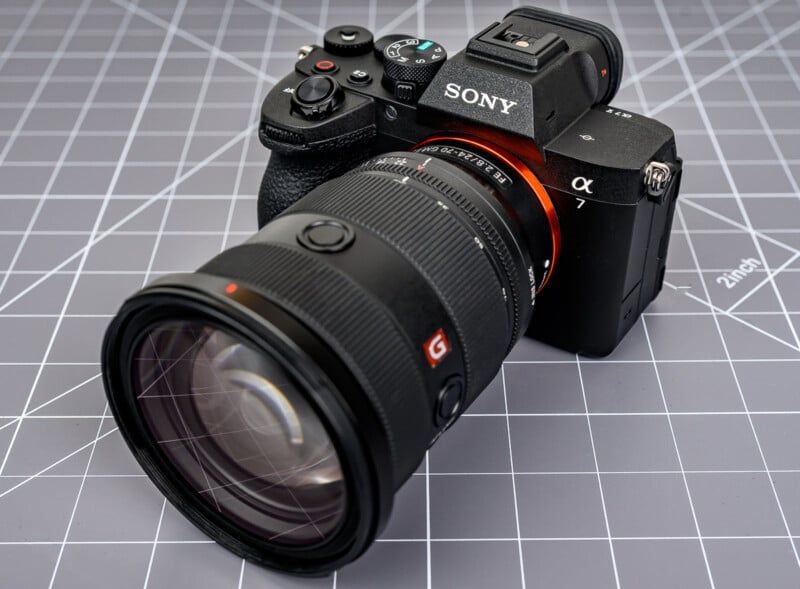
The Sony a7 V will be available later this month in the United States for $ 2,899 and in Canada for $3,699.
Image credits: Product photos by Erin Thomson for PetaPixel