Nat Geo Pictures of the Year Celebrates Most Powerful Photos of 2025

On the left, a close-up of a shark embryo inside its egg sac, illuminated to show veins and details. On the right, a great white shark swims near the water’s surface with its mouth slightly open.

National Geographic has unveiled its annual Pictures of the Year, showcasing 25 incredible images that exemplify National Geographic‘s acclaimed storytelling.

Every year, National Geographic photographers and contributors capture hundreds of thousands of photos while on assignment. A small portion of these end up published, while a much smaller group is selected for Pictures of the Year.

The selected photos feature a wide range of subjects, including wildlife, scientific discoveries, and compelling human narratives. They also feature many different approaches to photography, including compositing, drones, remote cameras, and underwater housing.
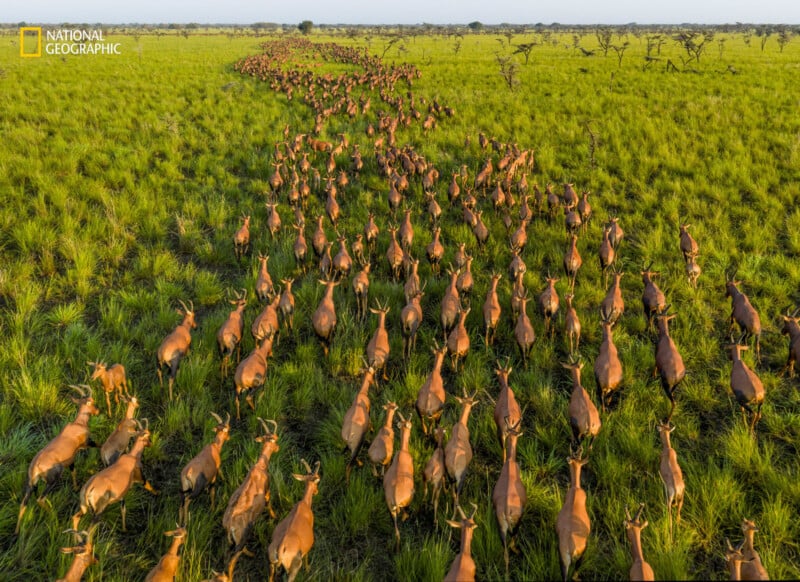
A large herd of antelope moves across a vast, green savanna under a clear sky, seen from above. The animals form a winding path through the tall grass. National Geographic logo appears in the upper left corner.
A long-awaited aerial wildlife survey released by South Sudan revealed something extraordinary. An estimated six million antelope were documented traversing the eastern plains of the country, changing our understanding of how many animals move across this part of Africa. Photographer Marcus Westberg used a drone to record the phenomenon, the planet’s largest land migration, calling it a “symbol of hope” for a region that has experienced years of civil unrest. (Photo by Marcus Westberg)

One of the standout images shows the first underwater photograph ever of a great white shark in Maine, while another shows the largest land migration on Earth as seen by a drone. Another photo shows the moment an egg transformed into a chick, while another selected shot captures a female polar bear preying upon a massive sperm whale in Svalbard, Norway.

A close-up image of a chicken embryo inside a translucent egg, showing intricate red veins and blood vessels illuminated against a dark background. National Geographic logo appears in the top left corner.
For years, photographer Anand Varma has attempted to document when an egg yolk can still be seen but a bird form has clearly emerged. He experimented by incubating embryos in artificial shells before finally capturing the transformation at 12 days old. Varma separately raised some embryos to chicks, which he donated to people in the community. (Photo by Anand Varma)
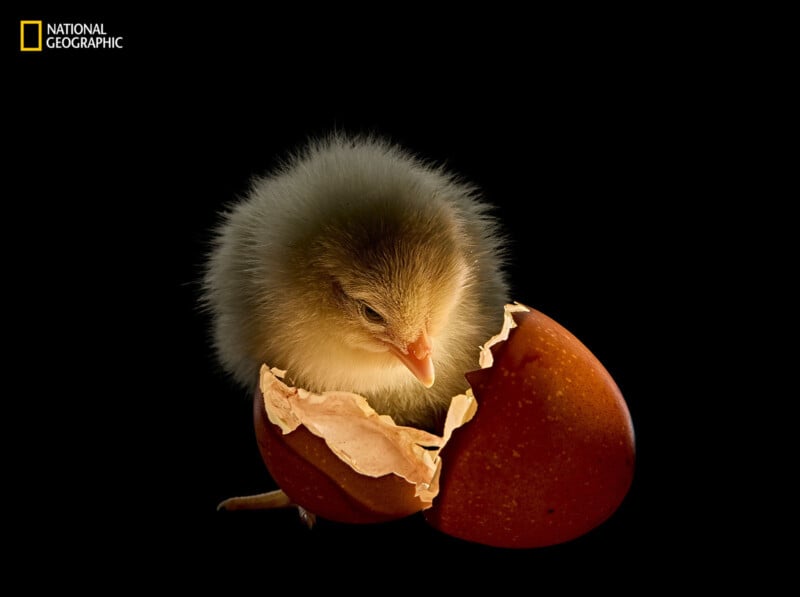
A fluffy chick sits emerging from a cracked brown eggshell against a black background. The National Geographic logo appears in the top left corner.
For years, photographer Anand Varma has attempted to document when an egg yolk can still be seen but a bird form has clearly emerged. He experimented by incubating embryos in artificial shells before finally capturing the transformation at 12 days old. Varma separately raised some embryos to chicks, which he donated to people in the community. (Photo by Anand Varma)

“Pictures of the Year is a project that is always inspiring and thought-provoking,” says National Geographic editor-in-chief Nathan Lump. “Each year, our photographers and editors sift through thousands of images, searching for those rare moments that stop us in our tracks. Individually, these photographs speak to beauty, fragility, and wonder. ”

“Taken together, I see a collective sense of urgency — a call to preserve what’s in danger of being lost, as well as a reminder of the poetic beauty to be found in carrying on, in daring to dream of a better future,” Lump continues.
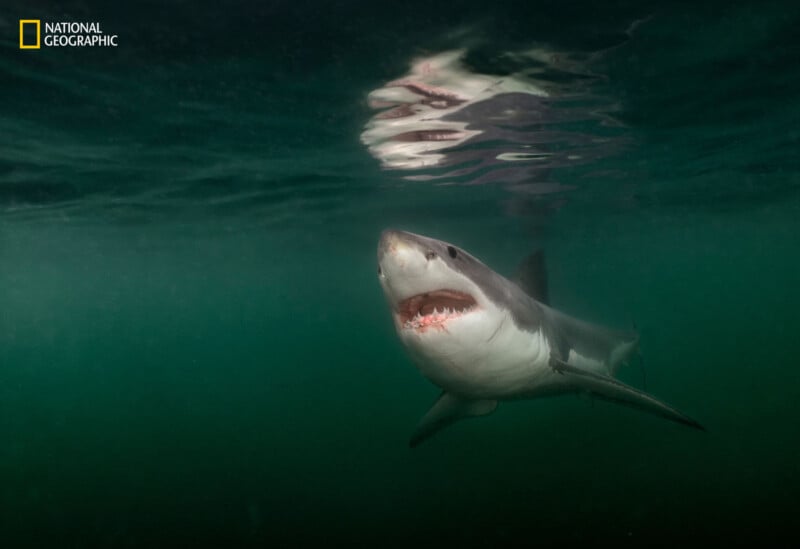
A great white shark swims near the water’s surface with its mouth slightly open, revealing sharp teeth. The dark green ocean contrasts with the shark’s pale body. The National Geographic logo is visible in the top left corner.
Photographer Brian Skerry has been chronicling marine life for decades, but this image represents his first run-in with a great white shark in the Gulf of Maine, a place he did not expect to encounter one—especially from four feet away. Sightings of sharks like this 10-footer are increasing from Cape Cod to Nova Scotia, perhaps due in part to changing climate patterns. (Photo by Brian Skerry)
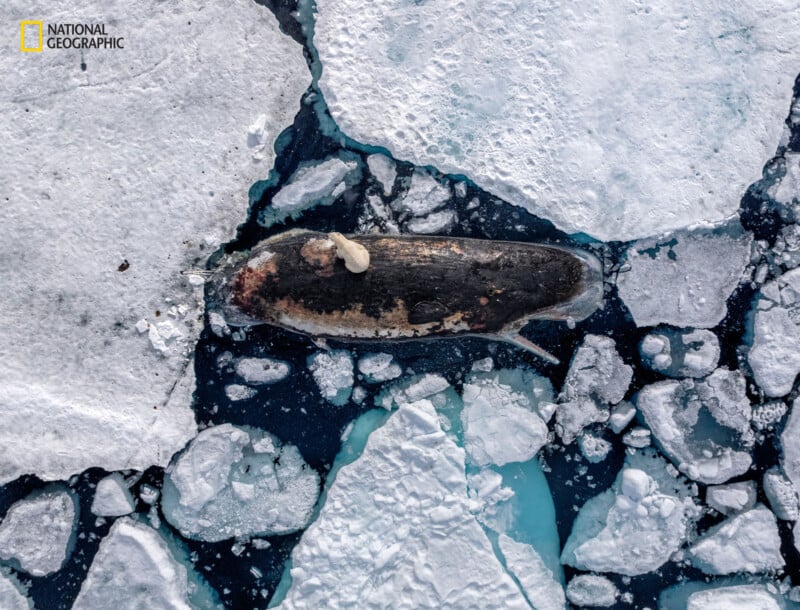
Aerial view of a narwhal swimming among floating chunks of ice in dark blue Arctic water, with the National Geographic logo in the top left corner.
A sperm whale floats amid shards of polar pack ice, dead and decomposing, mouth hanging open. When photographer Roie Galitz captured the scene with a drone, the image was so arresting that it took a moment to notice the hungry female polar bear stretching her jaw to break through the whale’s leathery skin. Galitz was leading a photography expedition along Norway’s Svalbard archipelago when he spotted a blackened blob floating on the horizon. As the icebreaker drew close, he could see (and smell) that the blob was a massive decaying carcass releasing an occasional exhalation of noxious gas, “like a big air cushion.” The encounter raised a curious question: What was a sperm whale doing here? The species prefers temperate climes, but as Arctic waters warm, some whales are moving beyond their traditional range. Strong currents and winds might also have pushed it north, a happy surprise for both Galitz and the bear, which worked hard for the feast. “You can see she’s trying to get in and get through, but the hide is just so thick.” (Photo by Roie Galitz)

The complete set of National Geographic‘s Pictures of the Year 2025 is available on Nat Geo’s website and in the December 2025 issue of National Geographic.
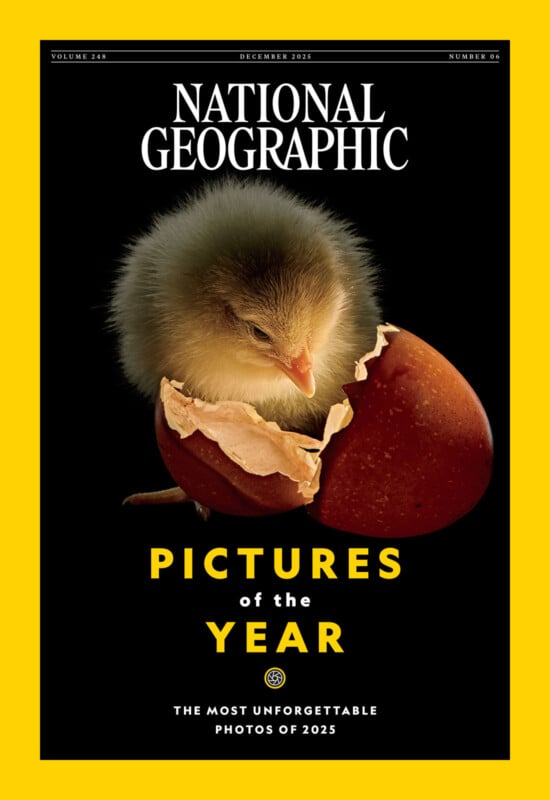
Cover of National Geographic magazine featuring a chick emerging from a cracked eggshell on a black background, with the text "Pictures of the Year" and "The Most Unforgettable Photos of 2025.

Readers are invited to participate as well by sharing their photos and videos of the year on social media using the hashtag “#NatGeoYourShotPOY25” from now through the end of December. Nat Geo photo editor Anne Farrar will select her favorites to be featured on @NatGeoYourShot.

This year’s retrospective also includes an in-depth look at Stephen Wilkes’ day-to-night images, two of which have been selected for this year’s Pictures of the Year. PetaPixel spoke to Wilkes ahead of today’s reveal for a separate Feature Story. (LINK)


Image credits: National Geographic. Individual photographers are credited in the photo captions, which National Geographic has provided.
Discussion