Sigma’s First Camera: The Sigma Mark-I is a Rare, Lovable Little Tank
Earlier this year, while touring the Sigma factory in Aizu, Japan, I walked into a small showroom where the company pays homage to its history with samples of almost every product it has ever made. That’s when I saw it: the most beautiful camera I’d ever laid eyes on. I had to have it.
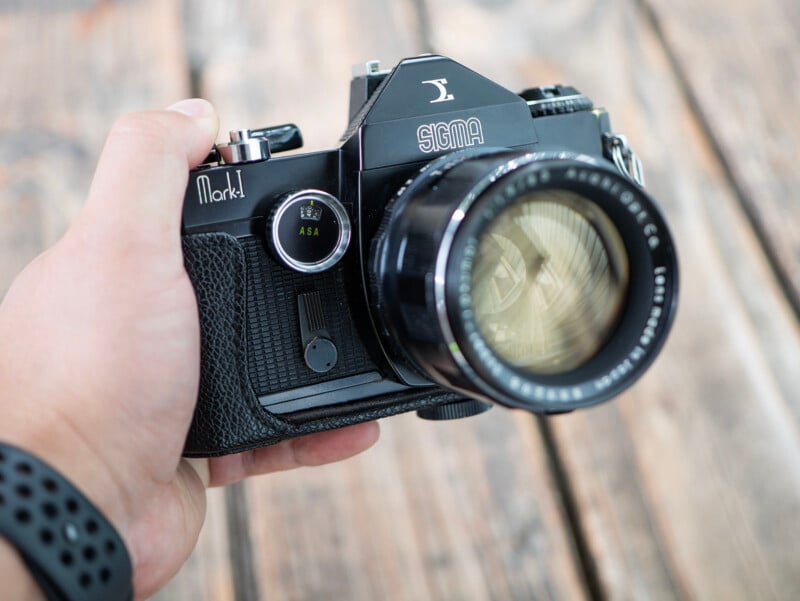
Sitting at the end of the first table was the Sigma Mark-I, a camera I’d never heard of before, let alone seen. It caught my eye almost immediately. As a huge fan of Nikon’s F and FTn design, I am attracted to thick cameras with sharp edges that make a strong statement at first glance. I immediately b-lined for it and, after assuring it was okay to touch it, I picked it up.
It was even more glorious in hand than I imagined.
Love at First Sight
Thick, heavy, and clearly built to withstand an active war zone, I laughed at the happenstance that the logo atop the pentaprism was the classic “Σ” logo that Sigma had, just the day before, revealed it would be using again.
I cocked the film advance reel and fired a shot. The loud and harsh “clunk” that I was rewarded with was music to my soul. I turned it around and looked at its face, and the oddly-placed ISO and shutter speed dial looked right back at me. I had to have it.
I immediately rapid-fired questions at the poor showroom attendant. When was this made? How many were produced? What mount does this take? Does it have a light meter?
1976. About 2,000. M42 screw mount. Yes.
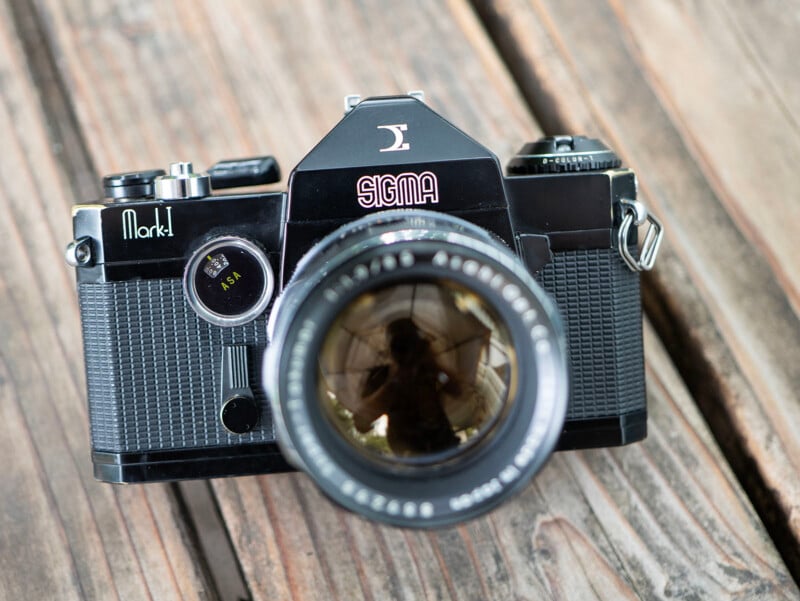
My heart sank. About 2,000? No wonder I’d never heard of it before. If Sigma only made around 2,000 total cameras nearly 50 years ago, there is no telling how few of them survived, let alone survived in working order. I looked down at the Mark-I in my hands and started to see the details. The camera was old and was showing it. The viewfinder was obscured by dust and had become quite hazy. The mechanics were still working, but the gears felt tight. It was not in particularly good condition.
If this was the quality of the Mark I had in its own museum, what hope did I have to find one in the wild? I couldn’t help but look, and started my search immediately.
Google results yielded very little. While a few photographers had written about their experience with the camera as recently as 2021, Google didn’t immediately hit me with shopping results, which is a bad sign. Undeterred, I fired up eBay and was greeted by a single result.
One. One camera in the entire world was available… and I could afford it.
Despite the fact that it is as close to unobtainium as you can imagine, it’s not because it’s highly collected. Quite the opposite: it seems like most photographers were in the same position as me and didn’t even know this camera existed. So there one was, sitting in a camera store in Germany, and paired with the Sigma XQ MC 39-80mm f/3.5 lens for just £120.72 — about $160.

I tried to buy it, but hit a wall: the seller wouldn’t ship to the United States. Luckily, I was standing next to my friend Gordon Laing, who lives in the United Kingdom. I convinced him to buy it for me, and I would get it from him the next time we met up, which was going to be just a month later in Prague for the Fujifilm event where the GFX100RF would be announced. He agreed, confirmed the purchase, and the wheels were in motion.
Before we met up, Gordon messaged that the camera looked to be in astonishingly good condition. In his words, it looked as though it had been cleaned and then set on a shelf ages ago. It looked brand new. It wasn’t stored with a battery in it either, so it looked like all the electronics were in working order, too.
When I finally got the camera in my hands, my jaw dropped. It is entirely possible that this is not only one of the few remaining Sigma Mark-I cameras in the world, but it might also be the one in the best condition. Gordon wasn’t kidding; it looked brand new. Outside of some of the interior flaking onto the pentaprism, which I was easily able to remove with a Q-tip, there were only minor signs that this camera had ever been used before. The metal corners on the top plate had some light wear, which shows via a copper patina that I think looks beautiful, and the hot-shoe was just slightly off kilter (it’s unclear if this is due to age or if it had not been installed perfectly straight back in 1976).
Whatever the case, I had it. The Sigma Mark-I was mine.
A Camera Nearly Lost to Time
I mentioned this camera was obscure, and that carries over to the employees of Sigma. While some definitely recognize it, there are many who have never seen it before. Sigma’s CEO, Kazuto Yamaki, remembered it and mentioned that it was a project Sigma undertook through a collaboration with Pentax. That explanation certainly makes sense given the M42 screw mount and the fact that its shutter mechanism feels very similar to the ones Pentax was making at the time. More on this shortly.
If you’re familiar with film cameras of this era, the design of the Mark-I might look a bit familiar, and that is because it is based on the Pentax Spotmatic. Back in 1976, Sigma had the desire to make a camera but not all of the resources to do it from scratch. It, therefore, partnered with Pentax to get most of the way there and then tweaked the design to fit Sigma’s vision. It, therefore, shares a lot in common with the Pentax Spotmatic, but it is still unique.
It was in the design where Sigma decided to stand out. The film winder is significantly chunkier (and surrounded by a dial that helps you remember if you’re shooting black and white or color film, another feature borrowed from the Spotmatic), the advance lever is bigger, and the shutter button is more forward-oriented to the point the edge hangs slightly over the front of the top plate. That film advance lever is a single-stroke design with 120 degrees of throw.
Instead of placing the ISO or shutter dial on the top plate, which would somehow crowd that space despite the fact that Sigma made everything slightly bigger, it elected to place it on the face of the camera, to the left of the lens mount.

It’s an odd place for this dial, and your middle finger is almost always touching it when you hold the camera to take a photo. I suppose the idea is that you could more easily access this button without taking your eye away from the viewfinder, but it doesn’t really work well in practice.
I find it to be one more lovable and endearing quality about this camera.
In preparing for this feature, we actually acquired the original brochure and sales sheet for this camera, deep from within Sigma’s archives. They are a treasure.
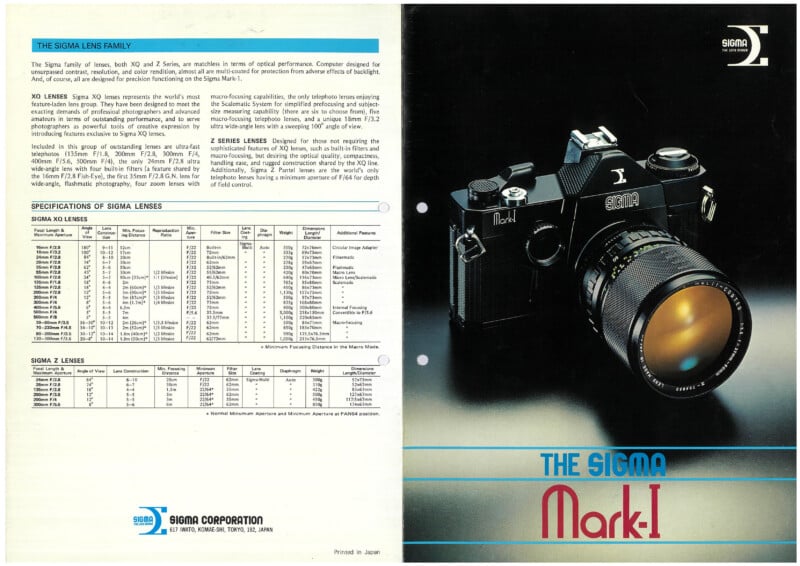
“Now at last, a camera is available which offers optimum performance with Sigma lenses and simultaneously meets the urgent requirements of the photo enthusiast. The basic design concept of the Sigma Mark-1 is one of simple dignity. The camera body and viewfinder remain uncluttered, allowing the photographer to concentrate on the image without distraction. And to respond quickly enough to capture precious moments, as they occur, spontaneously,” it reads.
“Foremost exposure accuracy is attained by coupling the two sensitive sensors, located within the viewfinder system, to a precise all-metal focal plane shutter which is designed to maintain its accuracy in all types of temperature and humidity extremes. Moreover, this highly durable marvel of engineering offers a full range of shutter speeds, from 1 second to 1/1000 second and Bulb. Additionally, electronic flash units will synchronize at all shutter speeds up to 1/125 second. Exposure accuracy is assured with all film speeds from ASA 20 to ASA 1600, a range broad enough to cover every need.”

Of note, the Mark-I features a shutter speed range from Bulb and one second all the way up to 1/1000 second, which was the standard for the time. The shutter construction is a six-blade, vertically moving focal plane shutter.

The camera also has a light meter, displayed on the right side of the viewfinder via an indicator needle set between two brackets, which is likely a carbon copy of the one found in the Spotmatic, and is in perfect working order. That said, because of the age, I did have to get a battery converter since the Mercury batteries of the time don’t match the voltage of current batteries, even if the same size is available. That wasn’t hard, though, as converters are readily available.
The light meter is turned on and off via a big switch on the left side of the lens mount, and it is my only major complaint about this camera design. The switch is vertically oriented, so it’s easy to turn it both off and on unintentionally. It can be on, but just a walking motion can knock it down a hair, which disengages it. It can be off, but it is easily swapped on when putting it into a bag. It’s a finicky little switch, but I appreciate the built-in, accurate light meter being there at all, so I was quick to forgive this transgression.


“The Mark-1 does not boast of being the lightest camera currently available,” it continues in a line that still brings a smile to my face (because yeah, this thing is a brick and the body alone weighs 770 grams). “For rugged construction, not compactness, was the primary concern of the Sigma engineers. It is designed for those who desire a camera that will survive years of hard use and always prove reliable.”
I love that description, because I agree: it looks like the Mark-I could take a bullet and still fire off a photo undeterred.
“In addition to optimum performance with Sigma lenses, lasting quality, exposure accuracy, and versatility, the Sigma Mark-1 offers a host of features including a sure-grip body surface; built-on hot shoe for cordless electronic flash operation; contrasty viewfinder for rapid focusing; large, easy-to-manipulate controls; depth-of-field preview; handsome, all-black, professional finish; deluxe carrying case and fumble-free neck straps; film reminder dial; self-timer.”
Much to my surprise, my $160 investment not only included the camera and lens, but it also included the original leather carrying case. It too is in shockingly good shape. Leather like this easily flakes and cracks, so seeing just a few places where that’s starting to happen tells me a lot about how well cared for this Mark-I was. The case is also incredibly nostalgic: it smells like a grandfather’s book collection. Iconic.
Looping back to the included lens, it’s not my favorite, and I immediately replaced it with two Pentax Super-Takumar prime lenses — a benefit of the design that Sigma actively points out in its sales brochure. But I absolutely adore the description:
“Shorter in length than a 100mm cigarette, this scalpel-sharp, ulti-coated optic simultaneously serves as a wide-angle, standard, telephoto, macro, and zoom lens. The image can be framed within the viewfinder exactly as desired simply by twisting the Zoom Ring. Moreover, the entire zoom range can be covered with a mere quarter turn of the Zoom Ring.”
We need to go back to measuring things with a 100mm cigarette.
The Sigma Mark-I: How It Shoots
My Sigma Mark-I is in perfect working order. The shutter is immaculately timed, and the light meter is fantastically accurate. The film advance lever feels like a dream, and you can hear the gears moving inside, a sound that is incredibly satisfying. And the shutter, oh the shutter, is just as soul-feeding as the one I held in Aizu.
It’s also very loud.


Chris Niccolls has stood near me when I have fired the Mark-I, and he has regularly laughed at how loud this camera is. You aren’t going to take a stealthy picture with the Sigma Mark-I: it sounds like a .22 caliber handgun. The mirror slaps when you fire a shot. I absolutely love it.
The Mark-I is a very simple camera, much like the Nikon F, which is probably why I like it so much. The viewfinder is not the most high-resolution — a problem I have with Nikon’s F series, too — and is particularly hard to work with in low light. I can focus with high accuracy when I’m outside in the sun, but I’ve blown some pretty important indoor shots simply because I couldn’t tell how out of focus I was. The photo below, a portrait of Kazuto Yamaki, is badly out of focus because I simply could not tell in the low light I was working in.

Working with a set shutter speed and just changing exposure via a lens aperture ring, the camera is very easy to shoot and meter on the fly. The light meter is very responsive and extremely accurate, allowing me to consistently capture beautiful photos regardless of my film choice.

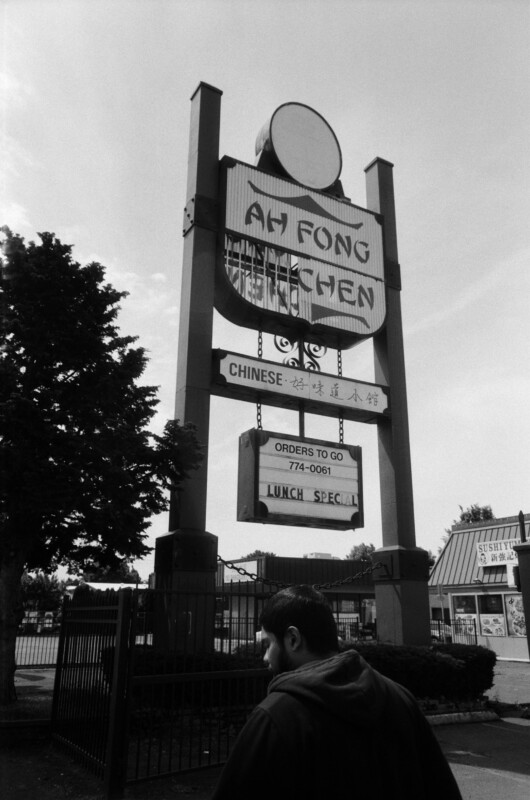


Think of it this way: if you like the Pentax Spotmatic but prefer an all-black affair with unusual dial placement, you’re going to love the Sigma Mark-I.




Sigma didn’t just release the Mark-I, it released two whole lens series that it designed to work with it and M42 screw mount. The XQ lenses, which it called the most “feature laden,” were Sigma’s more expensive, high-performance lenses. The line included a 16mm f/2.8 all the way up to a 500mm f/8, with plenty in between. The 135mm f/1.8 or the 100mm f/2.8 sounds particularly appealing to me, as a lover of anything in the 100mm to 135mm range.
The Z series lenses sat at the other end of the spectrum, promising high optical quality but without the “sophisticated features” of the XQ series. There were only six lenses in the Z series when the Mark-I was announced: a 24mm, a 28mm, and a 135mm all at f/2.8, as well as a 200mm f/3.5, a 200mm f/4, and a 300mm f/5.6.




These days, these lenses are seemingly as rare as the Mark-I, if not even more difficult to acquire. So while I would love some of the original Sigma prime lenses of the era to pair with my Mark-I, I’ll have to be patient and hope they appear on the market at some point.
There Was Never a Sigma Mark-II
Sigma never revisited the “Mark” naming for cameras. It’s next camera was the SA-1, a Pentax K-mount SLR that was dramatically different in design. It, to me, shed too much of the iconic look of the 1970s era to be nearly as timeless a piece as Sigma’s first camera. It is more advanced, to be sure, but feels more sanitized, too.

Cameras have always been a bit of a side project for Sigma. CEO Kazuto Yamaki has said his father liked them, which is why he continues to make them to this day. Modern approaches to camera design from Sigma are unusual, as the company chooses to try different approaches rather than compete directly with the likes of Canon, Nikon, or Sony. The BF, FP, SD, and DP are all unusual and worthy of remembrance. I just think it’s also important not to forget Sigma’s first camera, the one that started it all.
It’s a rare, lovable little tank that I’m happy to have in my regular rotation of cameras that I get to enjoy.