Why Canon’s 27-Year-Old PowerShot A5 Was a Landmark Camera
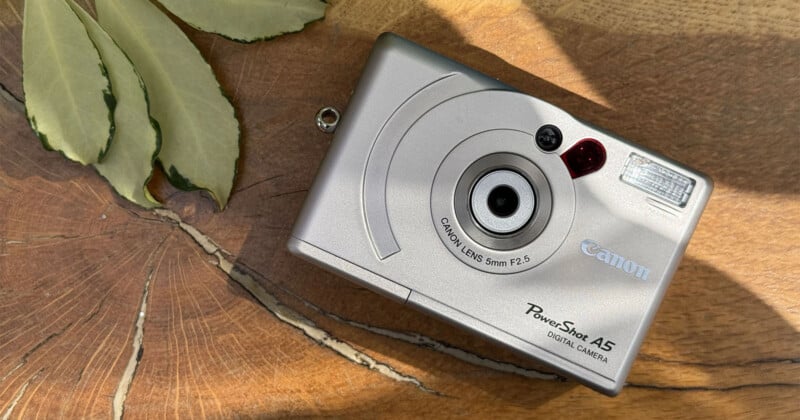
Gordon Laing of Cameralabs just published his newest Retro Review, this time looking at what he describes as Canon’s first “truly desirable-looking consumer compact,” 1998’s PowerShot A5.
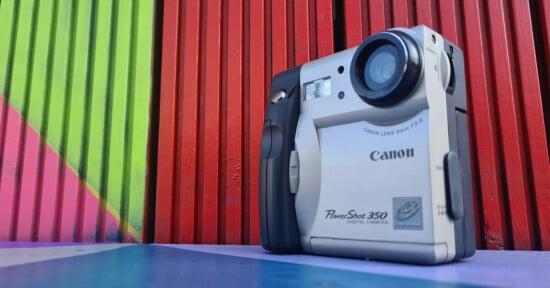
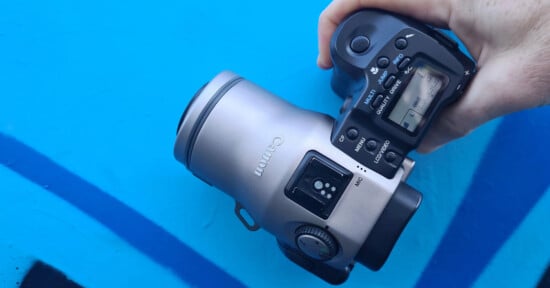
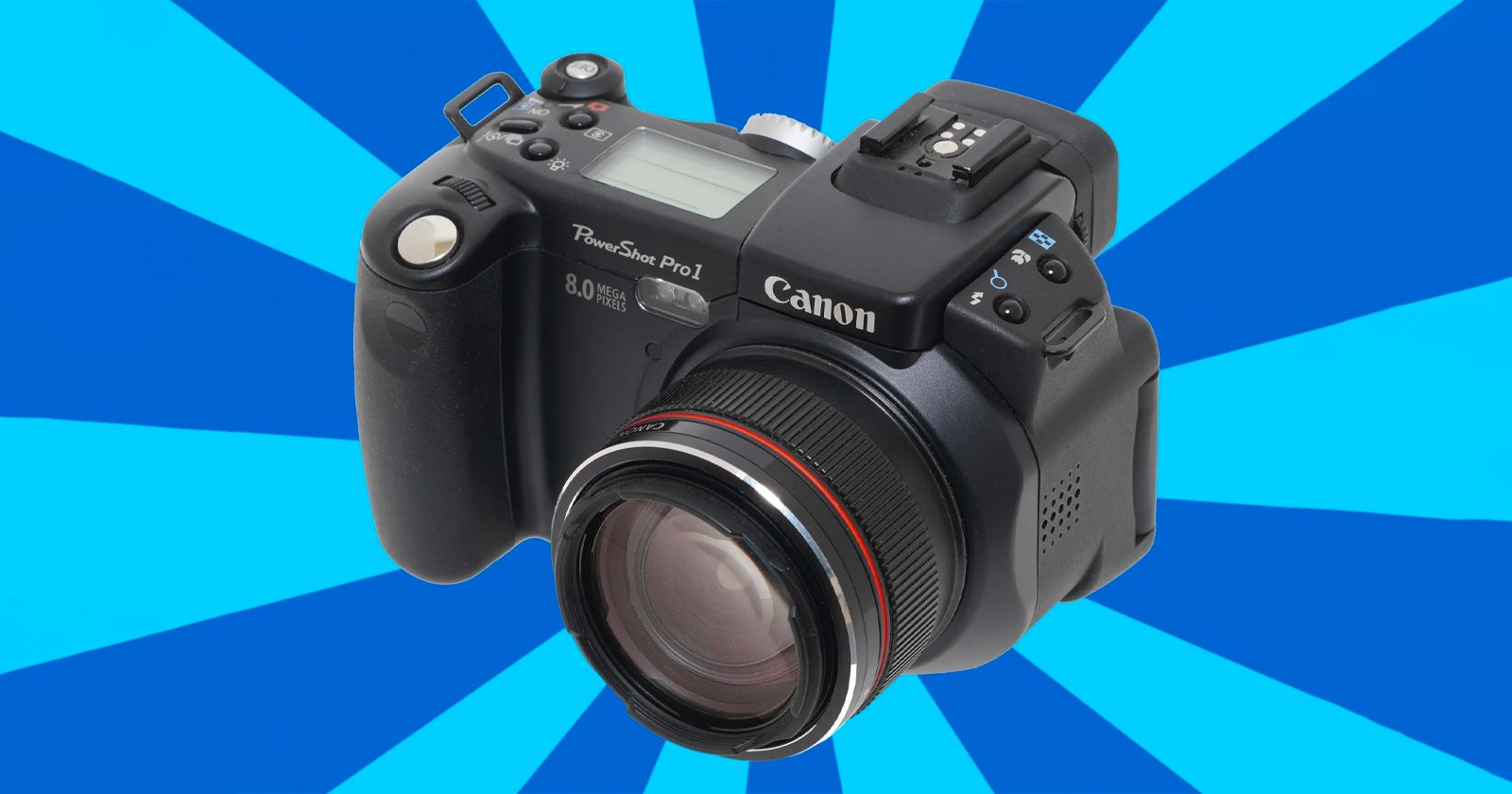
The A5 is far from the first PowerShot camera to get Laing’s beloved Retro Review treatment, joining 2001’s PowerShot G2 that he reviewed last year, 1997’s PowerShot 350 that Laing evaluated in March, and a litany of other PowerShot cameras.
However, the PowerShot A5 stands out among Canon’s illustrious PowerShot lineup in a key way. Despite launching in 1998, it was the final Canon PowerShot camera to include a fixed focal length lens, unless you count the vlogging-centric PowerShot V10, which Laing doesn’t. As he notes, the A5’s 5mm f/2.5 lens is equivalent to a 35mm prime on a full-frame camera.
“I have a soft spot for fixed lens compacts with prime lenses, and it’s certainly interesting to note the A5 and Fujifilm X100 series both share the same equivalent coverage from a fixed lens,” Laing writes.
He also argues that the PowerShot A5, the first PowerShot A-series model, was Canon’s first “truly good-looking consumer digicam,” and introduced a design aesthetic that informed subsequent models. Photographers can draw a direct line from many of Canon’s 21st-century PowerShot models back to the A5 introduced in 1998.

“The PowerShot A5 may have launched what would become Canon’s entry-level digital camera series, but when it first came out, no one knew how it would fit into future lineups. It was simply Canon’s latest digital compact, and their best-looking to date by far,” Laing says. “An almost identical design was used to launch the higher-end PowerShot S series with the S10 in 1999, before the first official Digital IXUS or ELPH arrived in the Year 2000, again with similar looks, albeit now in an even smaller form. That same year, Canon further expanded their lineup with the prosumer PowerShot G series.”

While the A5 may not look its age from the outside, its imaging pipeline is decidedly vintage. As evidenced by its 5mm lens, which has a seven times crop factor, the camera’s image sensor is tiny, as was typical for the era. The 0.8-megapixel CCD image sensor was “quite respectable” for its time, but does not hold up well on modern high-resolution displays. That said, the camera, despite being an entry-level model, offered CCD RAW image recording. While these photos could take up to 10 seconds to write to the memory card, they offered photographers reasonably good quality for the day, provided they had enough light to work with. Best-quality photos could only be shot at ISO 100, while ISO 400 was only available at a reduced resolution.

As Laing remarks, the latest version of Adobe Camera Raw can even open the PowerShot A5’s RAW files, which is quite impressive. Nonetheless, the RAW files were not all that flexible, unfortunately.
Laing’s comprehensive review goes into much greater detail and has more full-size sample images to enjoy. He has long hoped to get his hands on an A5, and it seems like it was £30 well spent. While future models would offer much better image quality and more features, the Canon PowerShot A5 was one-of-a-kind, and that comes with a certain charm.
To hear Laing’s thoughts on the state of the modern camera industry, be sure to watch last week’s PetaPixel Podcast, during which Laing and the PetaPixel team grade each camera company’s performance so far in 2025.
Image creditsPhotos by Gordon Laing of Cameralabs
Affiliate Disclosure PetaPixel articles may include affiliate links; we may earn a commission if you buy through one.