Introducing PixelMeter: The Reviews Aggregator for Cameras, Lenses, Smartphones, and More

PetaPixel has announced PixelMeter, the camera industry’s first review aggregator platform. PixelMeter collects reviews from across the landscape and condenses the opinions into a single, standardized score so photographers can see the best gear at a glance.
Check Out PixelMeter Here
Reviews have huge value and importance for photography equipment, but no single review can ever encompass the thoughts of every possible use case for that gear.
To address this shortcoming, PixelMeter takes the opinions of hundreds of reviewers and aggregates them into a single numerical score between 1 and 100. At launch, the PixelMeter includes scores for cameras, lenses, smartphones, and other photography gear like computers.
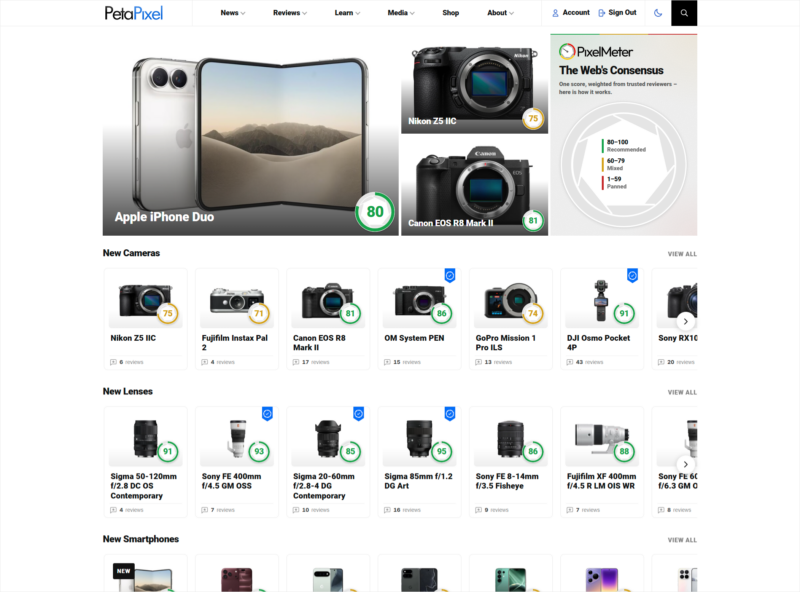
We have spent months working on isolating trusted reviewers and sorting them into tiers based on a custom rubric. All of their opinions and scores are put into one scale, and we weight them so the most trusted voices count more. You’ll find short excerpts and links to all the original reviews — often including PetaPixel’s own in-depth reviews — that contributed to the final PixelMeter score.
The number in the ring is the PixelMeter: a 1–100 aggregate of live reviews attached to that product. Below is the score breakdown:
- 95-100 — Masterpiece: Universal acclaim and one of the best ever in its category
- 90-94 — Exceptional: Near-universal acclaim
- 80-89 — Strong: Mostly positive reviews across the board with a few reservations
- 70-79 — Good: Generally favorable reviews, but notable caveats
- 60-69 — Mediocre: Lukewarm reviews with roughly equal strengths and weaknesses
- 50-59 — Underwhelming: Reviewers are generally more negative than positive
- 40-49 — Disappointing: Notably more reservations than praise
- 30-39 — Dust Collector: Near-universal panning, which means it’s usually not worth buying
- 1-29 — Paperweight: Reviewers broadly advise looking elsewhere.
While a score in the 70s is considered “good,” due to high levels of competition and therefore elevated bars for excellence, the standard for camera equipment is higher than that of movies, television, and video games, for example. As such, we concluded that the best way to highlight the truly great products was to reserve the green coloration for gear that scored at least an 80, or “strong.”
The goal of PixelMeter is to provide a fast read on reviewer consensus, but individual reviews are still the best way to go for detailed findings and individual opinions.

It is important to note what PixelMeter is not:
- It is not a simple average of every score we found
- It is not the percent of positive reviews versus negative (Rotten Tomatoes works that way; we do not)
- It is not PetaPixel’s own review
How the PixelMeter is Calculated
Firstly, we only count real reviews. First looks, unboxings, and specification roundups that never reach a verdict are not considered in the PixelMeter score. As such, we’re only accepting thorough reviews of products with a clear conclusion.
Secondly, every review is put into the same scale: 1–100. If the reviewer gives a different kind of score (4.5/5, 8.5/10, 85%, or a letter grade, for example), we convert that number mathematically for the purposes of the final PixelMeter score, but the excerpt of their review will always show their original score. If they never published a score, we infer a 1–100 rating from the verdict itself, which includes how strongly they recommend it, hedge, or tell you to look elsewhere. We do this so that those reviews can still count, and it’s especially important for YouTube reviews where many do not ever land on a specific score.
Thirdly, sources are grouped by a reviewer’s level of authority, or tier. Each source sits within a tier based on its reputation and reach. Reviews published by Tier 1 publications are weighed more heavily than those of lower tiers, and larger numbers of reviews in lower tiers do not affect the score disproportionately so that volume does not beat authority.
PetaPixel’s own reviews are treated as Tier 1 (we’re a photography publication with a dedicated reviews team that has decades of experience). But just because our score is included doesn’t mean our score becomes the PixelMeter score, nor do PixelMeter scores become PetaPixel review scores. A PetaPixel review is our score. The PixelMeter is the web’s consensus on that product, including our opinion.
Finally, we wanted to make sure to address reviews that have conflicts of interest. We decided to down-weight these scores instead of outright hiding them, as they still have merit. For example, retailer reviews still appear and are counted towards the final PixelMeter score, but at a reduced percentage of their usual weight inside of their tier. They are also clearly labeled. Finally, we do not consider sponsored reviews at all. If any are counted, it is not intentional and should be brought to our attention immediately so we can rectify the situation.
The Certified Keeper
Aside from a final PixelMeter Score, some gear may reach Certified Keeper status. These are products that get both a high PixelMeter score and have enough reviews from flagship sources.

At launch, to qualify as a Certified Keeper, a product must get a PixelMeter of 85 or higher and have at least five live reviews from Tier 1 sources.
The PixelMeter Evolves
Reviews do not always land all at once — in fact, they rarely do. Sometimes it can take weeks or months before enough reviewers have had time with equipment and publish their reviews. As such, while a product might be visible on the PixelMeter right away, reviews will continue to trickle in over time and each product page will be updated, too.
Expect a PixelMeter score to evolve slightly as more reviews are counted.


