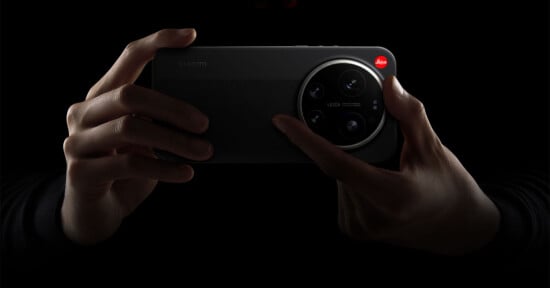
Leica Leitzphone Hands-on: This Is a Very Special Phone for Photographers
It seems fitting that on the centenary of the Leica I Model A, the German brand takes its iconic legacy and applies it to the Leica Leitzphone powered by Xiaomi. One hundred years after the first 35mm camera came to market, this device tries to mix modern and retro in ways other handsets don’t.
Still, the Leica Leitzphone is, in large part, an offshoot of the Xiaomi 17 Ultra given they share so much in both design philosophy and internal specs. Even the photo-centric purpose draws parallels between them. And yet, this also feels like a different experience once you begin shooting with it, as I have for weeks now.
Exclusive Leica Looks — film simulations and styles — along with a few distinct usability upgrades, make this phone one of the more interesting to come to market. It’s also what truly separates the Leitzphone from Xiaomi’s own flagship 17 Ultra, further exemplifying the notion of being a camera that also happens to be a phone rather than the other way around.
An Ode to Leica
Xiaomi and Leica co-developed the Leitzphone, though most of that collaboration clearly focuses on the software. As they describe it: “Uniting Leica’s iconic design language, signature camera interface, and imaging expertise with Xiaomi 17 Ultra’s peerless hardware configuration, it marks a new exciting chapter in mobile photography and videography.”
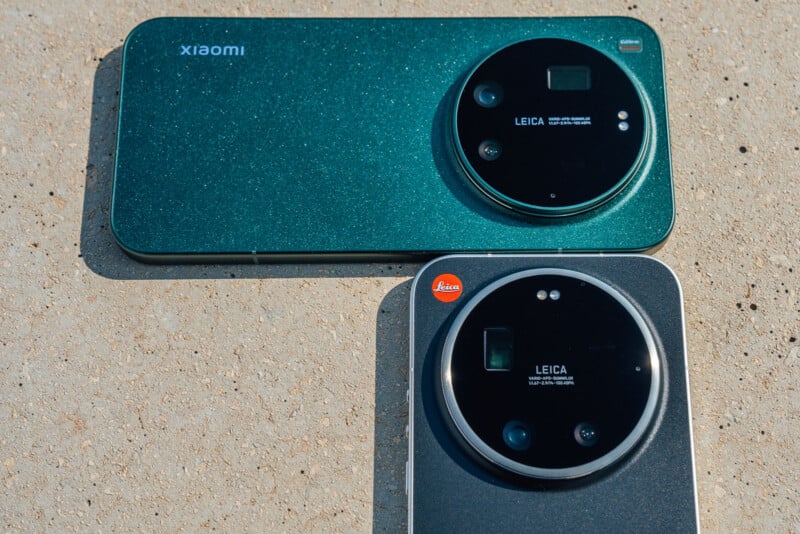
The Leica Leitzphone shares the same specs as the 17 Ultra, except for minor differences in thickness and weight. One interesting contrast, however, is that this phone’s case supports MagSafe, whereas the 17 Ultra doesn’t. You would need a third-party case to get that, as I’ve not confirmed that Xiaomi will make one of its own. It did release a 5,000mAh Ultra Slim Power Bank that is just 6mm thin (and amusingly, is available in the three iPhone 17 series colors). Even so, the camera module’s larger diameter means circular MagSafe accessories fit better than rectangular ones.
On stage at the device launch, Leica CEO Mattias Harsch said this about the development: “When we began this project, we did not ask how a smartphone should look like. We asked, what should a Leica phone be like from the perspective of a photographer.”
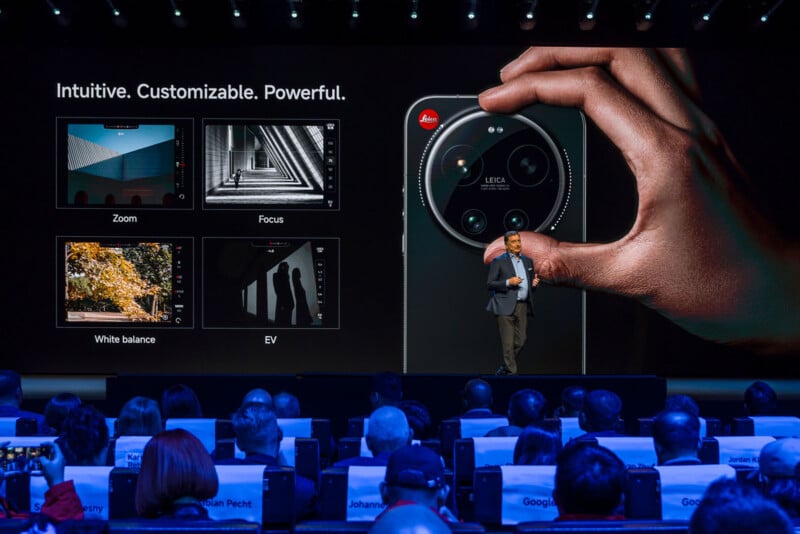
Rather than a list of features, there was to be an “attitude” about it, with a “Leica perspective” and, as mobile imaging has evolved, “what matters now is character — the way an image feels.” The red dot on the back signals Leica’s authorship and ownership, showing that it stands behind the entire experience, he added.
To punctuate that, Harsch brought Dr. Andreas Kaufmann onto the stage to underscore the project’s importance at the highest levels of Leica’s leadership. The message seemed to be that mobile imaging isn’t a peripheral hobby for the company, but rather something it’s taking increasingly seriously. Whatever Xiaomi pays for the partnership probably doesn’t hurt, either.
That’s also why the phone has its own distinct user interface, complete with unique app icons and very Leica-heavy branding. It looks and feels refined, down to the fonts, though third-party apps don’t always align with the overall aesthetic. The camera UI also bears many of the same Xiaomi hallmarks, only to divert in the various options unavailable in the 17 Ultra.
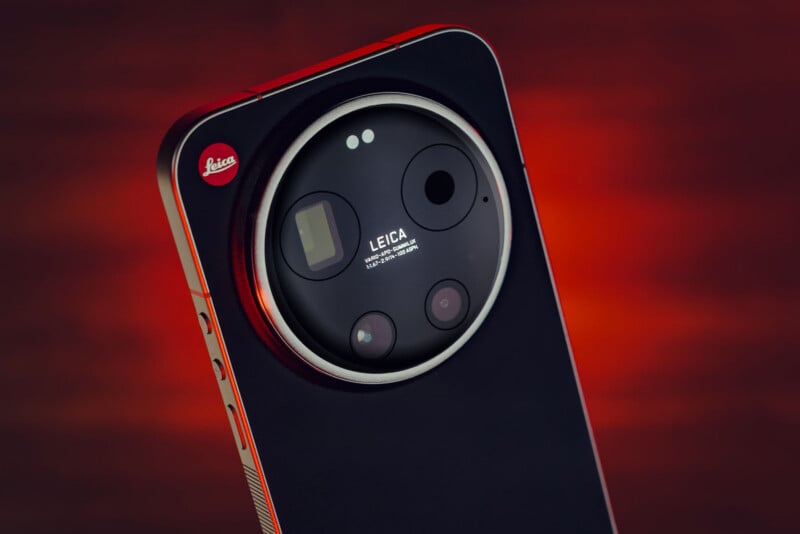
The Camera Ring is a good example of one of the few hardware tweaks exclusive to the Leitzphone that also makes a software difference. Available both on the device itself and the included case, it rotates either way, only the tactile feel is considerably looser on the case to the point where accidental bumps can easily happen. Fortunately, the included lens cap helps mitigate that somewhat when the camera is not in use. On the naked device itself, however, the precision feels like focusing a lens, and it’s a sublime feeling when composing a shot.
Reason being is that it can adjust zoom, exposure, switch focal length, or shuffle through filters, depending on which you choose. Within the camera settings, a “Camera Ring” section lets you customize its function, and what’s especially brilliant is that you can choose different options depending on the mode you’re using. For instance, if you prefer to have it control exposure in Photo mode, yet handle zoom for video, that’s no problem here. Pro mode takes it further by adding options for shutter speed, ISO, white balance, presets, and manual focus. Cycle through the modes in the menu, and there are variances in what’s available.

Using the Ring myself, its utility is easy to appreciate once you find the right mix. The one on the case got on my nerves every so often because of inadvertent adjustments when trying to frame a shot, forcing me to re-adjust. The problem, too, is that if it switches, say, 3.2x zoom to 3.1, the camera is no longer using a fully optical setup to capture the image. Like the 17 Ultra, the Leitzphone has a 200-megapixel 75-100mm telephoto lens (3.2x-4.3x), where the mechanics inside apply even to pixel-binned images in the other modes. Any millimeter adjustment within that range is purely optical, not a hybrid mix of optics and digital zoom outside it.
Separation by Legacy
The internal specs are the same, as is the co-developed processing and color science, but Leica took a more proactive approach with this phone by drawing on its legacy to add features and options the 17 Ultra doesn’t have.
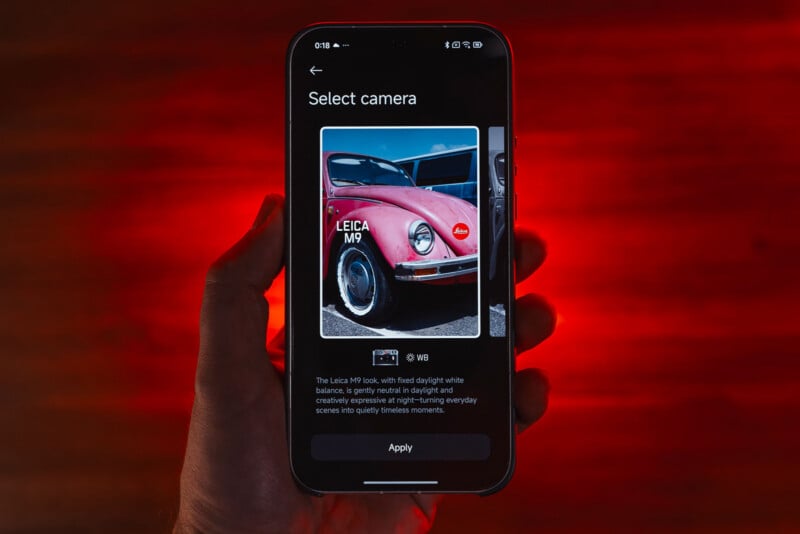
Chief among them is Leica Essential, a special mode that emulates the classic Leica M9 for color and M3 for monochrome images based on Monopan 50 film. The catch is that the M9 simulation uses a fixed white balance that stays neutral in daylight but tends to lean toward warm tones in low-light and night shots. Despite that, both can deliver photos that feel different than any other Xiaomi/Leica phone.


There isn’t much granularity in how you pay homage to those classic cameras and film stocks. While you can make the same adjustments as with any other mode (exposure, focus, etc.), you don’t have manual control over shutter speed, ISO, and white balance. So, if you wanted to dial it back at night or try your hand at a long exposure shot, there’s no way to add that level of control. The point-and-shoot aspect still delivers compelling results, but here’s hoping Leica and Xiaomi consider doing this in future devices aimed at mobile photographers.
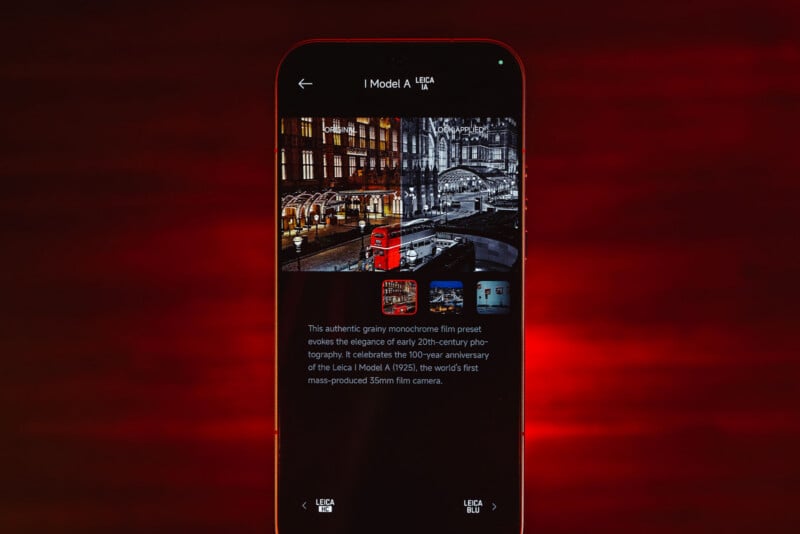
Somewhat hidden within the Filters menu is an array of Leica Looks. Like with other devices these two brands have co-developed, the standard Leica Authentic and Vibrant act as the overarching styles. Then there are the Leica filters, like Standard, Vivid, Natural, and Blue, that are common on Xiaomi phones, including the 17 Ultra.
But the rest are ones I’ve never seen on a phone before, including the 17 Ultra. Chrome, Classic, Contemporary, Eternal, Brass, Teal, Monochrome Natural, Monochrome High Contrast, and most intriguingly, an I Model A filter to emulate the grainy black and white film of Leica’s first 35mm camera.

These filters are exclusive gems that hopefully won’t be one-and-done additions. Tapping the ‘i’ button pops up an explanation of what the filter is, what it purports to do, and includes three before-and-after images you can gauge through the embedded slider. Even better, the filters are readily available on almost every mode in the camera, including Pro mode, enabling you to use manual controls with the look applied. The fact that you can also shoot 50-megapixel and 200-megapixel JPEGs this way is a bonus. My one gripe is that RAW photos are limited to 12.5 megapixels.
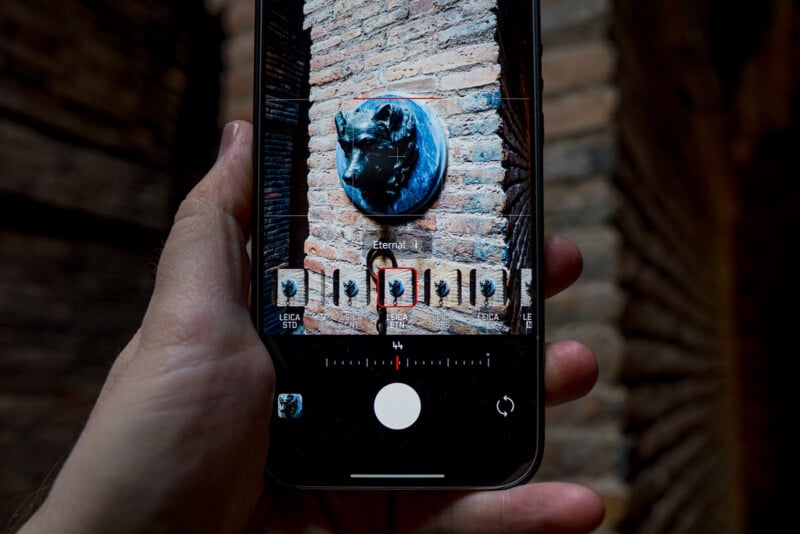
The filters even work with the onboard video modes. But my favorite part is the embedded slider for each filter, letting you adjust the look as much as you want. One neat trick is to do it with any of the monochrome modes, letting some color pop in for an artistic effect that could look cool in certain street photography situations.
The sliders aren’t exclusive, mind you, as you can do the same thing with any filter on the 17 Ultra, except the potency of some of these extra Leica Looks makes the adjustment feel more impactful.
Trust the Process? Depends on the Look
While shooting with both phones, I noticed a couple of interesting caveats in how they process images. The Light Fusion 1050L image sensor for the main camera is designed to capture as much light as possible. LOFIC, or Lateral Overflow Integration Capacitor, is designed to improve limited dynamic range, and both brands believe they’ve hit a new benchmark with these two devices.
For years, I’ve complained that Xiaomi struggled to handle direct light sources, often blowing them out and sometimes leading to clipping. Both the Leitzphone and 17 Ultra mark notable improvements in that regard.

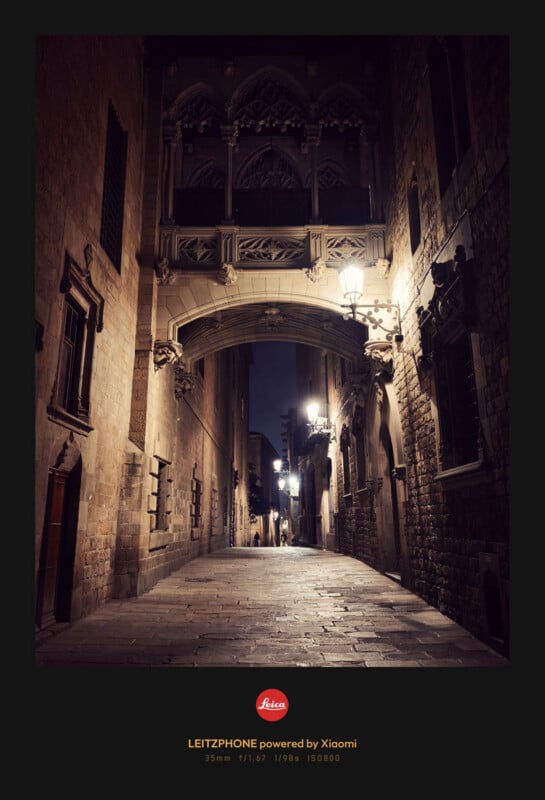
The only thing is that I’ve noticed different Leica Looks lead to different processing. In some, like I Model A and Classic, the processing lays off on pulling detail out of exposed light, whereas others, like Contemporary and Chrome, might get more out of it. It also depends on whether the bright highlight is due to daylight or to the bulbs. Dynamic range can sometimes shift in the same way, particularly in how Monochrome High Contrast and Eternal tend to deliver more dramatic effects.


Since the filters also work across the rear camera array (they’re disabled for the front camera), these results don’t really split, though aperture variances between them can play a role in what comes out. These nuances don’t generally apply the same way to the standard Leica filters that Xiaomi has used on its devices for years now. Shoot the same photo with Standard, Natural, or Vivid, and you’ll see the subtle (sometimes not so subtle) touches.
Unfortunately, metadata doesn’t indicate which filter you use, so it’s easy to forget until you’ve trained your eyes to recognize the distinctions in each style. One workaround is to open the photo in the Gallery app, tap the edit icon, then go to Frame, where Leica ones will usually display the Look. Either way, these filters are a ton of fun to utilize, and in a cities like Toronto and Barcelona, it’s easy to spend hours capturing photos.
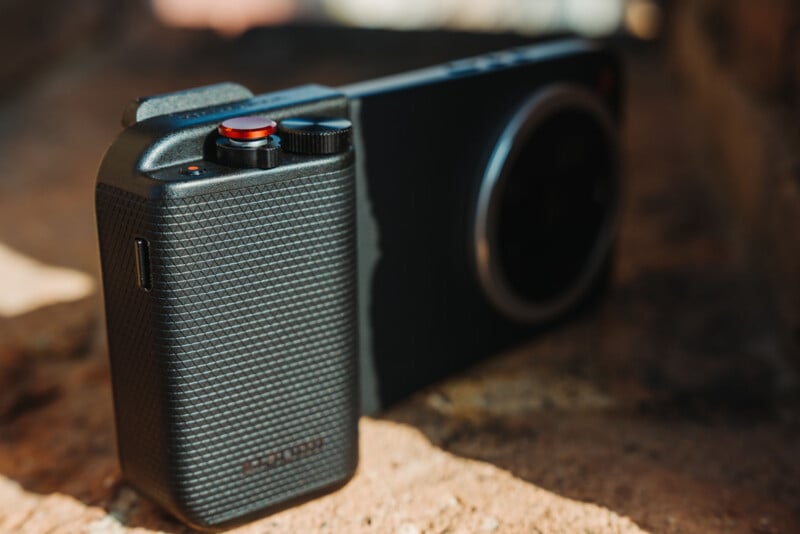
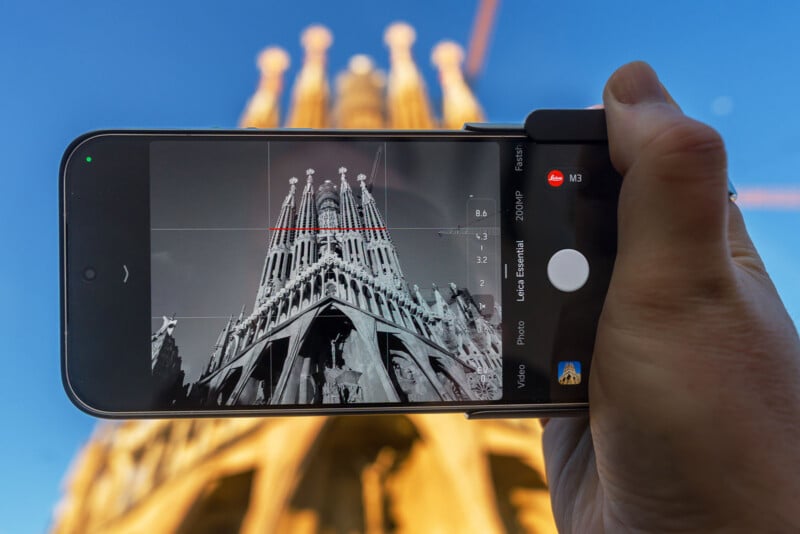
It’s also worth noting that Xiaomi’s Photography Kit Pro works just fine on the Leitzphone. Well, at least the grip does, where it slides in and enables full functionality like it does on the 17 Ultra. Once connected, its own settings become available to tweak as necessary. The shutter is joined by an exposure dial, a zoom lever, and a dedicated video recording button. The lens ring can also take 67mm filters, maintaining that support from the past two years. A 2,000mAh battery helps add some juice when the phone’s battery life is dropping.
Not a One-Off Experiment
Ultimately, is the Leica Leitzphone a limited commemorative project or the beginning of a longer-term product line? Angus Ng, Xiaomi’s international communications director, told PetaPixel that a repeat is possible.
“We’re going to see — who knows,” he says in an interview. “It’s technically not the first Leitzphone ever, but it is the first one in a long time, and it was the first for us. So, hopefully.”
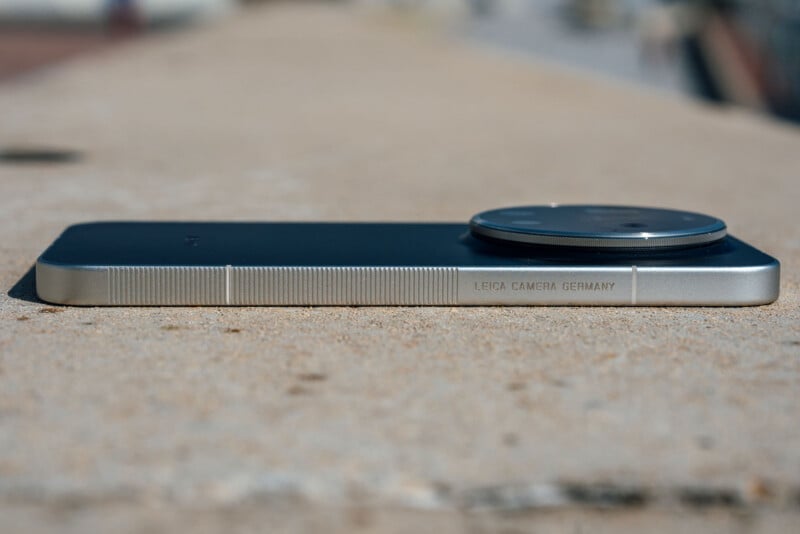
An “upgraded strategic partnership” between the two brands saw them work together on this device “from zero to 100.” Its €1,999 price tag makes it a niche luxury product by any phone standard, so I’m personally speculating that an annual cadence is probably unlikely, but that’s just me.
“This is the first attempt, right?” says Ng. “In the future, when people maybe want more difference, and want more of a Leica flavor in a Leitzphone then the Xiaomi Ultra series can offer, that’s something we can explore even further.”