Intense Auroras Are Possible Tonight

Sunspot 4341 erupted yesterday afternoon, producing a super-powerful X-class solar flare that lasted for hours. The resulting radiation hit Earth’s atmosphere, even causing a temporary radio blackout at short wavelengths. However, of much more interest to photographers is the solar flare’s Coronal Mass Ejection (CME) that is headed toward Earth now. It may trigger a G4-class geomagnetic storm, which could, in turn, deliver incredible auroras as far south as California and even Alabama in the United States.
Before diving into the specifics, it is worth relaying the typical caveat. Geomagnetic storms are very challenging to predict. There is always a chance that a CME misses Earth or arrives at a time that is not conducive to photographing auroras, like during daylight hours, for example. Further, even if the CME hits Earth as expected, there is no guarantee it will trigger powerful geomagnetic storms or auroras. Regular weather predictions are easy to miss; space weather ones are even easier.

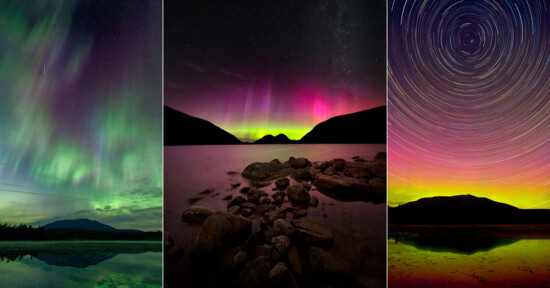
With that warning out of the way, aurora hunters should absolutely get their camera batteries charged, lenses cleaned, and gear packed because it could be a special event. The current solar cycle is on its way down, meaning that great aurora displays will, most likely, be fewer and farther between in the coming years. Auroras are finicky, so it’s essential to take advantage of opportunities when they arise.
The British Met Office’s Space Weather division currently has a G4-class geomagnetic storm watch in effect, starting at 00:01 UTC on Tuesday, January 20, which is just after 7 PM ET. The G4 watch is in effect until 23:59 UTC on Wednesday, January 21.

G4 is a “severe” geomagnetic storm with a Kp of 8 or sometimes even 9. That is very high, and just below a G5 (“extreme”) storm, the highest rating on the scale. G4-class storms occur an average of 60 days per solar cycle, or about 11 years. That may sound like a decent amount, but consider that a G4 storm can occur during daylight hours, rendering it meaningless for night-sky photographers.
Latest NASA CME model: CME may be FASTER than originally anticipated. Impact is slated for Jan 20 around 1 UT–it's a very fast CME and could deliver strong geomagnetic storming Monday night with auroras visible across mid-latitudes. We'll see what happens over the next 24 hr! pic.twitter.com/jbseAUh437
— Vincent Ledvina (@Vincent_Ledvina) January 19, 2026
The HUXt model has just released its prediction of the very fast X1.9 CME impacting with a speed of 1400 km/s around 11 UT on Jan 20. The confidence is high with a hit probability of 93%. This model has a later arrival than other forecasts. pic.twitter.com/oPNGdfQNX6
— Vincent Ledvina (@Vincent_Ledvina) January 19, 2026
Again, CME arrivals are very hard to predict. As of right now, an arrival tonight is the most likely outcome. The prominent CME is moving fast, and subsequent more minor CMEs are even possible, per Dr. Tamitha Skov.
Aurora-chasing photographers can check out some of PetaPixel‘s excellent guides to photographing the northern lights, including this one by Jason Parnell-Brookes and this guide written by Albert Dros. Spaceweather.com is an excellent resource to stay up to date with current geomagnetic conditions and to sign up for aurora alerts.
Image credits: Header photo by Jeremy Gray. Additional images by NASA.