I’ve Seen the GoPro-Branded Asus Laptop: Who Is This Made For?
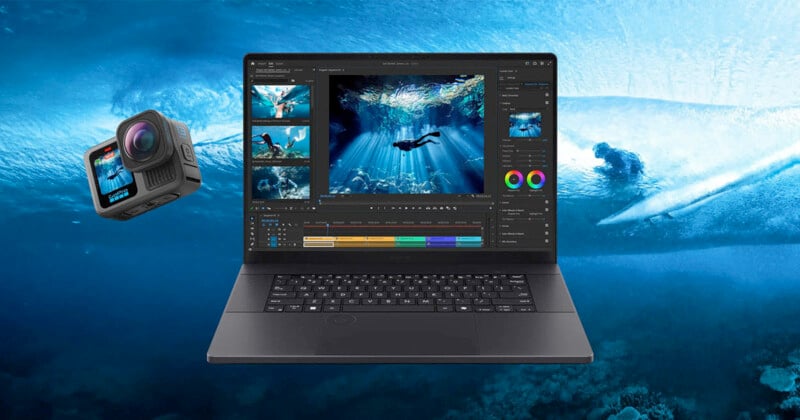
As PetaPixel reported this week, Asus and GoPro have come together and birthed a co-branded special edition Asus ProArt GoPro Edition laptop that looks to cater to content creators, but is that who is it really for?
The new device won’t come cheap starting at $2,400 when it launches in Q1 2026. It has the makings of a lifestyle play for both companies: Asus is trying to leverage GoPro’s action-oriented community and GoPro is working to strengthen its cachet in the broader creator market.
This follows a previous announcement in October 2025 when the two companies unveiled StoryCube, a Windows app to integrate GoPro Cloud and support 360-degree video workflows. Now, the collaboration gets more personal with hardware entering the mix, complete with GoPro styling and a bundle of gear to go with it.

A Refashioned Take
The ProArt GoPro Edition is, in many ways, an Asus ProArt PX13 with a different chassis and keyboard backlight. Thus, it maintains the same specs as the standard 2026 model but otherwise stands out through its aesthetic presentation. The laptop’s exterior’s vertical lines are based on the design language of GoPro Hero cameras, with “Velocity GoPro” emblazoned on the top of the device, along with ‘ProArt” adorned in the bottom corner. It doesn’t go rugged, but it’s not identical to a standard ProArt PX13 either.

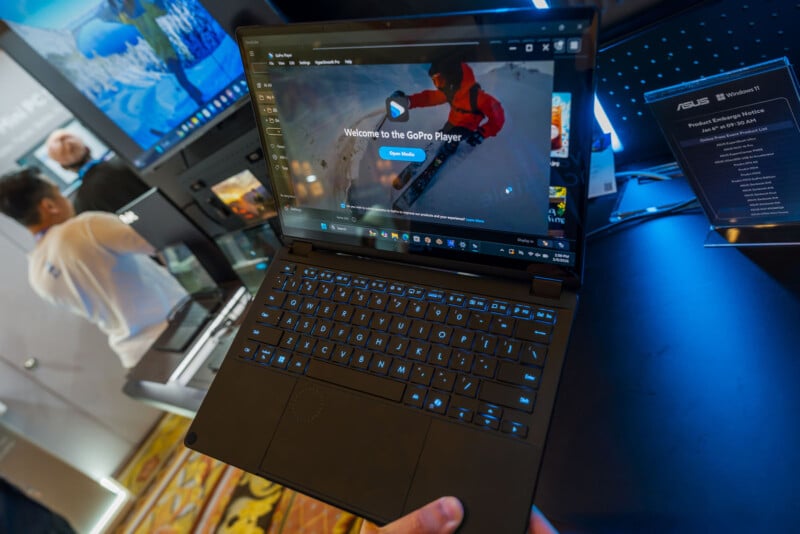
The keyboard gets a customized backlight that always glows with GoPro’s light teal hue (some argue it’s more like light blue) that sets it apart from the regular PX13. Beyond that, there are no visual or functional differences that I can see. It’s not unlike having a phone with a different case on it. Mind you, this is elegantly done here, and the lightweight body is easy to appreciate, but let’s call a spade a spade.
Repurposing the Box
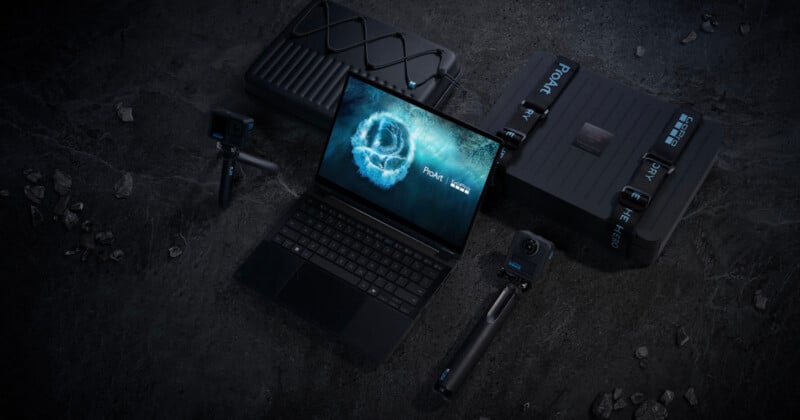
Part of the concept behind this is to offer a package mobile creators can utilize out of the box. Hence, the packaging isn’t a throwaway box but rather one with removable foam cubes you can piece together and configure to create custom storage for cameras, lenses, batteries, and other small gear. On top of that, you can repurpose the box for permanent storage instead of just tossing it.
The package includes two sturdy belts that serve multiple purposes. You can combine them into a single extra-long strap to secure luggage, displaying your GoPro allegiance while traveling, if that suits you. Alternatively, the belts connect to a hard-shell carry case that comes with the laptop, allowing creators to transport the device and its stylus over their shoulders for maximum mobility in challenging environments.
You do not get the camera and its accessories bundled with the laptop contrary to how Asus presents the device at events. Apart from the protective sleeve and Asus Pen 3.0, there’s no other GoPro swag to go with this device.


Power Under the Hood
The GoPro Edition offers the same power and performance on paper as the standard ProArt PX13 (2026), but since launching the MAX2 in 2025, GoPro figures this laptop is a perfect complement to its latest 360 camera capable of capturing 8K footage.
The laptop runs on the AMD Ryzen AI MAX+ 395 processor, a pretty powerful chip running at 3.0GHz with the ability to boost up to 5.1GHz across its 16 cores and 32 threads. The processor features an 80MB cache, so there’s muscle under the hood to handle consistent 360-degree video workflows and real-time editing in the field.
The bigger deal is that it includes 128GB of LPDDR5X RAM soldered directly onto the motherboard. Asus and GoPro expect this kind of memory bank eliminates bottlenecks when working with multiple high-resolution video streams simultaneously, allowing creators to scrub through 8K 360-degree footage from the GoPro MAX2 without stuttering or delays. Asus also says the configuration ensures resource-intensive apps like Premiere Pro will hum alongside StoryCube’s AI categorization tools, cloud syncing operations, and background rendering tasks without compromising system responsiveness.
The GPU is an AMD Radeon Graphics card, while an AMD XDNA NPU will deliver up to 50 TOPS of AI performance. That will impact how StoryCube works because of how it can accelerate AI-driven features, like automatically categorizing action camera footage, recognizing scenes like surfing, biking, and snowboarding without the processor stepping in for a boost. There are also supposed to be battery life benefits but that’s hard to tell from the CES show floor.
The 1TB drive is a bit modest compared to desktop workstations, but it may also be by design to steer users to GoPro Cloud. StoryCube has a direct line to the cloud service so that creators can preview and work with stored footage directly from the cloud, limiting local storage to active projects. You could also use an external SSD if you prefer that method.
A Fabulous OLED Panel
It’s hard not to like the 13.3-inch touchscreen display when looking at it. The 3K OLED (2880 x 1800) has a 16:10 aspect ratio for the extra vertical space. No surprise, color accuracy hits 100% DCI-P3 coverage and Pantone validation to give creators some confidence that what they see on screen matches industry standards.
There’s 400 nits brightness for standard content and 500 nits peak for HDR material, which is where the VESA Certified Display HDR True Black 500 certification comes in, although some HDR video editors would scoff at just 500 nits. Asus and GoPro claim “excellent visibility” when reviewing footage outdoors between shoots but color me skeptical about that one given the lack of top-end brightness. Same with the choice of a 60Hz refresh rate in spite of the fast 0.2ms response time. Given that video is such a strong focus here, a 120Hz panel might have made more sense given the price.

Being a touchscreen, the included Asus Pen is ready to go, featuring MPP 2.6 support and arriving with its own wireless charger. Much like the other ProArt models that come with the same pen, the GoPro Edition should work just as well for color grading work, quick annotations, or sketching out shot lists on location.
Premium Subscription to Sweeten the Deal
Those who buy the ProArt GoPro Edition get 12 months of GoPro Cloud Plus Premium (valued at $100). The subscription unlocks unlimited cloud storage for GoPro footage, 500GB of storage for non-GoPro files, automatic highlight videos, and guaranteed camera replacement.
That’s double what a subscription gets you with the latest standard ProArt laptops announced in 2025, which included six months of GoPro Premium+ with Creator Series ProArt models and three months with Zenbook and Vivobook configurations.
As for StoryCube, it uses AI trained specifically on action camera imagery to automatically categorize footage by activity type, recognizing scenes like biking, surfing, and snowboarding. It can organize content by time, device, and location using GPS data from GoPro cameras, dramatically reducing time spent managing the library.

Who Is This For?
Both companies see this partnership as a way to identify and target the space between “experiencers” and “curators” — people who both capture real-life adventures and possess the technical skills to transform raw footage into compelling stories. That means travel vloggers, advanced photographers and videographers, studio creators, sports content curators, and adventurous content creators all fall under that distinction.
Although it is easy to appreciate some of the brand crossover on offer here, it is easier still to wonder if Asus and GoPro could have taken things further. Perhaps a true rugged laptop to match a GoPro’s adventure-ready spirit, or even packaging in a GoPro camera with the laptop, or at least offer one at a discount, could have made this a more attractive offering.
The ProArt PX13 GoPro Edition costs slightly more than the standard model, but Asus positions the premium as worthwhile given the included accessories and extended subscription. More importantly, the device makes a statement about priorities in an increasingly crowded creator laptop market. Starting at $2,400 at launch, time will tell if this partnership is going somewhere.
Image credits: Images by Ted Kritsonis unless otherwise noted.