Large Format Photos Show US Military’s Simulated Iraq Warzones

Five people dressed in traditional clothing and carrying rifles are on a barren hilltop under a cloudy sky. One stands gesturing while others sit or kneel around him, with mountains visible in the distance.
Marine Major John Cowait playing the role of a warlord holding a Taliban training camp on a remote Afghan mountaintop, 2009 © Claire Beckett

From 2006 to 2023, photographer Claire Beckett embedded herself on military bases in the United States to capture elaborate training camps that simulated war zones in Iraq and Afghanistan.

Using a 4×5 analog large-format camera, Beckett focused on the depictions of Arabs and Muslims played by U.S. combat veterans who dressed up as insurgency fighters from the Middle East to help train American soldiers going into battle.

A mock Middle Eastern-style village with beige, box-like buildings and two domed structures, located in a desert landscape under a clear sky. Power lines and distant mountains are visible in the background.
Above Medina Jabal, 2009 © Claire Beckett
A group of people, some in white robes and others in casual clothes, walk near a large cloud of black smoke outdoors in a wooded area with trees and vehicles in the background.
Aftermath of an IED, 2007 © Claire Beckett
A person in a white hooded garment kneels on a wooden floor beside a light wooden box, using both hands to work on an object. The background is dark, highlighting the individual and their activity.
Army Specialist Gary McCorkle playing the role of Jibril Ihsan Hamal, member of the Sunni Islamist militant organization Islamic Army of Iraq, 2009 © Claire Beckett
Barbed wire coils surround a sandy area with a concrete barrier and a small building in the background. The sky is overcast, and dry vegetation is visible near the barrier and fence posts.
Joint Command Center, 2009 © Claire Beckett

Beckett’s new book, Defense Language, shows costumed role-players, elaborate Hollywood-inspired sets, and staged tableaus on military bases across the United States.

“With this project, I look at the way Americans such as myself interact with other cultures,” Beckett says. “The photographs draw attention to the problematic depiction of ‘cultural others’ in these trainings, challenging the implicit assumption of American cultural superiority.”

The military would draft in immigrants from Iraq and Afghanistan to make the training look and feel realistic. Local American civilians were hired to populate the artificial villages. Beckett’s photographs include a combination of formal portraits, landscapes depicting makeshift constructed buildings, and more informal images of the figures interacting within the training scenarios.

The photographs were made at Fort Drum, New York; Fort Irwin, California; Fort Jackson, South Carolina; Fort Polk, Louisiana; The Marine Corps Air Ground Combat Center (Twentynine Palms), California; and The Marine Corps Mountain Warfare Training Center, California.

A woman in a tactical vest, gloves, jeans, and boots stands on gravel holding a rifle by her side, in front of a plain light-colored wall. She looks directly at the camera with a neutral expression.
Lead insurgent Sergeant Ariel Combs, 2017 © Claire Beckett
A person with light eyes and a mustache wears a dark headscarf and a light-colored garment, looking directly at the camera with a neutral expression. The background is softly blurred with greenery.
Marine Lance Corporal Joshua Stevens playing the role of a Taliban fighter, 2009 © Claire Beckett
A desert landscape at sunset with rocky hills, sparse vegetation, and a few small, distant buildings. The sun is partially hidden behind the hills, casting a soft glow over the arid terrain.
Near Tiefort City, 2017 © Claire Beckett
A woman wearing a teal hijab and embroidered dress sits on an orange chair against a wooden wall, with a green vest and communication headset on her head, looking directly at the camera.
Civilian Howeida Abdelrahman playing the role of an Iraqi civilian, 2007 © Claire Beckett

The book also features ephemeral printed materials used by American soldiers and Marines deployed to Iraq and Afghanistan. Including fold-out pocket guides, language training books, and historical documents relating to Arab and Muslim people.

“As a young adult post 9/11, I worked as a Peace Corps Volunteer in Bénin, West Africa. Through this experience, I learned to see myself as an American, and to take ownership of my power in a global context,” Beckett says. “This experience forced me to confront the disproportionately large influence that we have as Americans, and how our actions, or inactions, impact the lives of people worldwide.”

A young man in a keffiyeh scarf, blue shirt, and camouflage pants sits on a bicycle outdoors, looking at the camera. The background includes concrete barriers and a blurred building.
Army Specialist Gary Louis Sims playing the role of Safah Mehdi Faris, member of Al-Qaeda in Iraq, 2009 © Claire Beckett
Three people stand beside a flowing forest stream, surrounded by trees and rocks. Two stand on grass near the water, while the third stands slightly behind them on a rock. A fallen log crosses part of the creek.
Marines Sergeant John Sexon, Lance Corporal Cameron Stark and Lance Corporal Joshua Stevens role playing as Taliban fighters, 2009 © Claire Beckett
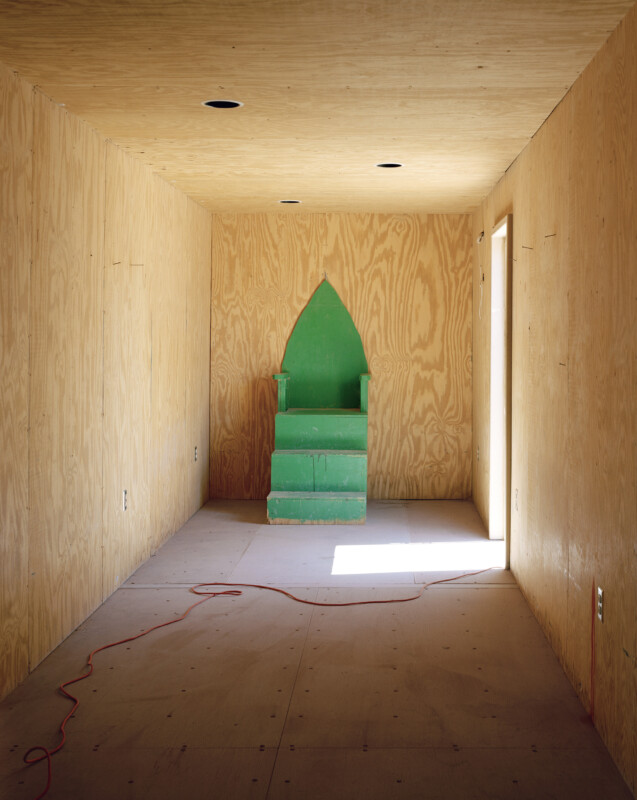
A small, empty room with unfinished plywood walls and ceiling, lit by sunlight from a side door. A single green, throne-like chair with a pointed back sits against the far wall, with an orange extension cord on the floor.
Shi’a Mosque, 2008 © Claire Beckett

Defense Language by Claire Beckett is published by Gost Books.


Image credits: Photographs by Claire Beckett
Discussion