DJI Appeals US Court’s Decision to Uphold ‘Chinese Military Company’ Designation
Late last month, DJI lost its lawsuit against the Pentagon, meaning that the Chinese technology company would remain designated a “Chinese Military Company” in the United States. DJI has officially appealed the decision.
When news of the U.S. District Court Judge Paul Friedman’s decision was released on September 26, DJI expressed its disappointment. DJI reiterated that it should not be labeled a Chinese military company and said it was evaluating its legal options. The company, best known for its drones and imaging technology, is now exercising one of its legal options. DJI filed an appeal with the United States Court of Appeals for the D.C. Circuit on October 13.
“While the Court upheld the Department of Defense’s (DoD) designation of DJI as a ‘Chinese Military Company,’ it also made several critical findings that reaffirm DJI’s long-held position that it is not owned by, controlled by, or otherwise affiliated with the Chinese government or military,” DJI says in a statement.
DJI maintains that because Judge Friedman rejected “the majority” of the Department of Defense’s claims, including the Pentagon’s allegations that DJI is “owned or controlled” by the Chinese Communist Party, China’s Ministry of Industry and Information Technology, or linked to China’s military-civil fusion enterprise zone. However, the District Court Judge also ruled that the Department of Defense has wide-ranging authority to designate companies as it sees fit.
DJI being labeled as a “Chinese Military Company” significantly affects the company’s ability to operate freely within the United States, including limitations on the types of contracts it can win.
The Court upheld a pair of the Department of Defense’s assertions, which DJI claims actually help prove that it is not a “Chinese Military Company.” One is that DJI holds National Enterprise Technology Center (NETC) status. DJI notes that this recognition is routinely granted to companies with “industry-leading technological innovation capabilities,” including some major U.S. companies operating in China across diverse sectors like food, automotive, and more.
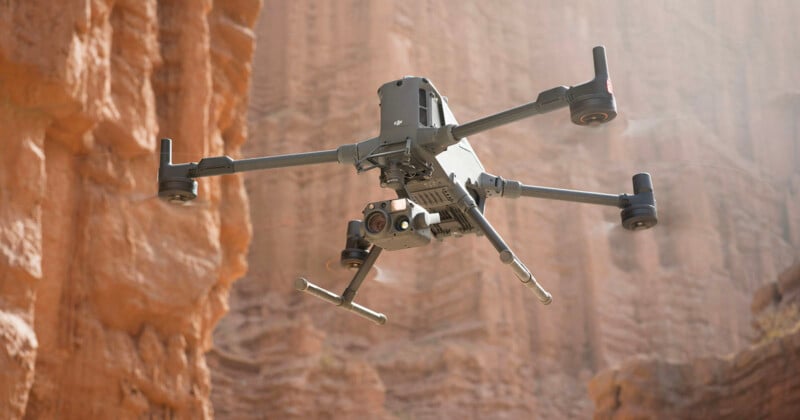
The Court also agreed with the Pentagon that DJI’s products have “substantial dual-use applications.” DJI argues that this is typical for many commercial technologies that “could be misused in military contexts,” and does not itself prove any military affiliation.
A DJI spokesperson provided a statement to PetaPixel concerning its appeal:
We respect the Court’s process but are disappointed that the designation remains in place despite findings that reject the core of the DoD’s allegations. We will continue to defend the integrity of our company as the findings reaffirm what we have maintained all along — that DJI operates independently, has no government or military affiliation, and is committed to the responsible development of drone technology.
Further, DJI reiterates that it has taken “comprehensive measures to prevent the misuse of its products, including for military purposes.” The company notes that it was the first in the industry to publicly denounce the combat use of its drones and maintains that it has “never” manufactured military equipment or marketed its drones for combat purposes.
A significant part of Judge Friedman’s ruling was that the Department of Defense should be given considerable leeway to oversee its own designations, especially in cases related to national security concerns. The judge agreed with the DoD that it had wide-ranging discretion, even if its assertions were not universally supported by evidence. Even though Judge Friedman disagreed with the Pentagon on many counts, he agreed that it had broad overreach.

While DJI may be able to successfully appeal more of the Department of Defense’s claims, the crux of the issue is whether the DoD has authority to maintain its list as it sees fit, even when some of its evidence is shaky.
This situation has the makings of a long, drawn-out legal battle. After all, Judge Friedman’s ruling came nearly a year after DJI sued the Department of Defense over its labeling DJI a “Chinese Military Company” in the first place.
Image credits: Header photo by Ryan Mense. Additional photos courtesy of DJI.