You might recognize the photograph above. Titled Valley Of The Shadow Of Death and snapped by British photographer Roger Fenton in 1855, it’s considered to be one of the oldest known photographs of warfare. Problem is, it might also be one of the oldest known examples of a staged photograph.
Read more…

At first glance, New York-based photographer Richard Barnes‘ Civil War photos might look like they were taken from some museum or historical photographic archive. Look a little closer, however, and you’ll begin to notice things that are quite peculiar. In one of them, there’s a pickup truck parked in the background. In another, a man wears a T-shirt and baseball cap — certainly not the fashion you’d expect to see in a mid-1800s photo.
The truth is, Barnes creates beautiful war photos that appear to be from over a century ago by using the Civil War-era process of wet plate photography to capture modern day Civil War battle reenactments.
Read more…

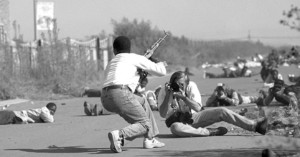
Editors have always been wary of sending photographers into war zones since the practice began in the early 20th century, but the speed at which the Internet distributes photography is increasing both the danger to photojournalists and the reluctance of the backers. The British Journal of Photography has an interesting look at the costs of conflict photography:
This situation, said [Jon] Jones, had led to a catch-22 in which young photographers are unable to get assignments because magazines and agencies refuse to take responsibility for the risks involved. “I think there’s a reluctance to send people into conflict zones. It doesn’t mean it’s right, but it’s the economic reality.” But that’s nothing new, he added. “When I went to Bosnia [in the 1990s], I didn’t have any support. I went with no money, then went back with £300, then again with £400, and built it up each time. It takes a while. But the initial step was just to go. Today, you get the same answer I was given 20 years ago: ‘Great. I’m not going to assign this to you, but I’d love to see you when you come back.’” And somewhere down the line, after a young photographer has proved his worth, it changes, he explained.
“You basically have to earn the right to get an assignment,” Knight added. “Nobody is going to assign you to a conflict zone right out of college. They want to see what you’ve done and what you are capable of. When I started it was the same. Once you’ve done that enough times, they might give you an assignment,” he told the audience. “When I started, I had to sell my own blood to eat.”
“I had to sell my own blood to eat”… Now that’s dedication to photography.
Photojournalism: The cost of covering conflicts [BJP via APhotoEditor]
Image credit: amc_in_bosnia_mid_1990s by U.S. Army Materiel Command

Freelance photojournalist Tracey Shelton captured the striking image above showing the instant a tank shell exploded in a Syrian rebel outpost earlier this week. She was filming the group of four rebels using her Canon 7D and 28mm, and had just set her camera on a tripod before the explosion occurred. The blast claimed three casualties, while one of the four men, the rebel standing directly in front of Shelton, escaped with minor injuries. Afterward, Shelton selected a number of stills from the 30fps footage and published them to Global Post (the news company she’s freelancing for), along with a vivid account of what had taken place.
Needless to say, the images elicited a strong reaction from the Internet community, with people calling them stunning, heartbreaking, and the most powerful war photographs they had ever seen. Check out the article on the Global Post for the full sequence of images.
Life and death in Aleppo [Global Post]
Thanks for sending in the tip, Jim
Image credit: Photograph by Tracey Shelton/Global Post

This may be a rare case in which a $695 class might actually save your life: Columbia University Graduate School of Journalism is offering a safety course for journalists who cover war, conflict and disaster zones.
Read more…

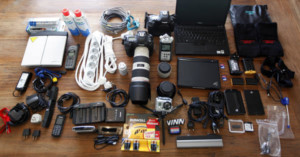
What would you pack if you were assigned to cover a war from the inside? The photo above shows what photographer Umit Bektas decided to pack in his camera bag for his embed with a US military unit in Afghanistan.
I was going to need two cameras but to be on the safe side, I took a third. As I was planning to do a multimedia piece as well, I packed an audio-recorder and GoPro Camera too. Also a Bgan to give me the internet access necessary to transmit my photos and the Thuraya to ensure communication at all events. As I placed my laptop in its bag, I thought “what if it breaks down” and added a nine-inch backup laptop too. Also packed was one spare battery for each piece of equipment that ran on them. For my cameras though, I took two spares each. As I would not be able to carry large lenses, I packed a converter, chargers, cables, memory cards, cleaning kits and adapters. All this filled up my largest bag.
Also in one of his bags was body armor and a helmet: a requirement for being embedded.
Are you ready for your embed? (via PopPhoto)
Image credits: Photograph by Umit Bektas/Reuters
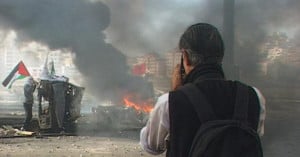
Here’s a fascinating video in which Italian photographer Ruben Salvadori demonstrates how dishonest many conflict photographs are. Salvadori spent a significant amount of time in East Jerusalem, studying the role photojournalists play in what the world sees. By turning his camera on the photographers themselves, he shows how photojournalists often influence the events they’re supposed to document objectively, and how photographers are often pushed to seek and create drama even in situations that lack it.
You might start looking at conflict photos in the news a lot differently after watching this.
(via ISO1200)

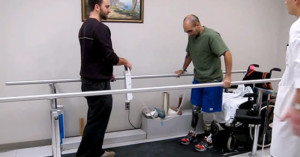
Photojournalist João Silva lost his legs to a land mine in Afghanistan at the end of last year, but — after months of intense rehabilitation — returned to work in July, landing a photo on the front page of the New York Times. On August 2nd, Silva visited the Bronx Documentary Center and gave a talk on his thoughts and experiences.
Read more…

The Guardian compiled a powerful collection of vignettes by war photographers recounting times when their work almost got them killed.
Anyone who says they aren’t frightened during war is either lying or a fool. It’s about finding a way of dealing with the fear – you have to be very calm. You’re not there to get your rocks off; you’re there because you feel your pictures can make a difference.
– Tom Stoddart
It’s amazing the kinds of dangerous situations photographers place themselves into to serve as the world’s eyes during wars and conflicts.
The shot that nearly killed me (via dvafoto)

New York Times photographer Lynsey Addario was recently released along with three male journalists after being taken captive in Libya. After details of her abuse was reported in the news, there were immediately reactions from those who believe that female journalists shouldn’t be assigned to war zones because of the risks. Addario responded yesterday, saying:
If a woman wants to be a war photographer, she should. It’s important. Women offer a different perspective. We have access to women on a different level than men have, just as male photographers have a different relationship with the men they’re covering.
[...] when I was in Libya, I was groped by a dozen men. But why is that more horrible than what happened to Tyler or Steve or Anthony — being smashed on the back of the head with a rifle butt? Why isn’t anyone saying men shouldn’t cover war? Women and men should do what they believe they need to do.
I don’t think it’s more dangerous for a woman to do conflict photography. Both men and women face the same dangers.
You can read the rest of her post over on the NYT Lens Blog.
Image credit: 038 by Nasser Nouri