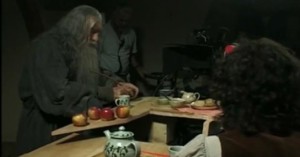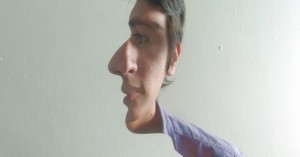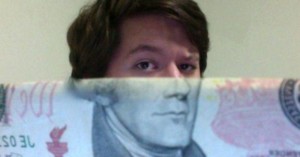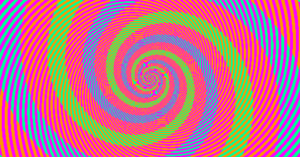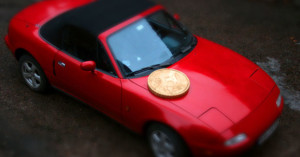
Have you ever wondered how Lord of the Rings director Peter Jackson made Frodo Baggins the hobbit so much smaller than Gandalf the wizard? Aside from using CGI and child body doubles, the filmmaking team also employed brilliant forced perspective techniques that tricked viewers with optical illusions. Read more…
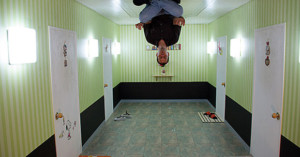
World travel bloggers Michael Powell and Jürgen Horn recently visited the The Trick Eye Museum in South Korea, where visitors can snap humorous and mind-bending pictures of themselves interacting with various painted rooms. They write,
If you don’t like having your picture taken, stay far away from the Trick Eye Museum, which is also not recommended for anyone who’s overly serious. Or those who have any semblance of pride. Basically, if you’re not willing to act like an idiot in front of the camera, you won’t have any fun here. But everyone else, and especially kids, should prepare for a good time.
The entire point of this “museum” is to provide setups for funny pictures. An upside-down room makes it look like you’re standing on the ceiling. Stand in front of Mona Lisa with a paintbrush. Lay down on the floor and hang on for dear life to the painting of a cliff.
At first glance, the images in Fabian Oefner‘s Nebulae might look like images of distant galaxies captured with a space telescope. They were actually shot in a studio using a number of fiber glass lamps. Oefner used exposures of different lengths to capture the ends of the lit fiber glass as points and streaks of light. He then combined multiple images into single photos to achieve the “star density” seen in the final images. Read more…
Dutch photographers Anuschka Blommers and Niels Schumm shot a series of photographs for a Dove ad campaign that uses the Thatcher effect for some stealthy creepiness. The effect is created by flipping a portrait upside down while keeping the eyes and/or mouth right side up. The human brain has a difficult time detecting these subtle “local” changes, and the portraits may look normal until you see them flipped. Try turning your monitor or head to look at these images upside down. Read more…
If you ever create a slideshow of portraits, you might want to avoid showing them aligned side-by-side with a gap in between. The video above shows a crazy optical illusion that researchers have dubbed the “Flashed Face Distortion Effect”. By flashing ordinary portraits aligned at the eyes, the human brain begins to compare and exaggerate the differences, causing the faces to seem hideous and ogre-like. Researcher Matthew Thompson writes,
Like many interesting scientific discoveries, this one was an accident. Sean Murphy, an undergraduate student, was working alone in the lab on a set of faces for one of his experiments. He aligned a set of faces at the eyes and started to skim through them. After a few seconds, he noticed that some of the faces began to appear highly deformed and grotesque. He looked at the especially ugly faces individually, but each of them appeared normal or even attractive.
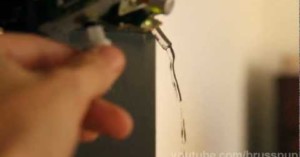
A couple weeks ago we shared an interesting video in which a speaker and Canon 5D Mark II’s frame rate were used to make water appear to be frozen in mid-air. This new video by YouTube user Brusspup takes the idea to the next level by making the water appear to travel upwards. He explains:
Fill a bucket full of water and place it about 5 feet off the ground. Place a subwoofer about 1 foot lower than the bucket. Run a plastic tube from the top bucket down in front of the subwoofer. Tape the tube to the front of the speaker. Then aim the end of the tube to an empty bucket on the floor. Get the water flowing from the top bucket. Now just generate a 24 hz sine wave and set your camera to 24 fps and watch the magic happen. Basically your cameras frame rate is synced up with the rate of the vibrations of the water so it appears to be frozen or still. Now if you play a 23 hz sine wave your frame rate will be off just a little compared to the sine wave causing the water to “move backward” or so as it appears. You can play a 25 hz sine wave and cause the water to move slowly forward.
This experiment has become quite a trend as of late — this particular video has been viewed over a million times in less than a week.
When recording video, a camera’s frame rate can produce some pretty strange effects. If matched up with a helicopter’s blades, a helicopter looks like it’s hovering in midair with motionless blades. YouTube user mrbibio found that the same thing can be done with falling water. His technique is brilliant: by pressing a water tube against a speaker, mrbibio was able to control the vibration frequency of the water flowing through the tube. He then adjusted the pulses of the water to match up with the frame rate of his Canon 5D Mark II. The result is a video of the water looking as though it’s frozen in time.
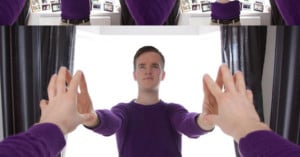
Snapping a self-portrait of oneself in a mirror is something every photographer has probably done before, but have you ever created one in which there isn’t a camera in the shot? The images look impossible, but they’re not too difficult to create using some careful planning and clever Photoshop trickery. Basically, all you need to do is photograph each arm and your head separately and then stitch the photographs together. Joshua Dunlop over at ExpertPhotography has published a tutorial on the technique.
Photographer Zander Olsen creates amazing optical illusions by wrapping trees with white linen, lining up the ends of the material with the horizon line in the background. Read more…
Venezuelan artist Jesús González Rodríguez has a project called 1/2 that features strange Photoshopped portrait illusions. They each show half a face, but is that face looking to the left or towards the camera? Read more…