Special Feature
Apple, Content Authenticity, and the War to Prove What’s Real
It is now easier than ever to type a few words into an AI generator and create a photorealistic image of something that never happened. So, when a photo goes viral, how do we prove that it is actually real? How do we prove a camera actually saw what is in the picture?
We used to have only one system that was pushing to save the photograph: the Content Authenticity Initiative. Since it was created, it gathered widespread support from both camera and smartphone makers, but there was one major exception: Apple. Now we know that was because Apple was making its own answer to the problem called Apple Reference Image.
Both the Content Authenticity Initiative and Apple are both trying to solve the deepfake problem, but they’re coming at it in two different ways. But is there a “best” way, and if not, can these two platforms work together?
The Content Authenticity Initiative and C2PA
C2PA — which stands for the Coalition for Content Provenance and Authenticity — is a standard put into place by the Content Authenticity Initiative. It came into being well before AI was a topic of conversation and kind of evolved how its being marketed as generative AI proliferated. I’ve actually argued that the Content Authenticity Initiative’s pivot to AI detection wasn’t the best move for a few reasons, but in short, it wasn’t what the platform was meant to do and it jumping to this angle works awkwardly backward as a solution.
The C2PA standard has made a ton of progress over the last three years, from its arrival into a physical camera in 2023 with the M11-P to its state now where basically every major standalone camera brand has come on board in support of it. Both Samsung and Google have integrated C2PA support into their latest smartphones in some way.
C2PA relies on tracking a file’s history. When a photographer takes a photo with a C2PA-compliant camera, the software attaches a digital, cryptographically signed stamp to the file. If that photographer then opens the image in Photoshop and edits the contrast, Photoshop adds another stamp. If they use AI to remove a trash can from the background, another stamp is added.
The idea is that if you were to view that photo online, you could click a little “Content Credentials” icon and see the entire history of who touched the file and what they did to it.
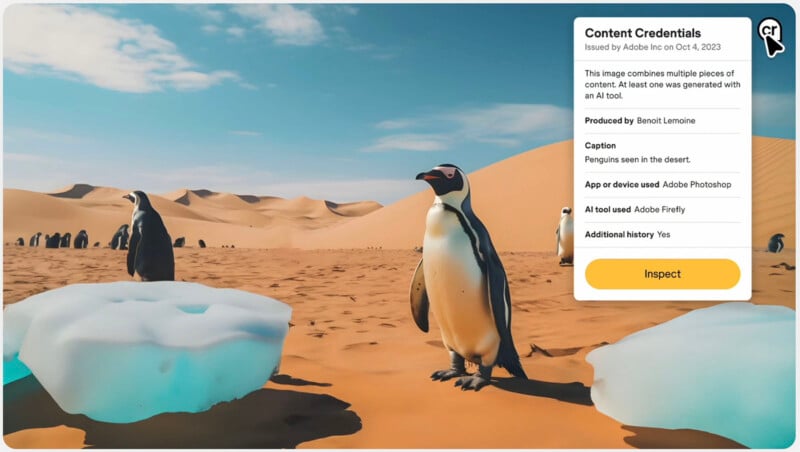
I say “the idea” because while it has widespread support and backing, its rollout has been fragmented and incomplete. There isn’t really full support for viewing content credentials the way it was built or intended right now. Outside of the C2PA Viewer website, that little icon doesn’t exist on a public-facing platform the way the founders envisioned.
Beyond that, C2PA has a few blind spots. First, it assigns the credentialed metadata to the image at the end of the software processing pipeline. This means if a hacker infects a camera or phone’s operating system, they could potentially inject fake pixels into the photo before the C2PA receipt is created.
This isn’t even a hypothetical: the C2PA signature process was hacked on the Nikon Z6 III. It’s such a big mess that Nikon can’t fix it on its own and it’s been sitting in limbo for over a year. Nikon’s issues may be why we haven’t seen C2PA expanded on by Sony or Canon. While both say they support it, Sony has been slow rolling it and Canon hasn’t done anything with it at all.
Second, standard C2PA often ties the photo to a public identity or a specific device to prove who took it. If you are a journalist in a dangerous environment, attaching your name or phone’s serial number to a leaked photo could put your job or even your life at risk.
One of the issues I’ve seen raised about C2PA is how inconsistent the organization is with how it should be implemented. The C2PA doesn’t distinguish compliance between Nikon’s purely software-based approach and Leica’s dedicated onboard security chip found in cameras like the M11-P. Camera companies then argue about what is the best way to implement it, and the result is that one brand’s C2PA may not be as secure as another’s, muddying what is supposed to be standardized.
Pixel-Level, Guaranteed Authenticity: Apple Reference Image
Apple’s philosophy is completely different, which explains why the company took so long to approach this complicated subject and why it also didn’t join the Content Authenticity Initiative.
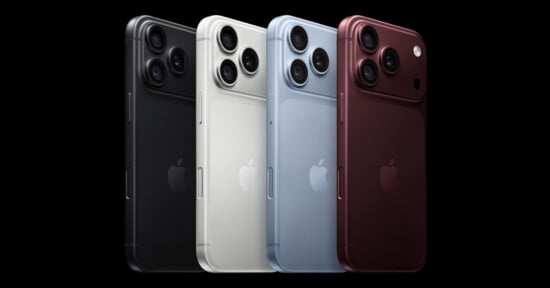
Apple Reference Image is an opt-in camera mode introduced on the main camera sensor of the iPhone 18 Pro and iPhone 18 Pro Max. Right now, this is the only camera that supports it.
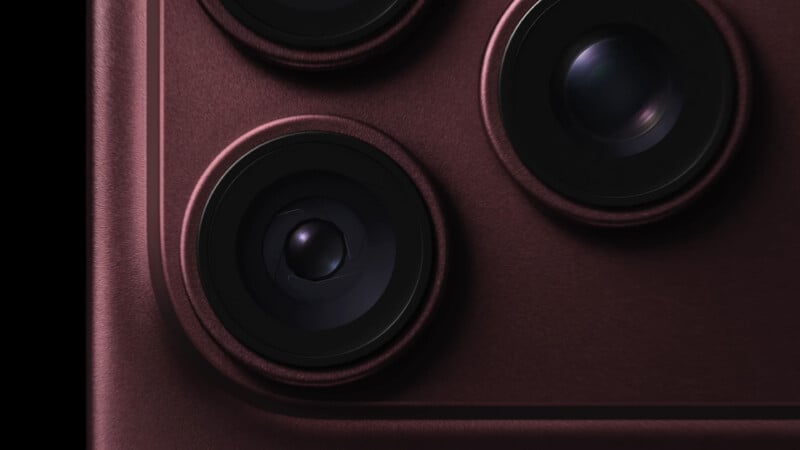
While C2PA tracks the history of an image file, Apple Reference Image proves the physical origin of the light hitting the camera.
“For Apple Reference Image, we are actually signing the image at the image sensor level. The thing that’s actually new about the silicon is all the hardware that does the processing to sign the image at the hardware level,” Matt Waldon, Apple’s Senior Director of Camera and Depth Hardware tells PetaPixel.
When you turn on this mode, the iPhone camera sensor reboots and enters a secure state. The instant you take a picture in this mode, the physical hardware sensor signs the raw pixel data using a secret cryptographic key that was generated for that specific device at the factory. This happens immediately: before the phone’s operating system or software can even look at the data, making it incredibly resilient to hackers trying to inject fake pixels.
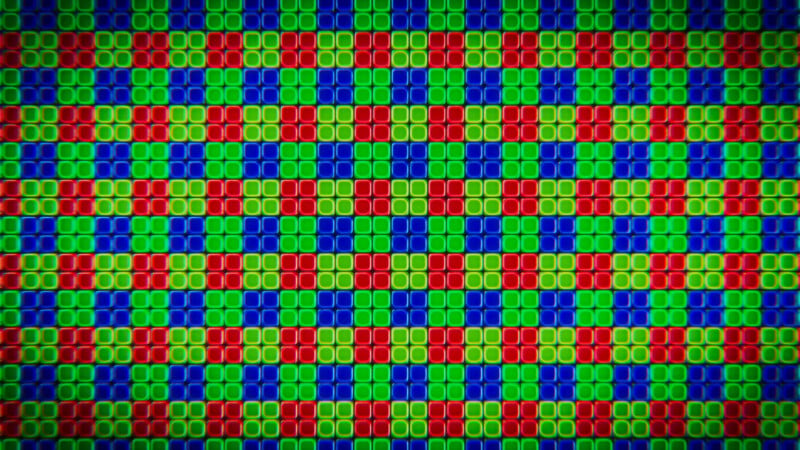
It creates what Apple calls a “secure digital negative.” It’s not hack-proof at this stage, but it’s far more secure than what is available with C2PA. To prove exactly when the photo was taken, the phone uses secure timestamps from Apple’s servers to establish a mathematical window of time showing exactly when the shutter clicked.
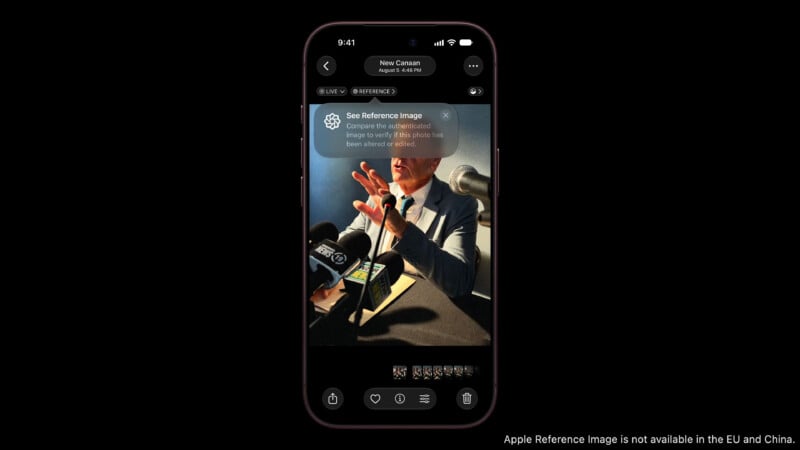
To make this even harder to hack, Apple’s system is actually divided into two stages. The first is the aforementioned sensor, but the second is checking that data in the cloud. Instead of checking the file on device and assigning metadata there, the iPhone uploads the negative to Private Cloud Compute—Apple’s highly secure, verifiable cloud environment. The cloud develops the raw data into a viewable JPEG, runs an AI check to make sure the sensor data wasn’t spoofed, and finally signs the image with a massive post-quantum cryptographic signature.
Yes, I’m aware that using words like “post quantum cryptographic signature” sounds like science fiction, but it’s actually Apple attempting to future-proof its system for decades.
Classical Math Versus Quantum Math
C2PA uses classical security math called RSA-3072. Apple Reference Image uses a hybrid signature that combines standard math with what is called ML-DSA-87, a new post-quantum algorithm. That means even if someone builds a massive quantum supercomputer in thirty years, they still won’t be able to forge an Apple Reference Image that was made today.
‘We designed the system to resist quantum attacks on any algorithm used to protect the integrity of publicly distributed reference images. The final signature on a reference image is a composite post-quantum signature combining RSA-3072 and ML-DSA-87. To our knowledge, Apple Reference Image is the only image provenance system that provides quantum-secure defenses.’
– Apple Reference Image, A New Approach for Verified Photography
Quantum computers don’t exist today, but they could exist in the very near future. Apple didn’t seem satisfied with creating a system that could be hacked easily by these future computers and spent extra time building a system that even those future computers couldn’t hack.
The C2PA originally determined that creating a standard that was immune to quantum computers wasn’t part of the initial goal and it says it plans to address this with updates in the future.
‘Future support for ML-DSA algorithms (ML-DSA-44, ML-DSA-65, and ML-DSA-87) with approved parameters… is planned for the C2PA standard. ML-DSA will be added to the list of supported signature algorithms when stable ML-DSA support is broadly available in commonly used cryptographic libraries.’
– C2PA and Content Credentials Explainer
As a result, media signed with today’s classical C2PA signatures will remain vulnerable to future quantum attacks unless re-signed or upgraded. Additionally, adding post-quantum algorithms to an open, multi-vendor standard requires updates across camera manufacturers, software developers (like Adobe), web browsers, and Certificate Authorities. That’s a huge lift and as discussed, the supporting C2PA companies can’t even agree on how to implement the system that’s available today.
In contrast, Apple’s system is secure right now and will remain so for at least 20 to 30 years.
Also, in direct response to the other issue of anonymity that C2PA doesn’t address, Apple Reference Image keeps you totally anonymous. Because Apple’s cloud does the final signing, nobody can look at two different reference photos and know they came from the same iPhone.
The Difference Between Apple and Leica
There is one last detail worth covering and that’s the difference between Leica’s hardware-based implementation of C2PA and Apple’s hardware-based Reference Image.
While both happen on device as an image is made, Apple assigns the cryptographic information to the raw pixel data before the operating system or computational processes are involved. After that, it processes the file in Private Cloud Compute. Leica creates the image first, then sents that information to its Secure Element chip to generate the C2PA metadata.
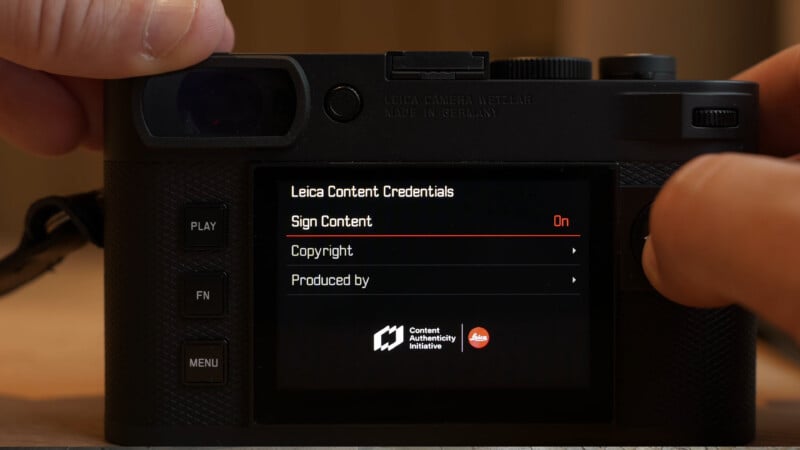
The crucial difference is that Leica signs the file after initial processing while Apple assigns it before. Apple argues their process is more secure, and based on what I know and have read about this type of technology, I agree with them. But Apple is only able to do this because it has complete control of the whole process from start to finish and has the benefit, and potentially the downside, of needing to use the cloud. Leica does it wholly disconnected from the Internet.
Apple Reference Image and C2PA: Strengths, Weaknesses, and Coexistence
The C2PA’s greatest strength is that it is an open, universal standard. It works across Sony cameras, Adobe software, and both Google and Samsung phones. Its weakness is that the digital receipt can be easily stripped away by an app that doesn’t support it and it can expose the identity of the person who took the photo.
Apple’s greatest strength is unbeatable, ironclad physical security. It provides a guarantee that the camera actually saw a real event. It was also developed to protect the anonymity of the photographer and it is immune to future quantum hackers.
But its biggest weakness is a symptom of Apple’s whole approach to basically everything it does: it’s entirely locked to Apple’s ecosystem or, as many call it, the walled garden.
Right now, you have to buy an iPhone 18 Pro, only use the main camera, rely on Apple’s cloud servers, and use Apple’s verification systems to prove the photo is real. You also have to use an iPhone 18 Pro to even see all this data, although Apple does say it plans to bring support to browsers (probably Safari) and Macs in the future.
Even in the future when theoretically all of Apple’s cameras on its phones are able to write use Reference Image, it will only protect Apple’s first-party camera hardware. Journalists use iPhones, sure, but they also use cameras from Sony, Canon, Nikon, and all of the others.
“I think it’s a space [where] a lot is still to be defined in terms of how people actually adopt ways to actually view that information. And that could really depend on platform to platform, medium to medium,” Jeremy Hendricks, an iPhone Product Manager and a member of Apple’s Worldwide Product Marketing tells PetaPixel.
“I think for us, the priority was getting it right in terms of starting at the most secure way possible. It goes way beyond adding metadata after the fact. So when you start at that source, pixel-level signing, it really builds that base for the most secure way possible for verifying that image authenticity. I think as we roll this feature out and make it available, it’ll take a lot of work and collaboration to see what that best path forward is for people to easily incorporate that into their platforms.”
Theoretically, Apple Reference Image would be an incredible tool for whistleblowers, newsrooms, human rights activists, and journalists in conflict zones. Basically, people who need to show absolute proof that an event happened, without risking their own safety. C2PA feels better suited for the broader creative industry like digital artists, social media platforms, and editors who need to track exactly how an image was altered on its way to your feed.
As it stands, these two systems can’t be used together — at least not directly. But it is theoretically possible to use them together as two halves of the same whole.
Imagine a photojournalist captures a protest using Apple Reference Image. That hardware-signed photo is archived as irrefutable proof that the event actually happened exactly as shown. But the journalist or their editor needs to crop the photo to fit into a story. When they open it in a photo editor to make that crop, the software attaches a C2PA receipt detailing the edit.
So you could use Apple Reference Image to prove the photo started as a real event in the physical world and you use C2PA to transparently track everything that happened to the photo after shutter button was pressed.
But even though it’s possible to use them together, I don’t think Apple ever intended Reference Image to be used with C2PA. I think Apple saw the problem and decided it would work on a solution all on its own, which is pretty much the way Apple approaches all problems. This has, obviously, pros and cons. That mentality also rubs a lot of folks the wrong way.
Which of these two methods will actually have the biggest impact on proving a photo is real? Right now, we don’t know. Even though C2PA is years old and Apple has created this brand new even safer system, there is a larger cultural problem: they say a lie can travel halfway around the world before the truth is done putting on its shoes. Even with both these standards out there, the truth still hasn’t left the house.
Additional Sources: Apple Reference Image, A New Approach for Verified Photography (September 2026) | C2PA and Content Credentials Explainer (2.2, 2025-04-22: Release)
Author’s note: The header image includes elements generated by Adobe Firefly AI. Please read PetaPixel’s editorial guidelines for a detailed explanation of our stance on AI imagery.
Affiliate Disclosure PetaPixel articles may include affiliate links; we may earn a commission if you buy through one.