
One Photographer, Two Stolen Bicycles, 10 Cities, 100,000 Photos: A Timelapse Tour Across Europe
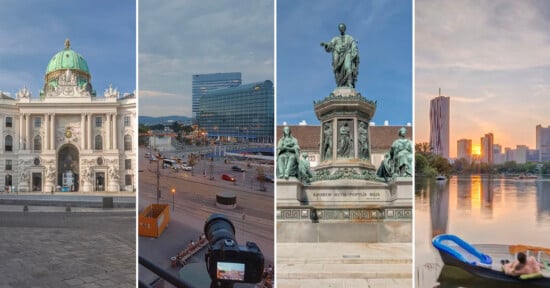
A photographer who took an epic trip starting from the southern tip of Europe all the way to northern Germany visited 10 cities and created 10 mesmerizing timelapses.
Kirill Neiezhmakov pushes the boundaries of what is possible in hyperlapse and timelapse photography. For his trip across Europe, the Ukrainian photographer experimented with AI-generated video-to-video morphing transitions, creating head-spinning visuals that grab the viewer’s attention.
The first city Neiezhmakov visited was Seville in mid-July when the Andalusian capital was baking in 44 degrees Celsius (111 degrees Fahrenheit) heat.
“Hunting for shadows just to set up my tripod became a daily ritual, and I quickly adopted the Spanish siesta tradition to wait out the worst of the afternoon heat,” Neiezhmakov tells PetaPixel. “Since this was the very first city, I was still figuring out the logistics and testing gear combinations on the fly.”
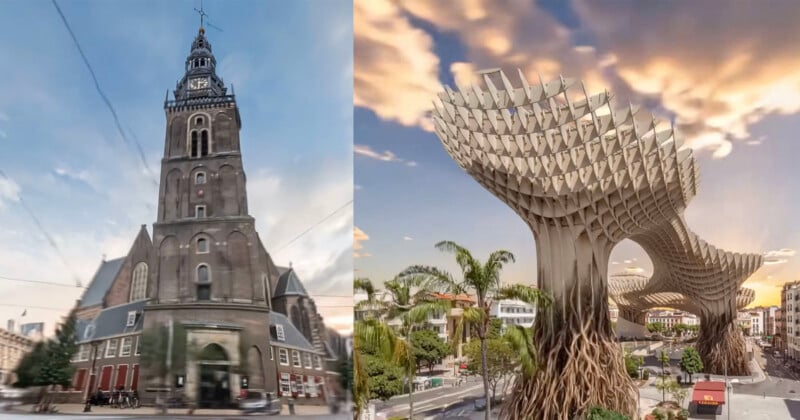
Next up was Valencia. This is where Neiezhmakov developed his “seamless flight” visual concept, which became the signature of the entire series.
For the AI morphing transitions, Neiezhmakov tried out three different AI image models: Pixverse, Kling, and Seedance 2.0.
“Pixverse is capable of surprisingly creative and unexpected transitions,” he explains. “Its main downside is unpredictability — you can go many attempts without a usable result, and occasionally it produces bizarre artifacts.”
Neiezhmakov says that at one point, Pixverse randomly generated a white cat leaping out of a building window, flying down the street, and diving into a fountain. “It is, however, very affordable, which makes experimenting forgiving,” he adds.
By the French city of Lyon, Neiezhmakov switched to Kling for his transitions. “Kling follows prompts significantly more precisely, and with practice, I was able to write increasingly complex multi-part prompts describing the exact direction of motion, lighting changes, and architectural texture — and get a usable result on the first attempt far more often.”
While things were improving technically, Lyon was also the scene of a disaster when the bicycle he had been using to get around on was stolen on the first night.
“A full day lost to police reports and stress. But Lyon’s free city bike system (Vélo’v) saved the project,” he adds.
For each city Neiezhmakov visited, he would put aside roughly three days for shooting. While there, he would capture between 40 and 60 sequences, with each sequence consisting of 150 to 300 frames. The entire trip resulted in several terabytes of data.
But of course, shooting is just one part, then comes the editing. For each timelapse, the intrepid photographer spends two to three days processing the RAWs, color-grading, and stabilizing in After Effects. Then he spends a day or two searching for the right music, then a further two to three weeks for the full edit: assembly, AI morphing transition generation and selection, sound design, color finishing, and exporting.
“Total post-production time per video was in the range of three to four weeks,” he says. “By the later episodes, parts of the pipeline had become faster as my workflow matured — but the AI transition work actually grew more time-intensive as my prompts became more ambitious and complex.”
“This project was the most demanding undertaking I’ve attempted as a solo self-funded creator,” he continues. “Physically exhausting and financially draining — but invaluable as a learning experience in technique, AI tools, workflow, and resilience.”
Throughout the trip, Neiezhmakov used a Laowa 15mm f/4.5 Zero-D Shift lens to combat the perspective distortion typically found in architectural photography.
“When you tilt a normal wide-angle lens upward to capture a tall building, the vertical lines converge — the classic ‘falling buildings’ effect,” he explains.
“Correcting this in post-production means cropping the image significantly, which is costly when you’re already working with a compressed RAW sequence. The shift lens solves this optically: by physically shifting the lens element upward, I keep the sensor plane perfectly parallel to the building facade and include the full height of the structure without any perspective distortion and without losing a single pixel of resolution.”
With his lens working well, Neiezhmakov had gear problems elsewhere: his replacement bicycle was stolen while in Rotterdam.
“I’d owned the replacement for barely a week when it disappeared from a busy bike rack in broad daylight. It was a serious blow to my morale.”
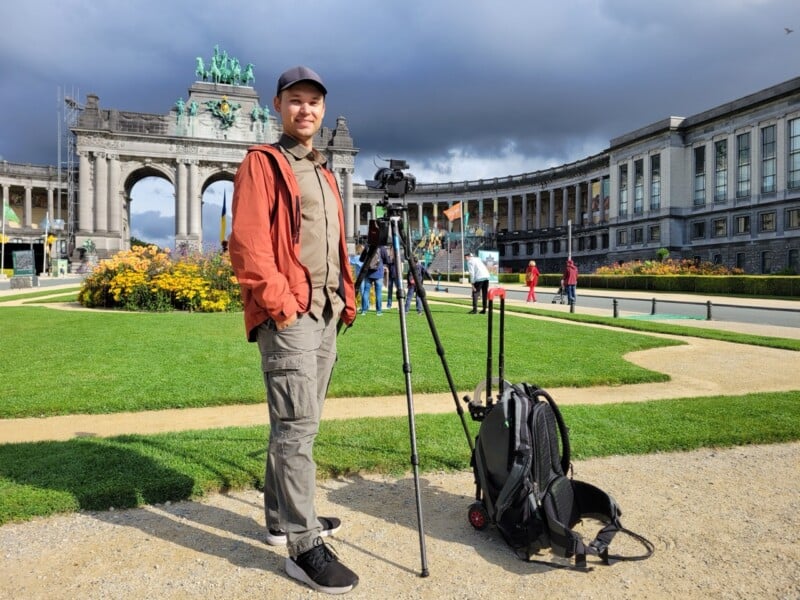
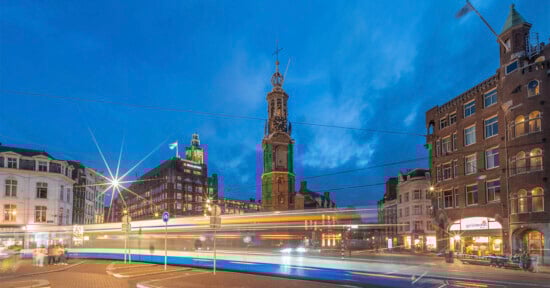
Most of the photos Neiezhmakov takes are a four to five-second exposure, creating smooth, fluid motion trails of the people and cars in the shot. It’s why he uses a tripod.
“A gimbal cannot hold steady at these shutter speeds; any micro-correction movement it makes appears as a smear or shake in the frame at exposures longer than roughly half a second,” he explains.
He also uses a Vertecfoto GH-V5 geared head to precisely re-align the camera so that the same reference point sits in exactly the same position in the frame as the previous shot.
“The process works like this: I set up my tripod, identify a fixed reference point on a building — a window edge, a corner, a lamp post — take a photo, then physically move the tripod a short, consistent distance forward (typically 15–30cm depending on the desired speed),” he says.
“The tripod-plus-geared-head combination remains, in my view, the only way to achieve this specific aesthetic in a moving hyperlapse.”
More of Neiezhmakov’s work can be found on his YouTube and Facebook.
Image creditsPhotographs by Kirill Neiezhmakov
Affiliate Disclosure PetaPixel articles may include affiliate links; we may earn a commission if you buy through one.