
‘AI Could Have Made It,’ Blogger Claims After Photographer Sues
A photographer sued a blogger for copyright infringement after the defendant allegedly used a photo without permission or license. The defendant then claimed that because they could have created the picture using AI, it should not be protected. Thankfully, a U.S. District Court dismissed this notion.
As California-based lawyer Rob Freund explains on X, formerly known as Twitter, the “could have made this picture with AI” copyright defense would have been disastrous for copyright law had the court upheld it.
As Freund notes, yes, if the accused had, in fact, created an image using AI instead of stealing an actual photo, they would have probably been completely fine, legally speaking. However, that is not what they did, and just because they could have done so has no bearing whatsoever.
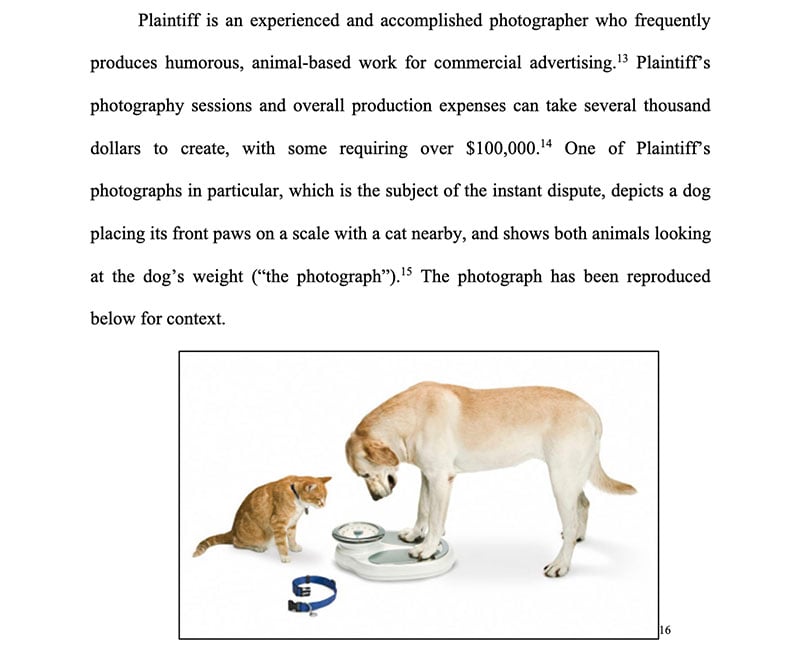
As the newly filed ruling from Chief Judge Matthew W. Brann in the United States District Court for the Middle District of Pennsylvania explains, plaintiff, successful commercial photographer Nick Vedros, filed a one-count complaint against the defendant, The Sterling Group of the Twin Tiers, Inc., over unauthorized use of Vedros’ photo of a dog on a weight scale next to a cat.
Vedros says the photo was created for a dog food advertising campaign for a product to help dogs lose weight. The photo was originally published in 2007 and registered with the United States Copyright Office on April 22, 2014.
The defendant in the case operates a business that sells English Labrador Puppies. The business has a website, which has a blog. The blog features various stories about dogs, including English Labradors, often using stock photos. The blog post that used Vedros’ photo was published back in 2016, and Vedros’ shot was shown in full without any credit.
Both parties, Vedros and the defendant, requested summary judgment in this case. The defendant advanced several legal defenses in the case, including the fair use doctrine.
Fair use is notoriously complicated, and there are four key factors to consider when determining if a fair use claim is defensible. These nonexclusive factors include the purpose of the work, the nature of the copyrighted work, how much of a copyrighted work was used, and whether the use of the copyrighted work has any effects on the market for its sale or its value. This defense failed in the judge’s view.
The work was also not transformative in any way, since Vedros’ original copyrighted photo was displayed in full, unaltered. However, the defendant claims that the use of the work differed and that it was used on the blog as educational content rather than for commercial purposes. However, the blog and its articles are attached directly to the puppy-selling business, which is a commercial endeavor.
“Defendant did not alter the work, instead reusing the photograph in its entirety,” the ruling explains. “When a work is reproduced exactly for the same purpose as the original, the use is not transformative.”
The photo also served no educational purpose in the context of the article whatsoever, Judge Brann writes.
Copyright violations are typically standard fare. They happen often, not always maliciously, and can often be solved quite simply. However, this case is particularly interesting because of another of the defendants’ claims: “that a similar photograph ‘could have’ been produced using artificial intelligence.”
Judge Brann characterizes this argument as lacking merit.
“Defendant’s argument that artificial intelligence (‘AI’) could have been used to generate the image is not well taken,” the judge writes.
As Judge Brann notes, there is no contention that Vedros used generative AI to create the original image, which would have had consequences for its copyright protection, but that the defendant has asked the court to rule in their favor because the original image could have been created using AI.
“Defendant asks the Court to rule, without any legal support, that copyright does not protect works which could have been generated with AI,” Judge Brann writes. “Such a holding would destroy the foundations of copyright law. The Court declines to endorse or entertain this proposition.”
Ultimately, Judge Brann ruled in favor of the plaintiff, finding that the defendant failed to provide a sufficient legal defense for its use of Vedros’ copyrighted photo. Liability will be determined later, although given that the offending blog post had only 43 views before Vedros’ photo was removed, significant damages are unlikely.
At face value, this seems like an open-and-shut case about unauthorized use of a photo. While protecting the copyrights of photographers and other artists matters a great deal, Judge Brann’s dismantling and immediate shutting down of a defense that argues a copyrighted photo or other work does not deserve protection because generative AI “could have” created an identical or legally similar work is the bigger deal.
A copyrighted work thankfully does not lose any of its protected status just because someone could, conceivably, replicate it using AI.
Image creditsHeader photo licensed via Depositphotos.com.
Affiliate Disclosure PetaPixel articles may include affiliate links; we may earn a commission if you buy through one.