
GoPro Is Considering Selling the Company

GoPro says it is formally reviewing strategic options, including a potential sale or merger, marking a potentially major turning point for one of the most recognizable brands in modern imaging.
As reported by Reuters, the announcement follows a difficult stretch for the California-based action camera maker, which has faced declining revenue, widening losses, layoffs, and intensifying competition from rivals such as DJI and Insta360. Despite those challenges, news of the strategic review sent GoPro shares sharply higher in after-hours trading, as investors reacted to the possibility of a larger technology or imaging company stepping in.
According to the company, GoPro’s Board of Directors has authorized management to engage a financial advisor and evaluate a range of options intended to maximize shareholder value. The company emphasized that no decisions have been made and that there is no set timetable for the review process.
“Over the past 24 years, GoPro has developed significant technology, IP, and brand assets along with world class product development and scaled manufacturing capabilities,” said Nicholas Woodman, GoPro’s founder and CEO.
“We are excited to work with our advisors to evaluate potential opportunities in various sectors to maximize shareholder value.”
A Defining Moment for One of Imaging’s Most Recognizable Brands
For much of the past two decades, GoPro helped define the action camera category. The company’s compact, mountable cameras became synonymous with adventure sports, travel content, and first-person video capture, eventually growing into one of the most influential consumer imaging brands of the 2010s.
At its peak, GoPro represented more than just hardware. The brand became deeply tied to a style of visual storytelling built around portability, durability, and immersive point-of-view footage.
But the imaging landscape has shifted considerably in recent years. Smartphones have absorbed much of the casual video market, while dedicated competitors like DJI and Insta360 have aggressively expanded into stabilization-heavy action cameras, modular systems, and 360-degree capture.
That pressure has made it increasingly difficult for GoPro to maintain the level of dominance it once enjoyed.
Strategic Review Follows Defense and Aerospace Push
The company’s announcement comes only weeks after GoPro revealed that it had engaged consulting firm Oliver Wyman to explore opportunities in the defense and aerospace markets.
That move suggested GoPro was already looking beyond the traditional consumer action camera business and exploring how its imaging technology, manufacturing capabilities, and ruggedized camera systems could be adapted for industrial or government applications.
According to GoPro, the company received multiple unsolicited strategic inquiries after announcing that initiative, prompting the Board to formally begin evaluating broader alternatives.
In a statement accompanying the announcement, GoPro founder and CEO Nicholas Woodman pointed to the company’s “technology, IP, and brand assets” alongside its manufacturing and product development infrastructure as core strengths that may hold value across multiple industries.
Weak Financial Results Continue to Weigh on the Company
The strategic review arrives alongside another difficult earnings report for the company.
GoPro reported first-quarter revenue of $99 million USD, representing a 26% decline year-over-year. The company also posted an adjusted loss of $0.35 per share, significantly wider than the $0.12 per share loss reported during the same quarter last year.
The company attributed some of the financial pressure to declining camera sell-through, macroeconomic conditions affecting consumer electronics spending, and inventory-related charges.
GoPro also withdrew its previous full-year financial outlook, citing both market uncertainty and the ongoing strategic review process.
Those results continue a longer-term trend of instability for the company, which has spent years attempting to balance hardware sales with subscription services, software ecosystems, and recurring revenue initiatives.
What a Sale or Merger Could Mean
At this stage, it remains unclear what form a potential transaction could take, or whether one will happen at all.
However, the announcement is likely to spark speculation across both the imaging and broader technology industries. GoPro still maintains strong global brand recognition, a large catalog of imaging patents, extensive manufacturing experience, and established software and cloud infrastructure tied to its cameras.
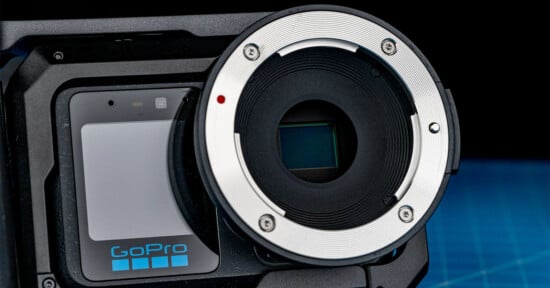
Less than a month ago, GoPro unveiled its brand-new Mission 1 Series of 8K rugged, comapct cameras, including the Mission 1 ILS with a Micro Four Thirds mount.
Potential buyers or partners could theoretically range from consumer electronics firms to defense contractors or outdoor technology companies looking to expand their imaging capabilities.
Some investors and industry observers have already speculated about companies with adjacent ecosystems, including wearable tech, drones, mapping, AI-driven video platforms, or navigation hardware.
At the same time, any acquisition would also inherit the challenges GoPro has struggled with for years: slowing hardware growth, fierce competition, and the difficulty of sustaining premium standalone cameras in an increasingly smartphone-centric world.
Whether the company ultimately remains independent, merges with another business, or pivots further into industrial and defense applications, the coming months could be among the most consequential in GoPro’s history.
Image creditsGoPro
Affiliate Disclosure PetaPixel articles may include affiliate links; we may earn a commission if you buy through one.