
Major Lawsuit Claims Mark Zuckerberg ‘Personally Authorized’ Use of Copyrighted Works for AI
Five publishing houses and a best-selling novelist have filed a lawsuit alleging that Meta illegally used millions of copyrighted works to train its AI language system Llama, and Mark Zuckerberg “personally authorized” the company’s copyright infringement.
Five major publishers — Hachette, Macmillan, McGraw Hill, Elsevier, and Cengage — and author Scott Turow are suing Meta and its CEO over “one of the most massive infringements of copyrighted materials in history.”
The class-action copyright infringement lawsuit, filed Tuesday morning in the United States District Court for the Southern District of New York, alleges that Meta and Zuckerberg used millions of copyrighted books and journal articles without permission to train the company’s AI program, Llama. According to a report by The Financial Times, the lawsuit also claims that copyright notices and other copyright management information were removed from those works.
The plaintiffs allege that Zuckerberg and Meta “followed their well-known motto ‘move fast and break things’” by drawing on a large body of written material without authorization.
“Defendants reproduced and distributed millions of copyrighted works without permission, without providing any compensation to authors or publishers, and with full knowledge that their conduct violated copyright law,” the complaint reads in part. “Zuckerberg himself personally authorized and actively encouraged the infringement.
According to the filing, Meta accessed millions of copyrighted books and journal articles from websites hosting pirated material. It also alleges the company downloaded unauthorized scrapes of “virtually the entire internet” to train its generative AI models. The suit further claims that “Zuckerberg himself personally authorized and actively encouraged the infringement.”
Meta vowed to “fight this lawsuit aggressively” in a statement on Monday.
“AI is powering transformative innovations, productivity and creativity for individuals and companies, and courts have rightly found that training AI on copyrighted material can qualify as fair use,” the statement reads.
The case follows a recent class-action lawsuit involving AI company Anthropic and a group of U.S. authors who alleged their work was used without permission to train AI systems. In September, a judge approved a $1.5 billion settlement in that case, in what was described as the largest publicly reported copyright recovery in history.
When news of the settlement became public, it was seen by some as a potential turning point that could lead other AI companies to compensate rights holders for the use of their material. While settlements do not set legal precedent, they can influence how similar cases develop in the evolving area of AI and copyright law. Legal experts suggest the settlement may set the stage for future payments, whether through court rulings, negotiated settlements, or licensing agreements.
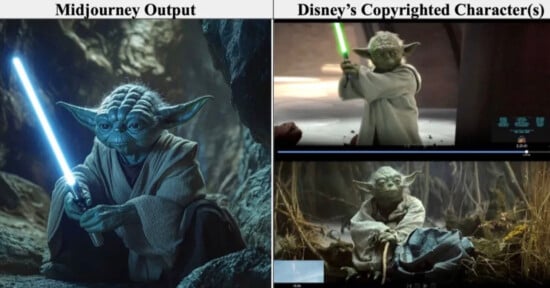
There are several ongoing cases against AI companies. For example, a group of artists filed a class-action lawsuit against AI image generators Stable Diffusion and Midjourney, among others.
Image creditsHeader photo licensed via Depositphotos.
Affiliate Disclosure PetaPixel articles may include affiliate links; we may earn a commission if you buy through one.